Controlled Environment Agriculture (CEA), including vertical farming, relies on finely tuned parameters to optimise plant health and productivity. Among the most critical of these is vapour pressure deficit (VPD): a concept that links air temperature and humidity in a way that directly affects how plants transpire, grow and develop. Understanding VPD in indoor plant production is fundamental for anyone involved in modern horticulture; it is not just a measure of environmental comfort but a core principle for managing plant physiology under artificial or semi-artificial conditions.
Defining Vapour Pressure Deficit
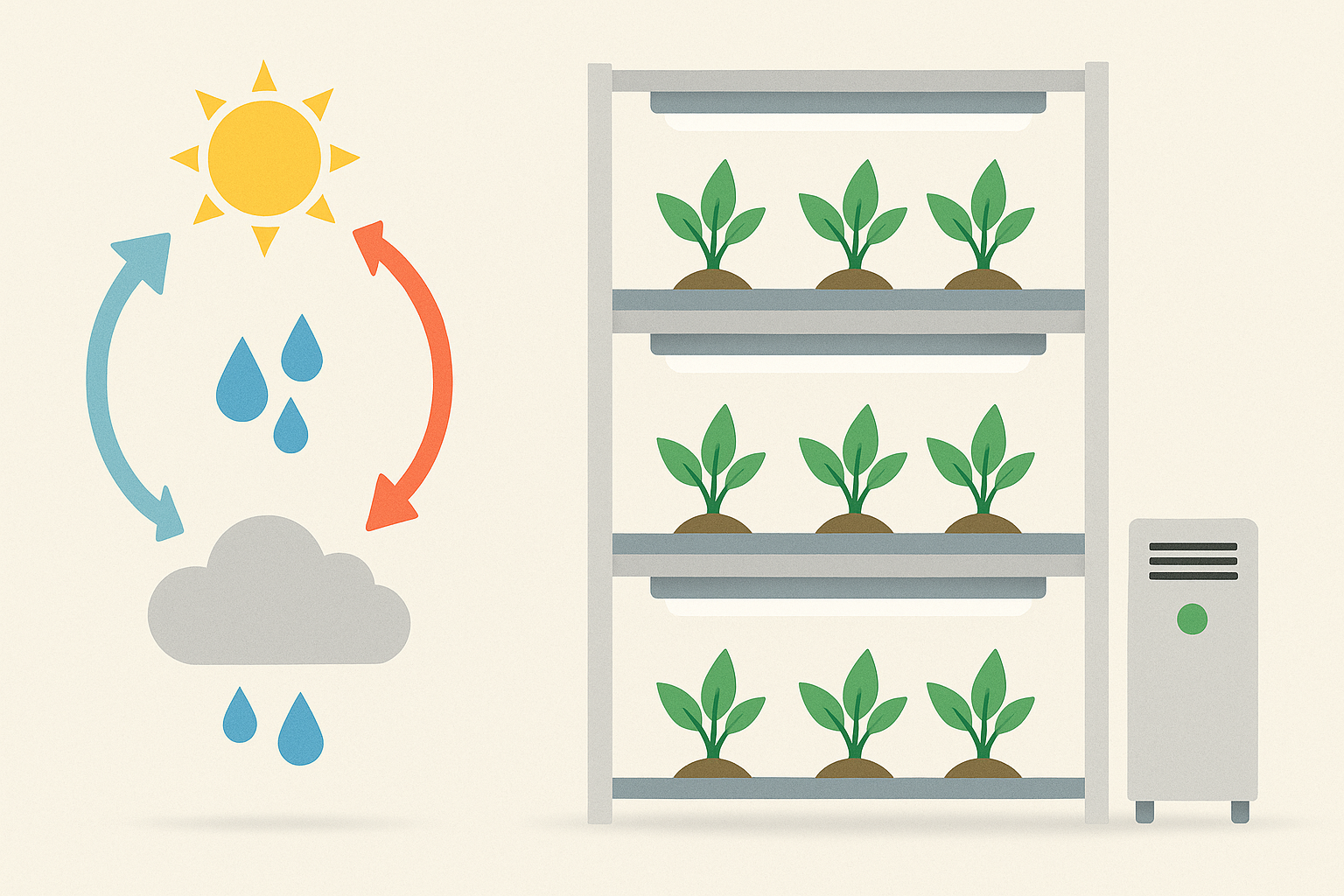
At its simplest, VPD is the difference between the amount of moisture in the air and how much moisture the air could hold when fully saturated. More precisely, it is the difference between the saturation vapour pressure (the maximum water vapour the air can hold at a given temperature) and the actual vapour pressure (the current water vapour content). This value is usually expressed in kilopascals (kPa).
Unlike relative humidity, which can be misleading due to its temperature dependence, VPD provides a more accurate picture of the evaporative demand of the environment. In practice, it tells us how forcefully a plant will lose water through its stomata: low VPD values mean reduced transpiration; high values indicate that the plant is losing water more rapidly. Both extremes can have adverse consequences.
Why VPD is Central to Indoor Crop Management
In natural field conditions, plant-environment interactions fluctuate with the weather; in a CEA facility, those interactions must be engineered. VPD lies at the heart of this management challenge because it influences three critical physiological processes: transpiration, nutrient uptake and photosynthetic efficiency.
Transpiration drives the mass flow of nutrients from roots to shoots. When VPD is too low, typically below 0.4 kPa, plants struggle to transpire adequately. Their stomata may close to conserve moisture, reducing nutrient flow and stalling growth. Conversely, if the VPD exceeds 1.6–2.0 kPa, plants may transpire excessively, risking water stress, salt accumulation in the root zone, and stomatal closure for entirely different reasons. In both cases, the result is suboptimal photosynthesis and impaired development.
Indoor growers are therefore advised to monitor and regulate VPD within a target range specific to the growth stage of the crop. For example, young seedlings benefit from lower VPDs to minimise desiccation, while mature, fruiting plants often perform better at moderately higher VPDs, which support active transpiration and nutrient demand.
The Science Behind the Measurement
Calculating VPD requires an understanding of basic psychrometrics (the thermodynamic properties of moist air). It depends on two environmental readings: air temperature and relative humidity. With these, saturation vapour pressure can be derived using temperature-dependent equations (commonly based on the Tetens or Magnus formula), and actual vapour pressure is calculated using the current relative humidity percentage. The VPD is then obtained by subtracting the actual vapour pressure from the saturation value.
This might seem technical, but many commercial sensors and climate control systems now offer real-time VPD tracking. However, growers must still understand the concept behind the numbers: a reading of 1.0 kPa in one part of the canopy may not be replicated in another if airflow and temperature distribution are uneven.
VPD and Climate Control in Vertical Farms
Vertical farming introduces additional complexity. Unlike single-layer greenhouses, vertical farms often involve stacked tiers of cultivation with artificial lighting and enclosed HVAC systems. This means microclimatic variations in temperature and humidity are more pronounced between levels. Without proper control, this can lead to inconsistent VPD profiles, which in turn create uneven growth, pest vulnerability and inefficiencies in energy and water use.
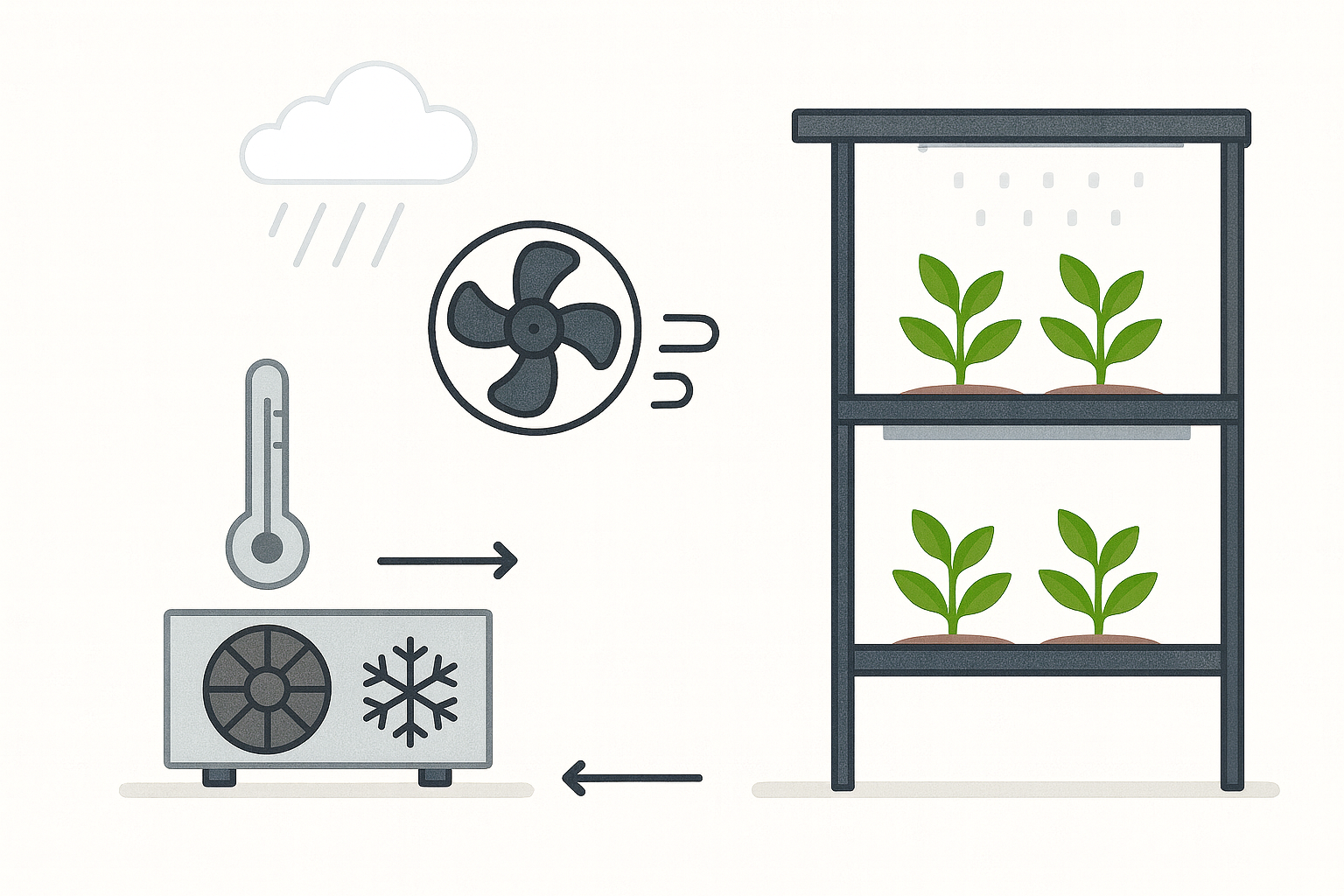
Balancing VPD in such systems demands integration across HVAC design, dehumidification capacity, lighting strategy, and irrigation management. Airflow must be sufficient to avoid air pockets of stagnant humidity; lighting intensity must be matched to temperature to avoid leaf overheating; and irrigation cycles must be adjusted so that root zone moisture is in harmony with leaf transpiration rates.
VPD, Stomata and Crop Quality
From a physiological standpoint, VPD governs the aperture of stomata: the microscopic pores through which plants exchange gases. High VPD leads to stomatal closure, which limits carbon dioxide intake and inhibits photosynthesis. On the other hand, excessively low VPD can leave stomata open longer than optimal, increasing the risk of pathogen entry and reducing water-use efficiency.
For crops grown in high-value vertical farming systems, such as leafy greens, herbs or certain fruits, maintaining an optimal VPD ensures uniform leaf texture, colour, flavour and shelf-life. In fruiting crops, precise VPD regulation during flowering and fruit set can influence yield quantity and quality, as reproductive tissues are especially sensitive to water stress.
VPD in Crop Scheduling and Stage-Specific Strategies
Different growth stages demand different VPD targets. Seedlings and clones, which have underdeveloped root systems, benefit from higher humidity and therefore lower VPD to reduce transpiration loss. During the vegetative stage, VPD is gradually increased to encourage stronger transpiration and nutrient transport. In flowering or fruiting stages, maintaining a moderate to high VPD supports carbohydrate allocation and product development, though the exact value depends on species and cultivar.
Therefore, sophisticated growing operations will often alter environmental characteristics dynamically over the crop cycle, tuning VPD in response to the developmental needs of the plant. This proactive VPD control is a hallmark of advanced horticultural practice and enables consistently high-performance outcomes in vertical systems.
Conclusion: A Cornerstone of Precision Agriculture
Vapour pressure deficit (VPD) is far more than a technical footnote in environmental control, it is a cornerstone of successful indoor plant production. It serves as a unifying measure that connects temperature, humidity, plant water relations and nutrient transport. Whether managing a bench of lettuce in a vertical farm or modelling climate control for a commercial-scale CEA facility, VPD provides the actionable insight needed to balance productivity with sustainability.
Investors, growers and researchers alike would benefit from prioritising VPD understanding in system design and operational strategy. As the indoor farming sector evolves, tools that enable precise and dynamic VPD control are likely to become standard components of any intelligent horticultural platform. By mastering this fundamental principle, CEA practitioners can move beyond reactive management and towards truly optimised crop environments.