
In Controlled Environment Agriculture (CEA), the precision and stability of environmental conditions directly determine crop quality, consistency, and productivity. Understanding why environment uniformity is important in CEA goes beyond the avoidance of obvious pitfalls such as temperature fluctuations or uneven light: it is central to plant health, resource efficiency, and commercial viability. In a vertical farm or any highly managed indoor cultivation system, environmental variability reduces the potential for reliable and consistent plant production outcomes.
Defining Environmental Uniformity in CEA
Environmental uniformity refers to the even distribution of key growing parameters, such as temperature, humidity, CO₂ concentration, airflow, and light intensity, across the entire cultivation area. Rather than focusing solely on target values at a single point, growers must ensure spatial consistency throughout the growing space. This includes both horizontal and vertical planes: a uniform canopy climate is just as critical as consistency from top to bottom in multi-tier systems.
To use a metaphor: managing environmental uniformity is like baking bread. The recipe (nutrients, genetics, water) can be perfect, but if parts of the oven are hotter or cooler than others, the loaf will rise unevenly, creating a compromised final product. Similarly, in CEA, a patchy environment leads to variable growth rates, inconsistent morphology, and unpredictable yields.
Microclimates and Their Impact
Even in well-controlled systems, microclimates can form due to air stratification, obstructed airflow, poor duct placement, or suboptimal lighting layouts. These small-scale environmental differences have large consequences: plants exposed to slightly cooler or more humid microenvironments may exhibit slower transpiration rates, increased susceptibility to pathogens such as powdery mildew or grey mould, or lagging growth stages compared to their neighbours.
This variation undermines uniform harvest timing, complicates labour scheduling, and may necessitate re-sorting crops post-harvest. In larger vertical farms or greenhouses, inconsistencies may even remain unnoticed until they are reflected in yield data or quality assessments, by which point they have already incurred a cost.
Why Uniformity Matters: Biological and Operational Efficiency
Plants interpret environmental signals and use them to regulate physiological processes including photosynthesis, transpiration, nutrient uptake, and flowering initiation. For example, leaf stomata, the tiny pores involved in gas exchange, respond to ambient conditions with great sensitivity. When temperature or humidity varies unpredictably, stomatal function becomes erratic, impacting both carbon assimilation and water use efficiency.
From an operational perspective, uniformity simplifies crop modelling and forecasting. Decision-support systems that rely on sensors, historical data, or AI-driven controls require stable input conditions to provide meaningful insights. Where environmental conditions fluctuate beyond a narrow band, predictive models lose precision, and the farm must adopt more reactive, less efficient modes of management.
Technologies and Strategies to Achieve Uniformity
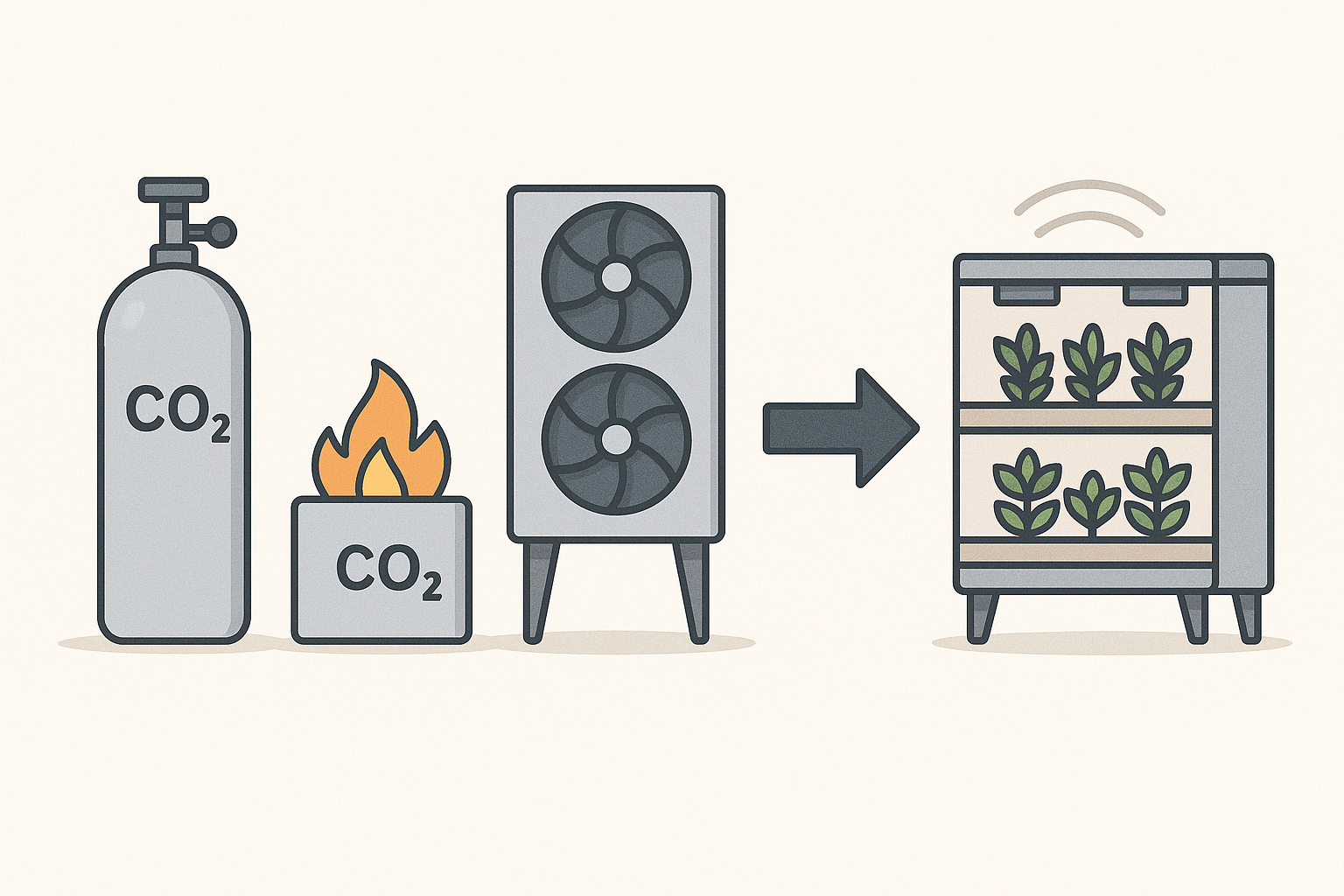
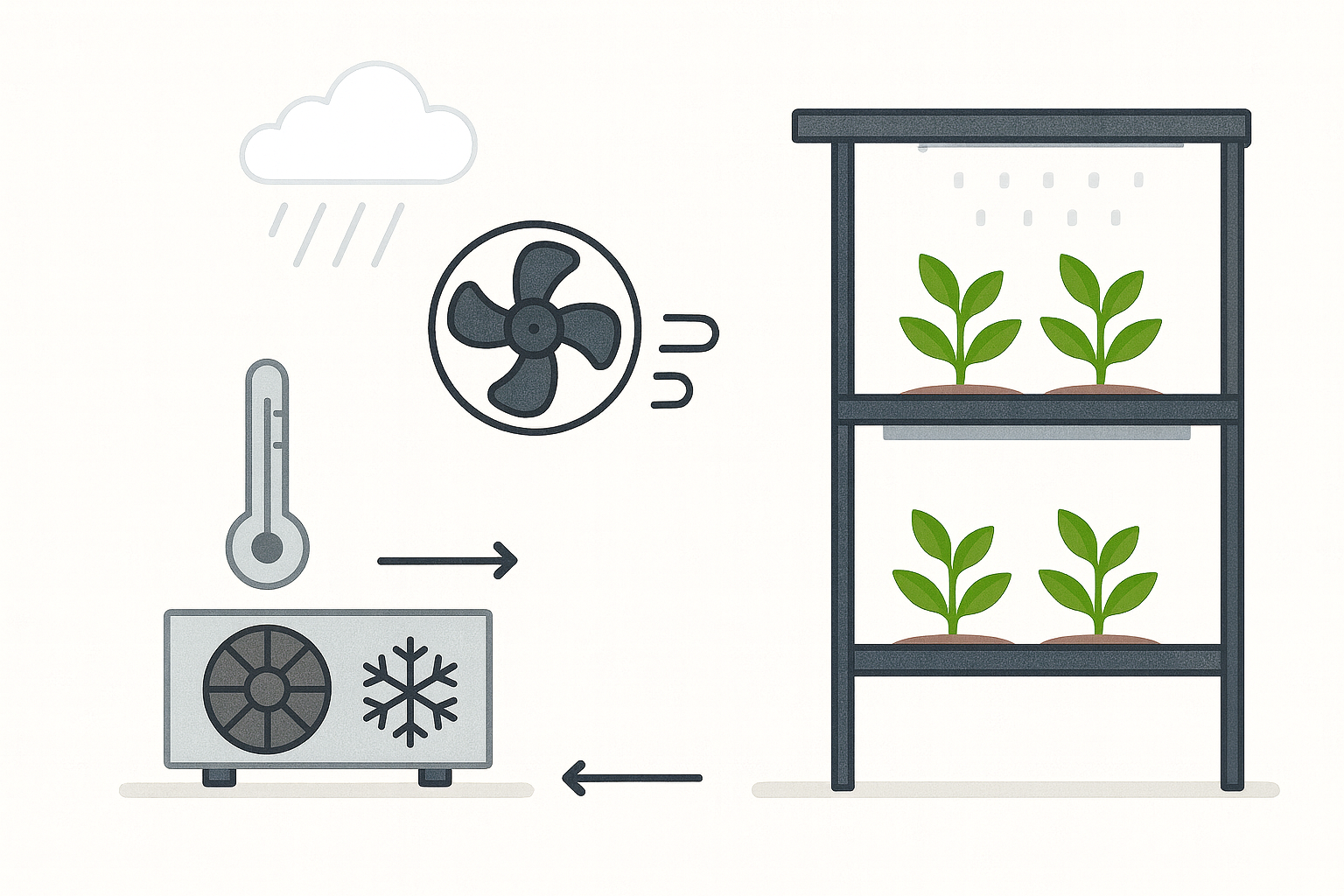
Achieving high levels of uniformity involves integrating technologies across HVAC, lighting, airflow, and sensor feedback systems. Precision climate control equipment, including variable-speed fans, directional ducting, and zoned heating or cooling, enables the fine-tuning required for spatial consistency. Uniformity also depends on good design: symmetrical layouts, well-spaced racking, and consideration of how air and light behave within the grow environment.
Sensor networks are essential for identifying areas of deviation. Deploying dense arrays of temperature, humidity, and CO₂ sensors allows for high-resolution mapping of conditions across the growing space. The information these sensors provide is most effective when coupled with automated control systems that can adjust environmental settings dynamically. Think of it as a thermostat not just for a room, but for every square metre of space within a grow facility.
An illustrative example comes from research in hydroponic lettuce systems, where studies have shown that even slight thermal gradients, differences of just 1 to 2°C, can lead to measurable disparities in biomass accumulation and tissue nitrate content. This underlines the fact that environmental uniformity is not simply a matter of plant comfort, but of commercial relevance.
The Role of Airflow and Mixing
Air movement is a particularly important factor in maintaining uniformity. It serves not only to reduce boundary layers on leaf surfaces (facilitating transpiration and heat exchange) but also to prevent stratification of gases such as CO₂, which is denser than air and tends to accumulate in lower areas. Uniform airflow ensures that fresh CO₂ reaches plant stomata and that humidity does not pool in corners, both of which are vital for avoiding physiological disorders and fungal outbreaks.
Yet airflow cannot be achieved by brute force alone; the goal is not high velocity but well-distributed circulation. Mixing fans, laminar flow systems, and diffused ventilation are all techniques used to gently homogenise the air within cultivation zones.
Lighting Uniformity: Beyond Brightness
Light distribution plays a similar role in maintaining even development. Uneven photosynthetic photon flux density (PPFD) leads to variability in energy delivery, which translates directly into differences in leaf size, chlorophyll content, and eventual biomass. When light intensity differs across a tray or tier, so too does the plant’s photoperiodic perception, potentially causing uneven flowering or bolting.
Sophisticated lighting systems, often using LED arrays, now allow for tailored spectral quality and controlled intensity. However, even the most advanced system must be installed and calibrated with uniformity in mind: angles, spacing, and reflective surfaces must be designed to eliminate shadow zones and hotspots.
Looking Ahead: Automation and Digital Twin Integration
As CEA technology advances, maintaining environmental uniformity is likely to shift from reactive to proactive through the use of digital twins and AI-enhanced control systems. These systems model the entire growing environment virtually, allowing simulations of environmental changes before physical implementation. The result is an increasingly predictive form of agriculture in which uniformity can be maintained not just spatially but temporally, anticipating changes in external conditions or crop load and adjusting accordingly.
Nonetheless, challenges remain. Energy efficiency often competes with climate consistency, and achieving uniformity must be balanced against sustainability goals. Additionally, real-time sensing technologies, while improving rapidly, still pose challenges in terms of cost, calibration, and data interpretation at large scale.
Conclusion
Environmental uniformity is not a luxury in Controlled Environment Agriculture: it is foundational. It underpins reliable crop development, simplifies operations, and maximises resource efficiency. As systems become more automated and data-driven, the requirement for precise, even growing conditions will become greater.
Understanding why environment uniformity is important in CEA provides a basis for improving both design and practice across vertical farming systems. The question for the future is not simply how to achieve uniformity, but how to maintain it dynamically across time and space as crops, technologies, and growing conditions evolve.