Introduction: The Role of Dew Point in Indoor Farming Environments
In the context of controlled environment agriculture (CEA) and vertical farms, dew point is a fundamental yet often underappreciated parameter. It sits at the intersection of temperature and humidity, both of which are tightly managed in indoor growing systems. Understanding dew point in CEA and vertical farms is critical because it directly influences plant health, energy efficiency, and the overall success of climate control strategies. Put simply, dew point is the temperature at which air becomes saturated with water vapour and condensation begins to form. In enclosed cultivation environments, this single value provides a precise, actionable measure for predicting moisture-related risks and optimising system performance.
The Science Behind Dew Point
Dew point is a thermodynamic property defined by the temperature at which relative humidity (RH) reaches 100%. At this point, the air can no longer hold all of its water vapour, leading to condensation. Unlike relative humidity, which fluctuates with temperature, dew point offers a stable reference point for understanding the absolute moisture content of the air. For growers, this distinction is crucial: while RH tells you how ‘full’ the air is relative to its capacity at a given temperature, dew point tells you how much water is actually present.
In practical terms, this means that two spaces could have identical RH values, but if their temperatures differ, the actual water vapour content (and therefore the dew point) could vary significantly. For vertical farms, where temperature and humidity are often adjusted independently, dew point offers a more reliable metric for managing condensation risks and preventing disease.
Dew Point and Plant Pathology: Managing the Risk of Condensation
In CEA systems, condensation is not simply an inconvenience: it is a direct risk to plant health. Water droplets on leaves, stems or surfaces create ideal conditions for the proliferation of fungal and bacterial pathogens. These diseases thrive in high-humidity environments, particularly when surface moisture is present. By monitoring dew point and ensuring that the plant or surface temperature remains above it, growers can proactively reduce the likelihood of condensation and its associated risks.
Condensation is also a common issue on structural elements of grow spaces, particularly walls, ducting, or glazing where temperature gradients can be steep. If moist air comes into contact with a cold surface below the dew point, water droplets will form. In vertical farming systems with dense stacking or enclosed compartments, these microclimates can easily develop, making dew point management a matter of both plant and infrastructure protection.
Dew Point as a Climate Control Reference
Because dew point is directly tied to absolute humidity, it offers a more consistent basis for environmental control than relative humidity alone. Many advanced CEA climate systems now use dew point as a core reference for managing HVAC operations, dehumidification loads, and even air flow patterns.
Consider a scenario where a vertical farm is operating at 24°C with 60% RH. If the air temperature is reduced to 18°C without adjusting moisture levels, RH will rise sharply, potentially exceeding the dew point and triggering condensation. However, if the system monitors dew point in real time, it can modulate both temperature and humidity to avoid this outcome. This approach is especially useful in dynamic growing environments where lighting schedules, transpiration rates, and ventilation cycles vary throughout the day.
Modern climate control systems may incorporate dew point sensors alongside dry bulb and wet bulb temperature readings to calculate enthalpy and moisture load. This allows for more precise control over heating, cooling, and ventilation strategies, ultimately reducing energy consumption and improving crop outcomes.
Plant Transpiration and Dew Point Balance
Plants themselves play a significant role in modifying the dew point of the environment. Through transpiration, they release water vapour into the air, thereby raising its moisture content and, by extension, the dew point. In a sealed or poorly ventilated grow room, this increase can happen quickly, especially during peak photosynthetic activity.
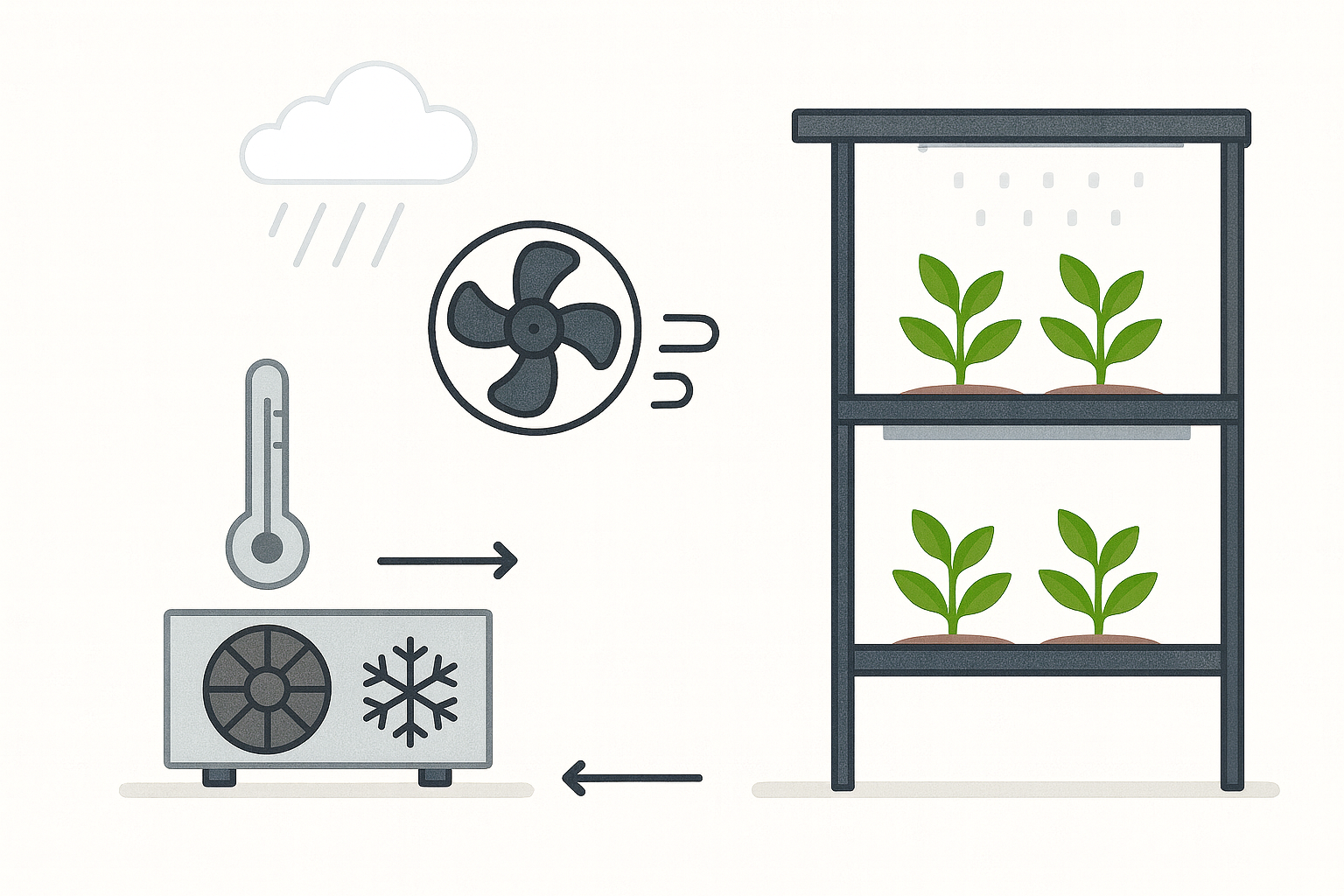
The challenge for growers is to maintain an environment where the ambient dew point does not exceed the temperature of the plant canopy or nearby surfaces. If this balance is not maintained, transpired moisture will condense directly on leaf surfaces, particularly in shaded or stagnant zones. This is one reason why effective air flow, both horizontal and vertical planes, is essential in vertical farms. By ensuring that air is well-mixed and that temperature gradients are minimised, it becomes easier to keep all surfaces above the local dew point.
Energy Considerations: The Cost of Moisture Removal
Dew point also has significant implications for the energy demands of a vertical farming system. Dehumidification is a major energy sink in CEA, particularly in sealed systems where mechanical methods must be used to remove excess water vapour. Because energy input increases exponentially with decreasing dew point, overly aggressive dehumidification can quickly become cost-prohibitive.
For instance, cooling air below its dew point to condense and remove moisture requires substantial latent heat removal. By tracking dew point and setting reasonable thresholds that prioritise plant health without over-dehumidifying, growers can optimise energy efficiency. Some systems also recover heat from condensation processes, using it to pre-warm incoming air or water, illustrating how dew point can be leveraged as part of an integrated energy strategy.
Dew Point and Integrated Climate Strategies
In advanced CEA installations, dew point is not viewed in isolation; it is integrated into a broader framework of climate management. Parameters such as vapour pressure deficit (VPD), wet bulb temperature, and absolute humidity all relate to dew point and influence how it is interpreted in context. For example, VPD, a key factor in plant transpiration, is directly affected by the dew point, since it reflects the difference between the vapour pressure at the leaf surface and that of the surrounding air.
Similarly, in evaporative cooling systems, wet bulb and dew point temperatures determine how effectively the system can operate. In humid climates or during high-transpiration periods, maintaining a favourable dew point becomes the limiting factor for environmental control.
To this end, many growers adopt predictive modelling or digital twins to simulate the effect of changing dew point values over time. This allows them to test control strategies before applying them in real-world scenarios, reducing risk and improving system performance.
Conclusion: A Practical Metric for Real-World Decisions
Understanding the dew point in CEA and vertical farms is important for any operator seeking to optimise plant health, minimise energy use, and maintain biosecurity. While relative humidity remains a useful indicator, dew point potentially offers the most stable and actionable reference for moisture management.
By integrating dew point monitoring into climate control strategies, alongside airflow design, canopy temperature regulation, and dehumidification, CEA practitioners can create more resilient, efficient, and productive indoor farms. As vertical farming systems continue to evolve in complexity and scale, dew point will remain a key variable in the ongoing challenge of cultivating high-quality crops in fully controlled environments.