Introduction: The Critical Role of Humidity in Indoor Plant Farming
Humidity in indoor plant farming is a central environmental factor that significantly affects plant health, productivity, and energy efficiency in controlled environment agriculture (CEA) systems. Unlike open-field cultivation, where ambient weather conditions largely dictate plant–air interactions, CEA enables precise control over air moisture content. This ability to regulate humidity is both an advantage and a challenge; it demands a clear understanding of vapour dynamics, transpiration, and atmospheric water balance within enclosed spaces. Without consistent management, even marginal humidity imbalances can cause physiological stress in crops, increase disease risk, or lead to inefficient resource use.
Vapour Pressure and Plant Physiology
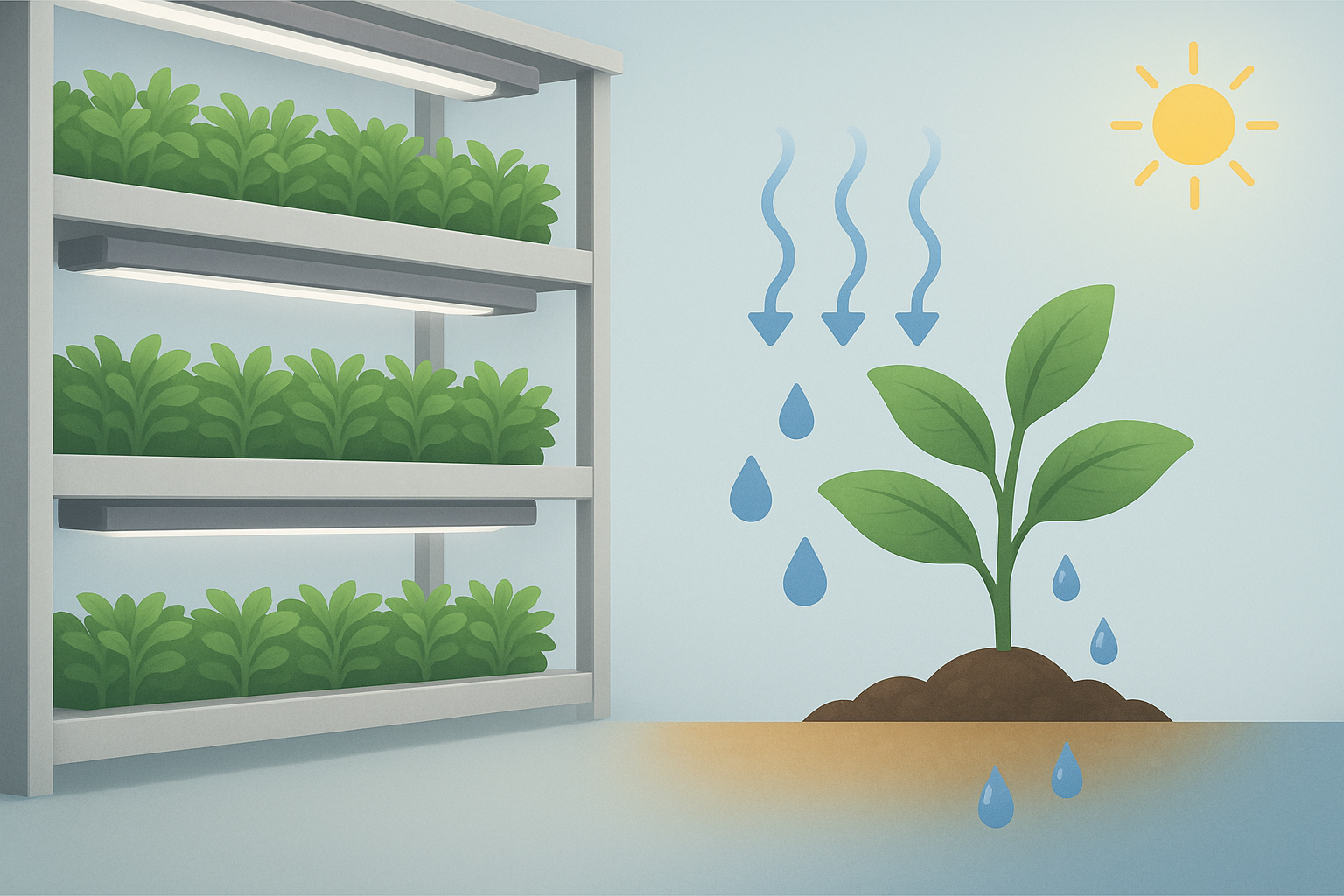
Humidity refers to the amount of water vapour in the air; in plant-centric terms, it is best understood through vapour pressure deficit (VPD). VPD measures the difference between the amount of moisture the air could hold when saturated and the amount it currently contains. It is a more actionable metric than relative humidity alone, as it links directly to the driving force behind transpiration: the movement of water from roots to leaves, which supports nutrient transport and evaporative cooling.
In low-humidity conditions (high VPD), transpiration rates accelerate. This can cause plants to close their stomata to conserve water, leading to restricted photosynthesis and stunted growth. Conversely, overly high humidity (low VPD) suppresses transpiration altogether, resulting in weak stems, delayed nutrient uptake and increased susceptibility to fungal pathogens powdery mildew and grey mould. Understanding this delicate balance is essential for maintaining crop health and consistency.
Microclimates and Spatial Variability
CEA environments, particularly vertical farms, can exhibit significant spatial variation in humidity due to the layout of equipment, air circulation patterns and plant density. Even within a single growing room, localised zones of high humidity (e.g. between densely packed foliage or poorly ventilated corners) can form microclimates that diverge from overall setpoints. These inconsistencies can lead to uneven crop development or localised disease outbreaks.
Hence, spatial uniformity in humidity is just as critical as achieving the correct average level. Achieving this requires careful integration of HVAC systems, airflow design and sensor placement, rather than reliance on single-point measurements. Real-time distributed monitoring, supported by data-driven modelling, is increasingly being adopted to visualise and manage these subtle gradients effectively.
Humidity and Energy Use in CEA
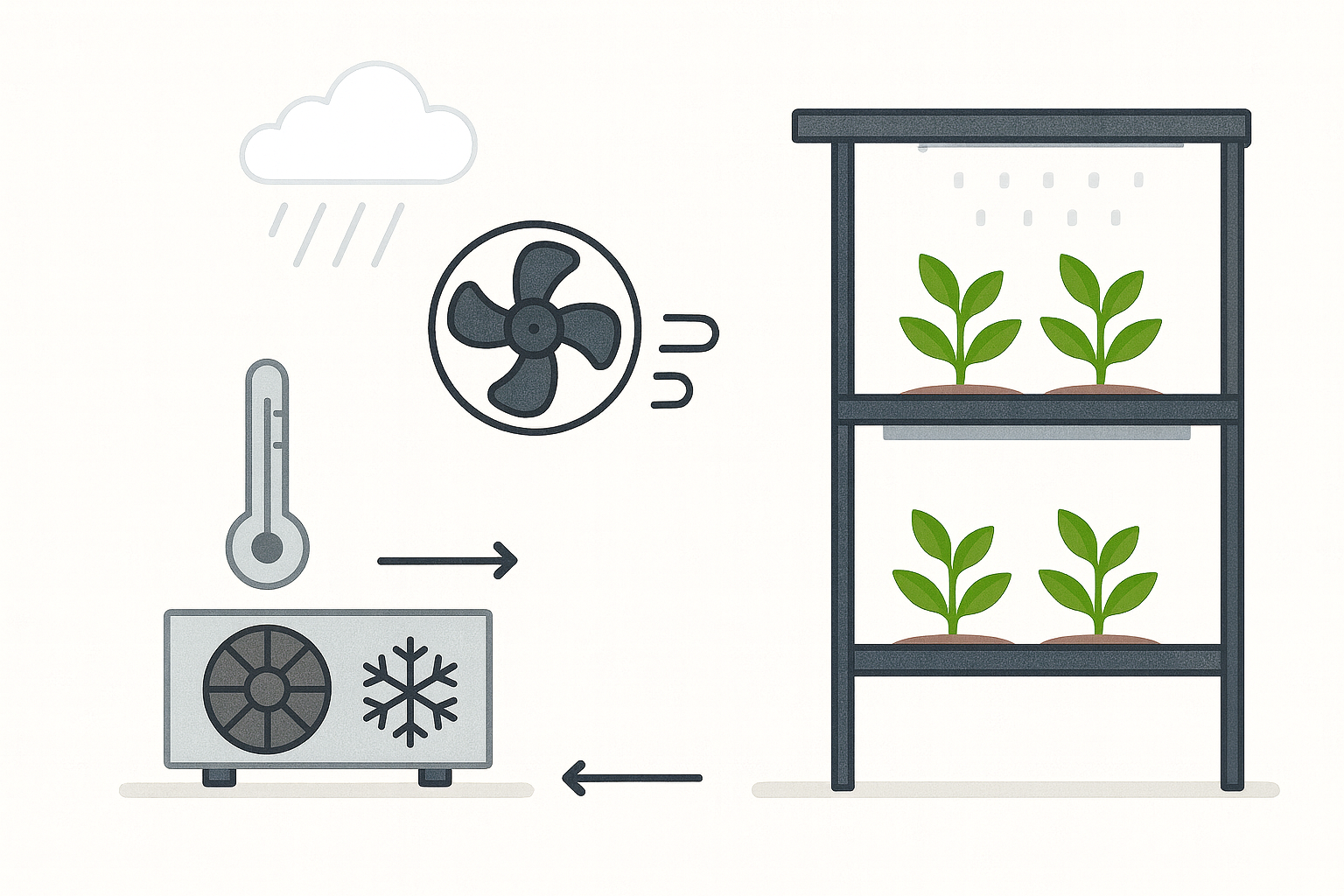
Humidity management is not solely a plant physiology concern; it is also a major driver of energy demand. In sealed or semi-sealed systems, latent heat loads, arising from transpiration and evaporation, must be managed to maintain environmental conditions. Dehumidification, often through condensing coils or desiccant systems, requires significant energy, particularly when ambient temperatures must be held steady. In warm climates or tightly packed vertical farms, this challenge becomes especially acute.
Some CEA operators mitigate this through integrated HVAC–dehumidification solutions or hybrid approaches such as energy recovery ventilation, which reduces the energy penalty of air exchange. Others are exploring plant-driven climate strategies, where crop transpiration patterns are anticipated and counterbalanced through predictive control systems. These technologies aim to align plant needs with operational efficiency; however, their success depends on an accurate understanding of vapour fluxes within the grow space.
Disease Pressure and Pathogen Control
High humidity fosters conditions conducive to the proliferation of pathogens, particularly fungal and bacterial diseases. In CEA systems, where plant density is high and air exchange is limited, spores and bioaerosols can spread rapidly. Pathogens such as Botrytis, Fusarium and downy mildew thrive at relative humidity levels above 85%, especially where leaf surfaces remain wet due to condensation or poor airflow.
Control strategies must therefore address both macro and micro-environmental conditions. Mechanical dehumidification and air exchange play a role, but so too does canopy management: potentially including appropriate spacing and pruning to promote evaporation and air movement. Ultraviolet sterilisation, HEPA filtration and spore-trapping diagnostics may also be employed to maintain biosecurity, especially in high-value crop production where disease outbreaks can be economically devastating.
Humidity Control Technologies
Technologies for managing humidity in CEA systems fall broadly into active and passive categories. Active systems include refrigerant-based dehumidifiers, HVAC-integrated latent control systems, and ultrasonic or high-pressure misting for humidification. Passive strategies may involve material choices, such as vapour-barrier cladding, and architectural design that facilitates natural convective flow.
Advanced systems now combine environmental sensors, machine learning algorithms and actuators to enable dynamic humidity control. These closed-loop systems allow growers to maintain optimal VPD targets throughout different growth stages. For instance, young seedlings may require higher relative humidity to prevent desiccation, while mature fruiting crops benefit from drier air to prevent mould formation. Automation therefore enables precise, stage-specific climate programming that would be infeasible to manage manually.
Research and Future Directions
Humidity in indoor plant farming remains an area of active research. While the basic principles of vapour dynamics are well established, their translation into complex multi-level plant environments is still developing. Recent studies have investigated the interactions between transpiration and LED light spectra, suggesting that far-red wavelengths can influence stomatal behaviour and thus vapour release. Other work explores the use of plant sensors and thermal imaging to infer real-time transpiration rates as a basis for humidity control.
There is also growing interest in the development of predictive humidity models, capable of adjusting environmental controls in advance of measured changes. These models require robust datasets and an understanding of both physical air properties and biological plant responses. As such, interdisciplinary collaboration, spanning plant physiology, thermodynamics, and systems engineering, is central to the next generation of CEA humidity control technologies.
Conclusion: Precision Humidity Management as a Cornerstone of CEA
In summary, humidity in indoor plant farming is more than a background condition; it is a dynamic variable that interacts with plant physiology, energy systems and biosecurity. Effective humidity management requires a systems-level approach: balancing transpiration, airflow, equipment function and plant development in real time. As CEA systems become more advanced, the ability to fine-tune humidity at both spatial and temporal scales will become increasingly central to sustainable, high-yield production.
By understanding and mastering humidity mechanics, growers, engineers and researchers alike can ensure that controlled environments fulfil their promise: consistent, efficient and resilient food production systems tailored to tomorrow’s agricultural demands.