Introduction
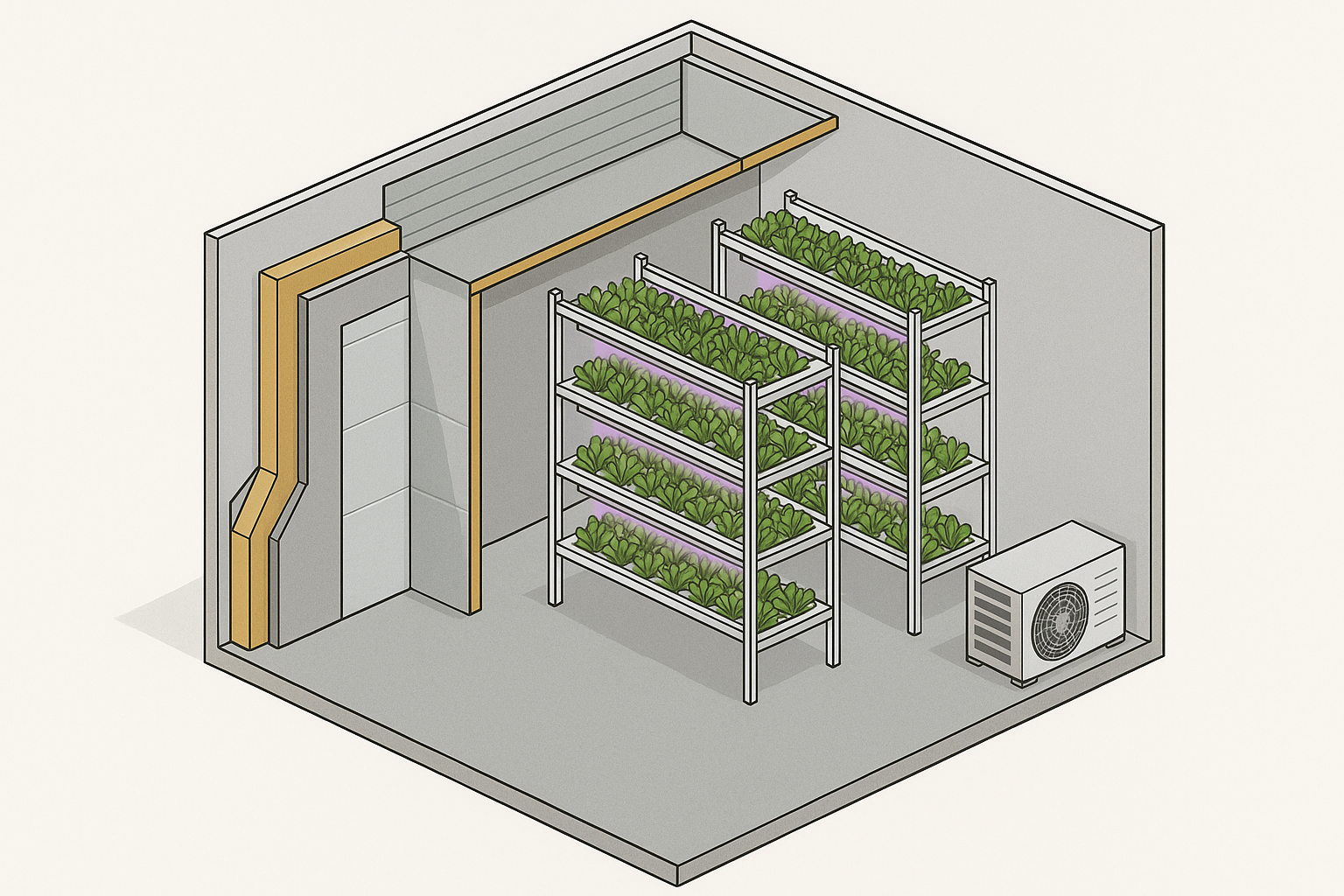
Insulation requirements for effective production in indoor farming are fundamental to the success of controlled environment agriculture (CEA) and vertical farming. Unlike traditional open-field cultivation, these systems rely on carefully engineered environments in which temperature, humidity, air circulation, and energy use must be balanced with precision. Insulation forms the boundary between the external climate and the engineered growing zone; without it, maintaining the stability of the environment becomes inefficient, costly, and often unsustainable. The choice of materials, methods of installation, and ongoing performance of insulation directly affect the energy demands of a facility, the consistency of crop growth, and ultimately the economic viability of the operation.
Why Insulation Matters in CEA
In indoor farms, every parameter is engineered to create optimal plant growth conditions. Insufficient insulation undermines these controls by permitting thermal losses or unwanted heat gains, forcing heating, ventilation, and air conditioning (HVAC) systems to work harder. This increases operational costs and carbon emissions while reducing predictability in crop cycles. For example, in a vertical farm using multi-tier racks, poor wall or roof insulation could allow external temperature fluctuations to influence airflow patterns around plants. Such variations not only alter energy use but may also create microclimates that lead to uneven growth or even plant stress.
In essence, insulation acts as a shield: it stabilises the internal environment, lowers reliance on mechanical climate systems, and preserves the uniformity essential to reliable harvests. This is why insulation is not simply a building fabric consideration but a production parameter central to modern CEA design.
Thermal Performance and Energy Efficiency
The key performance measure of insulation is its ability to resist heat transfer, often expressed as the thermal transmittance or U-value. A lower U-value indicates that less heat passes through the material, making it more effective. In the context of vertical farms, walls, ceilings, and even flooring may need to meet specific U-value targets to reduce energy wastage. This is particularly relevant in temperate regions where farms face seasonal swings in outside temperature.
High-performing insulation reduces the workload on HVAC systems, leading to lower electricity consumption. Given that energy is among the highest operating costs for CEA facilities, the relationship between insulation and profitability is clear. For instance, a well-insulated structure can reduce the frequency of temperature adjustments by automated systems, which in turn lowers peak energy demand and improves long-term system efficiency.
Controlling Humidity and Condensation
Insulation is also vital for controlling vapour movement. Plants constantly transpire, releasing moisture into the growing area. If warm, moist air encounters poorly insulated or thermally bridged surfaces, condensation may form. This not only risks structural damage and mould growth but also undermines biosecurity, creating conditions favourable to pathogens.
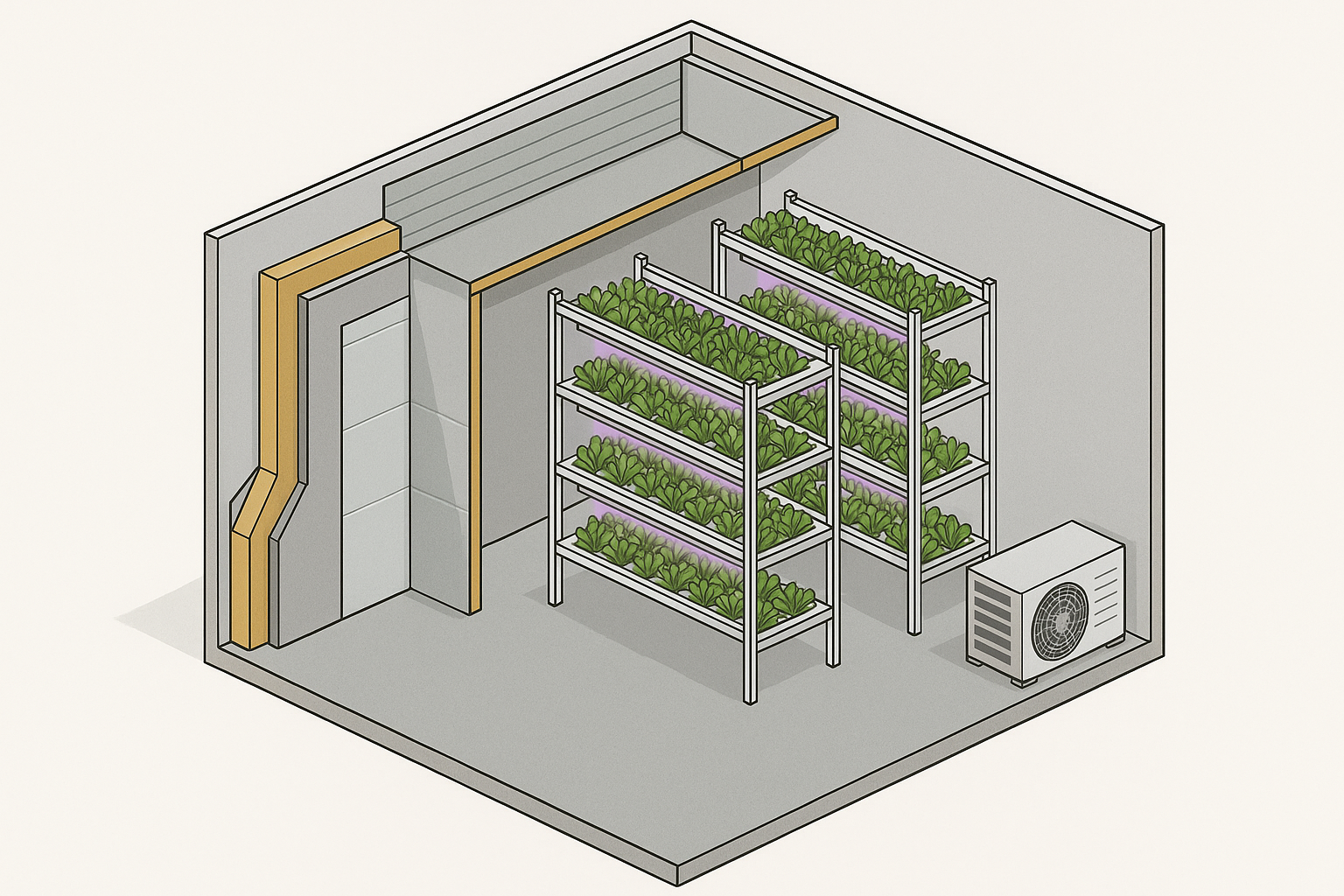
To prevent such outcomes, insulation materials must often be combined with vapour barriers or smart membranes that regulate moisture flow. The interplay between thermal insulation and vapour control layers is an important element of farm design, especially where cold climates or high internal humidity levels present challenges. For example, insulated sandwich panels with integrated vapour barriers are increasingly used in vertical farming construction, as they provide both thermal stability and moisture resistance in a single system.
Acoustic and Structural Considerations
While thermal performance is usually the focus, insulation also contributes to acoustic management and structural performance. Fans, pumps, and HVAC units can generate significant noise, which may disrupt nearby urban communities where many vertical farms are located. Insulation helps dampen this noise, making facilities more compatible with city settings.
Structurally, insulation materials must integrate with load-bearing designs, particularly when combined with multi-tier racking systems. Rigid insulation boards or composite wall panels provide additional stability compared with loose-fill materials, which are unsuitable for the highly engineered and precise conditions of CEA. The choice of insulation therefore has implications not only for energy management but also for how the farm can be constructed and maintained.
Material Options and Their Suitability
Several material categories dominate insulation design for indoor farms. Mineral wool and fibreglass are widely available and effective but must be carefully sealed to avoid air leakage. Rigid foam boards, such as extruded polystyrene (XPS) or polyisocyanurate (PIR), offer high thermal resistance with thinner profiles, making them useful in space-limited facilities. Vacuum insulated panels (VIPs), while expensive, can deliver exceptional performance where maximum space efficiency is required.
In addition, sustainable options such as recycled cellulose or natural fibre insulations are increasingly considered, particularly in facilities seeking lower embodied carbon. However, their long-term resistance to humidity and microbial exposure requires careful assessment before adoption. Thus, material selection is a balance between thermal performance, cost, durability, and environmental impact.
Regional and Climatic Context
Insulation requirements vary according to regional climate. In cold northern climates, the priority is preventing heat loss during winter months, while in hot and humid regions the emphasis is on limiting heat gain and controlling moisture ingress. Even within the same region, urban farms may face different demands compared with rural installations, due to variations in building stock and ambient temperature profiles.
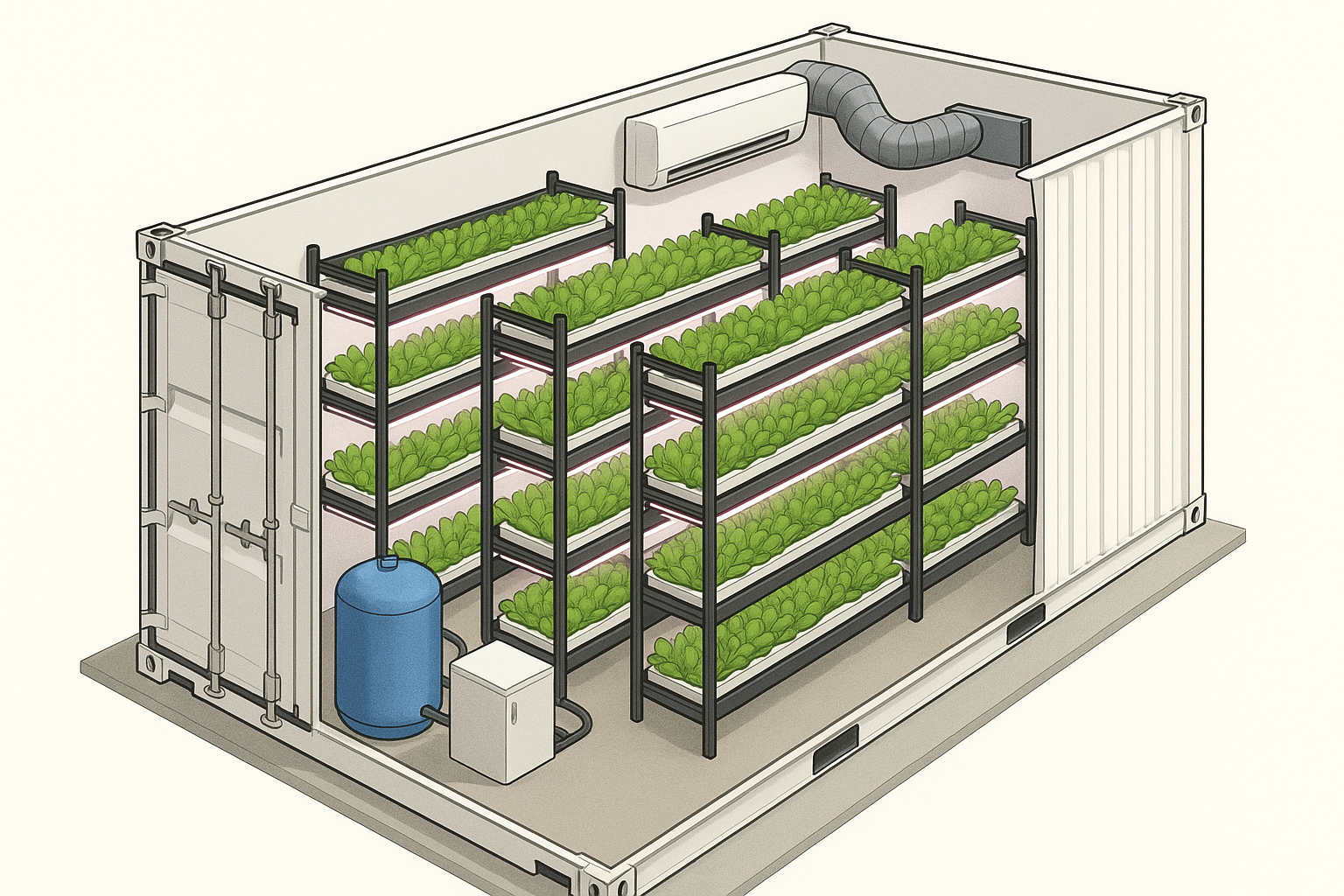
For example, a container farm located in Scandinavia will rely on high-performance insulation to prevent significant heating costs, while a warehouse conversion in Singapore must prioritise vapour-tight insulation systems to reduce cooling loads and prevent condensation. Recognising these climatic contexts ensures that insulation design is not treated as a generic specification but as a tailored element of overall farm engineering.
The Link Between Insulation and Crop Outcomes
Insulation is not merely a cost-saving device but a factor that shapes plant performance. Crops thrive when their growing environment is stable, predictable, and uniform. If insulation fails to prevent temperature stratification within a vertical rack, some tiers may become warmer or cooler than others. This leads to inconsistent yields and can compromise the precise scheduling of harvests that underpins commercial success.
Furthermore, when insulation performs well, it supports secondary systems such as CO2 enrichment or supplemental lighting by ensuring that the benefits of these inputs are not undermined by external variability. Thus, insulation contributes indirectly but critically to the biological efficiency of the entire production system.
Conclusion
Insulation requirements for effective production in indoor farming go beyond traditional building design; they represent a core operational determinant in CEA and vertical farming. By providing thermal stability, managing humidity, reducing energy consumption, and protecting crop uniformity, insulation acts as a foundation for the controlled environments on which these systems depend.
As the industry expands globally, the demand for energy-efficient, climate-resilient, and crop-focused design will intensify. Understanding the role of insulation is therefore essential not only for engineers and architects but also for growers, investors, and policy-makers who aim to build systems that are economically viable, environmentally responsible, and biologically consistent. Insulation is, in short, one of the invisible yet decisive technologies enabling the reliable production of food in controlled environments.
DIY Science!
To calculate the U-value (thermal transmittance) of an insulated element such as a wall, roof, or floor, you need to determine how much heat flows through the construction per unit area, per degree of temperature difference. The U-value is measured in W m-2 K (watts per square metre per degree Kelvin).
Here is the process:
Step 1: Identify all layers of the construction
For example, a vertical farm wall might include:
- Internal surface resistance
- Vapour barrier or plasterboard
- Insulation layer
- Structural wall
- External cladding
- External surface resistance
Each layer has its own thermal resistance.
Step 2: Find thermal conductivity (λ-value) of each material
- This is a property of the material, expressed in W m-2 K
- Example values: mineral wool ≈ 0.035 W/m·K; PIR board ≈ 0.022 W m-2 K; concrete ≈ 1.7 W m-2 K.
Step 3: Calculate resistance (R-value) of each layer
For each layer:
R = d / λ
where:
- d = thickness of the material in metres
- λ = thermal conductivity of the material in W/m·K
This gives thermal resistance in m-2 K/W.
Step 4: Add surface resistances
By convention, internal and external surface resistances are included to account for heat transfer at boundaries. Standard values (from ISO 6946):
- Internal surface resistance (Rsi) = 0.13 m-2 K/W
- External surface resistance (Rse) = 0.04 m-2 K/W
Step 5: Add all resistances
R_total = Rsi + Σ(R_layers) + Rse
Step 6: Take the reciprocal to find U-value
U = 1 / R_total
Example Calculation
Suppose a vertical farm wall consists of:
- 150 mm mineral wool insulation (λ = 0.035 W m-2 K)
- 200 mm concrete wall (λ = 1.7 W m-2 K)
- R_insulation = 0.15 / 0.035 ≈ 4.29 m-2 K/W
- R_concrete = 0.20 / 1.7 ≈ 0.118 m-2 K/W
- Add surface resistances: R_total = 0.13 + 4.29 + 0.118 + 0.04 = 4.578 m-2 K/W
- U-value = 1 / 4.578 ≈ 0.22 W m-2 K