Introduction to Using Container Farms for Indoor Farming
Using container farms for indoor farming has become an increasingly visible approach within the wider field of Controlled Environment Agriculture (CEA). In simple terms, these systems convert standard shipping containers into highly controlled plant production environments. By enclosing the growing space in an insulated, transportable structure, container farms provide a compact, modular platform for crop cultivation in locations where traditional agriculture is constrained by space, climate, or infrastructure. Their adaptability makes them relevant not only for urban agriculture initiatives, but also for remote communities, research applications, and early-stage commercial ventures.
Container farms offer a ‘ready-made’ growing environment, which can allow growers to manage key growth factors such as temperature, humidity, light intensity, photoperiod, nutrient delivery, and carbon dioxide concentration from the outset. This production control, without any necessary trial and error to establish and maintain environmental growing conditions, can improve crop outcomes from an inaugural harvest. However, this benefit comes with trade-offs: principally high capital costs relative to potential return on investment, which are often prohibitive, alongside the high energy demand, operational costs, and system-biology complexities found in other CEA systems.
Design and Technical Principles
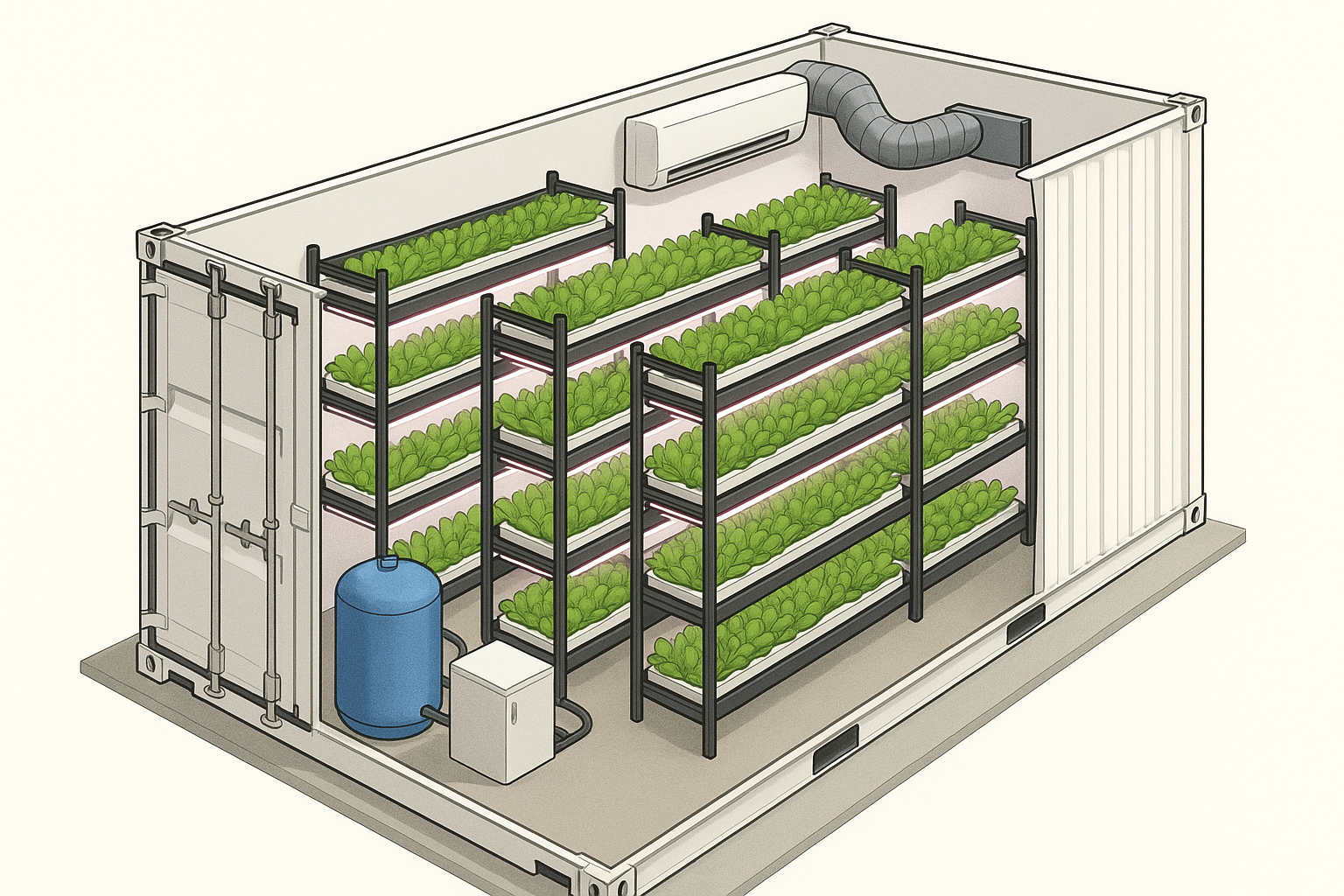
The physical structure of a container farm is typically based on the ISO-standard shipping container format, typically 12 metres (40 feet) in length, though shorter units are also used. The interior is insulated and fitted with vapour barriers to maintain environmental stability and prevent condensation damage. Climate control is achieved through integrated heating, ventilation, and air conditioning (HVAC) systems, often combined with dehumidification units to maintain optimal air moisture levels.
Artificial lighting, generally in the form of high-efficiency light-emitting diodes (LEDs), supplies the photosynthetically active radiation required for plant growth. These are arranged to maximise light distribution while minimising shading and energy waste. Hydroponic or aeroponic systems replace soil as the growing medium, allowing precise delivery of water and dissolved nutrients to plant roots. Sensors feed real-time data on environmental parameters to a central control system, which automates adjustments and can be monitored remotely via connected software.
This design approach reflects the broader principles of CEA: creating a stable, optimised growth environment that decouples plant growth from external weather variability. For example, in leafy greens production, light spectra and nutrient composition can be fine-tuned to influence leaf colour, texture, and nutritional content, while cycle timing ensures consistent harvest scheduling.
Urban and Spatial Advantages
One of the most significant advantages of container farms in urban agriculture is their minimal spatial footprint. Because they are self-contained, they can be installed on unused industrial lots, in car parks, near transport hubs, or on the grounds of institutions such as schools and hospitals. Their mobility allows for redeployment if land use priorities change, reducing long-term site risk for operators.
Proximity to consumers shortens supply chains and can reduce transport-related carbon emissions, particularly for perishable crops such as salad greens, herbs, and microgreens. This is particularly relevant in dense urban areas where demand for fresh produce is high but arable land is scarce or prohibitively expensive. In certain cases, container farms have been deployed in food deserts to improve local access to nutritious produce, although economic viability in such settings depends on subsidy, partnership, or premium sales models.
Operational Considerations and Limitations
While container farms offer flexibility, they are not universally the most efficient choice for all crops or all contexts. Their internal growing area is limited by the container dimensions; even with vertical racking, production scale is constrained compared with large-scale vertical farms in purpose-built facilities. This physical limit can result in higher per-unit production costs, especially where energy prices are high or crop margins are low.
Thermal regulation can also present challenges. In hot climates, cooling energy demand can be substantial; in colder regions, heating requirements may dominate. Efficient system design and renewable energy integration are critical to improving environmental performance and cost-effectiveness. Water use is typically lower than in field cultivation, yet nutrient solution management, filtration, and waste handling require consistent attention to prevent contamination or system failures.
For new entrants, the controlled nature of container farming can be a learning curve. Knowledge of plant physiology, hydroponic system management, and environmental control technology is essential to maximise yields and quality. Commercial operators often benefit from linking with local research institutions or experienced growers to refine practices and troubleshoot emerging issues.
Research and Development Applications
Container farms have found a role beyond commercial production in research, education, and pilot-scale experimentation. Because their environmental conditions are tightly controlled, they provide an excellent platform for testing plant responses to specific variables such as light spectrum shifts, nutrient composition changes, or novel plant protection strategies. Additionally, they can be set up alongside larger production facilities, to allow crop research and development activities without the potential for cross contamination with production lines.
They are also being investigated for deployment in extreme environments, including polar research stations and remote islands, where fresh produce supply chains are unreliable. In these contexts, container farms serve as both a practical food source and a test-bed for innovations that could inform future controlled-environment systems in challenging conditions, including potential space exploration missions.
Sustainability and Policy Context
From a sustainability perspective, container farms are part of the ongoing discussion around urban food systems, localised production, and resilience to supply chain disruptions. Their environmental performance varies depending on design, operation, and energy source. Where renewable energy is integrated, and where transport distances for inputs and outputs are minimised, they can contribute to reducing the embedded emissions of fresh produce supply. However, lifecycle assessments often highlight that electricity use for lighting and climate control is a dominant factor in overall environmental impact.
Policy-makers are increasingly interested in such systems as part of urban resilience strategies, but regulatory frameworks for siting, building codes, and food safety must be navigated. Incentives, such as energy grants or low-interest loans for agricultural innovation, can influence the adoption rate.
The Role of Container Farms in the Broader CEA Landscape
Container farms occupy a distinct niche within the wider CEA spectrum. They are particularly suited to contexts where mobility, modularity, and rapid deployment are valued. For certain crops, and at small to medium scale, they can offer a viable production model. They also serve as a gateway technology for communities, entrepreneurs, and institutions to engage with controlled-environment growing practices without committing to large, immobile facilities.
As urban populations grow, and as the challenges of climate change, resource efficiency, and food security intensify, container farms provide one of several tools for diversifying production systems. Their success depends on appropriate crop choice, energy management, skilled operation, and integration into local food networks. Continued research and transparent evaluation of performance metrics will be essential to determine their long-term role and economic competitiveness.
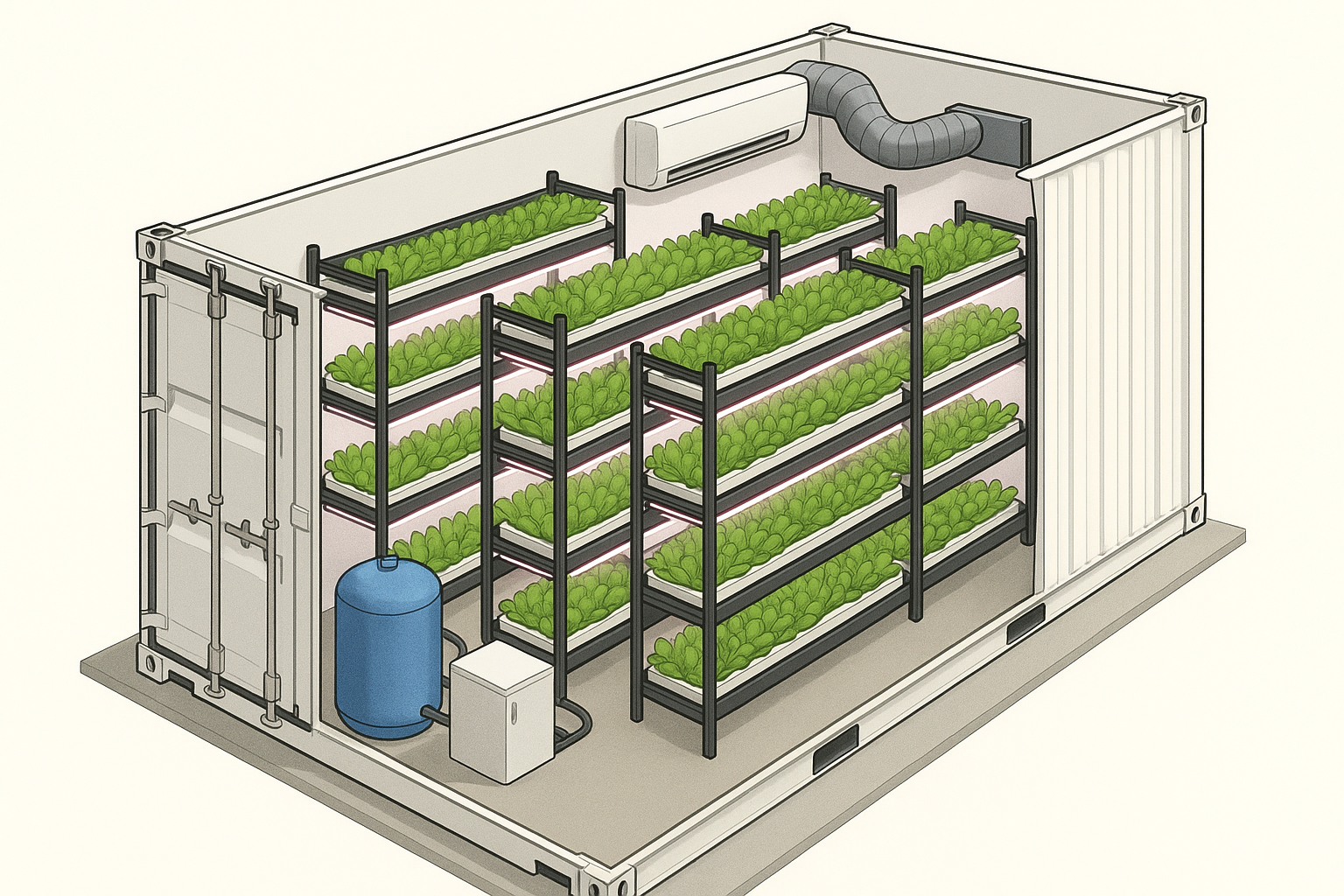
Some basic figures:
Specifications, Energy Use, and Crop Outputs in Container Farms
Example Container Specifications
A typical container farm is based on a standard ISO shipping container, most commonly 40-foot length. The following specifications are representative:
- Dimensions: 12.2 m (length) × 2.4 m (width) × 2.6 m (height)
- Gross Internal Volume: ~75 m³
- Usable Growing Area: 40 – 55 m² depending on rack design and number of tiers
- Rack Systems: 3 – 5 tiers, typically producing between 250 and 400 planting sites per tier
- Construction: Steel shell with added insulation (polyurethane panels, U-value typically 0.25 – 0.30 W m² K)
- Climate Control: HVAC system with dehumidification and airflow management, capacity around 5 – 8 kW
Energy Demand Ranges
Energy consumption varies by design and crop type. Approximate daily averages are as follows:
- LED Lighting: 150 – 200 kWh per day (using modern high-efficiency LEDs at 2.5 – 3.0 µmol/J)
- HVAC and Dehumidification: 40 – 80 kWh per day depending on climate zone and insulation quality
- Pumps and Ancillary Equipment: 5 – 10 kWh per day
- Total Range: 200 – 300 kWh per day, equating to 5 – 7 kWh per kg of leafy greens produced
When integrated with renewable energy (solar PV or external grid-supplied green tariffs), the environmental footprint can be substantially reduced.
Crop Yields and Outputs
Container farms are generally optimised for leafy greens and herbs. Representative outputs are:
- Lettuce (e.g. romaine, butterhead): 3,500 – 5,000 heads per 40-foot container per month, depending on variety and cycle length
- Herbs (basil, coriander, parsley): 20 – 25 kg per week, with rapid turnaround cycles
- Microgreens: 15 – 20 trays per week, with cycle times of 7 – 14 days
- Annual Yield (Leafy Greens): 40,000 – 60,000 heads per container, equating to ~7 – 9 tonnes fresh weight
Environmental Parameters (Typical Ranges)
- Air Temperature: 20 – 24°C for leafy greens; adjusted for species-specific requirements
- Relative Humidity: 55 – 70 % with dehumidification to manage transpiration loads
- CO₂ Enrichment: Often maintained at 800 – 1200 ppm to accelerate growth
- Nutrient Solution EC (electrical conductivity): 1.2 – 2.0 mS/cm depending on crop stage
- pH Range: 5.5 – 6.2 for optimal uptake in hydroponic systems
Operational Lifespan and Maintenance
- Container Shell: 15 – 20 years with proper anti-corrosion treatment
- LED Fixtures: Rated for 50,000 – 60,000 hours, typically 8 – 10 years under daily use (but potentially variable depending on manufacturer)
- HVAC Systems: Service life 8 – 12 years depending on operating intensity
- Average Replacement Costs: LEDs and HVAC represent the most significant capital reinvestments over the container’s lifespan