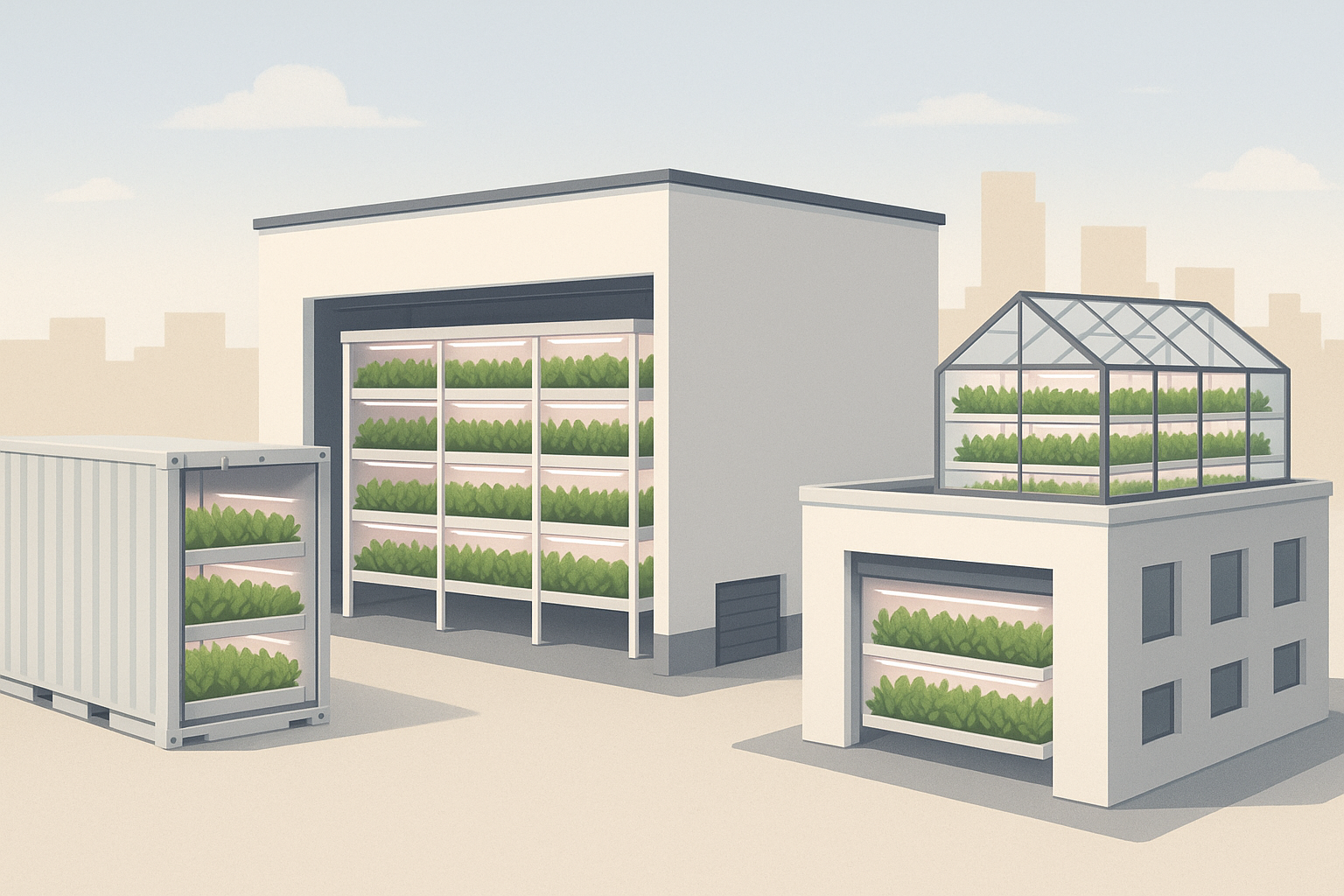
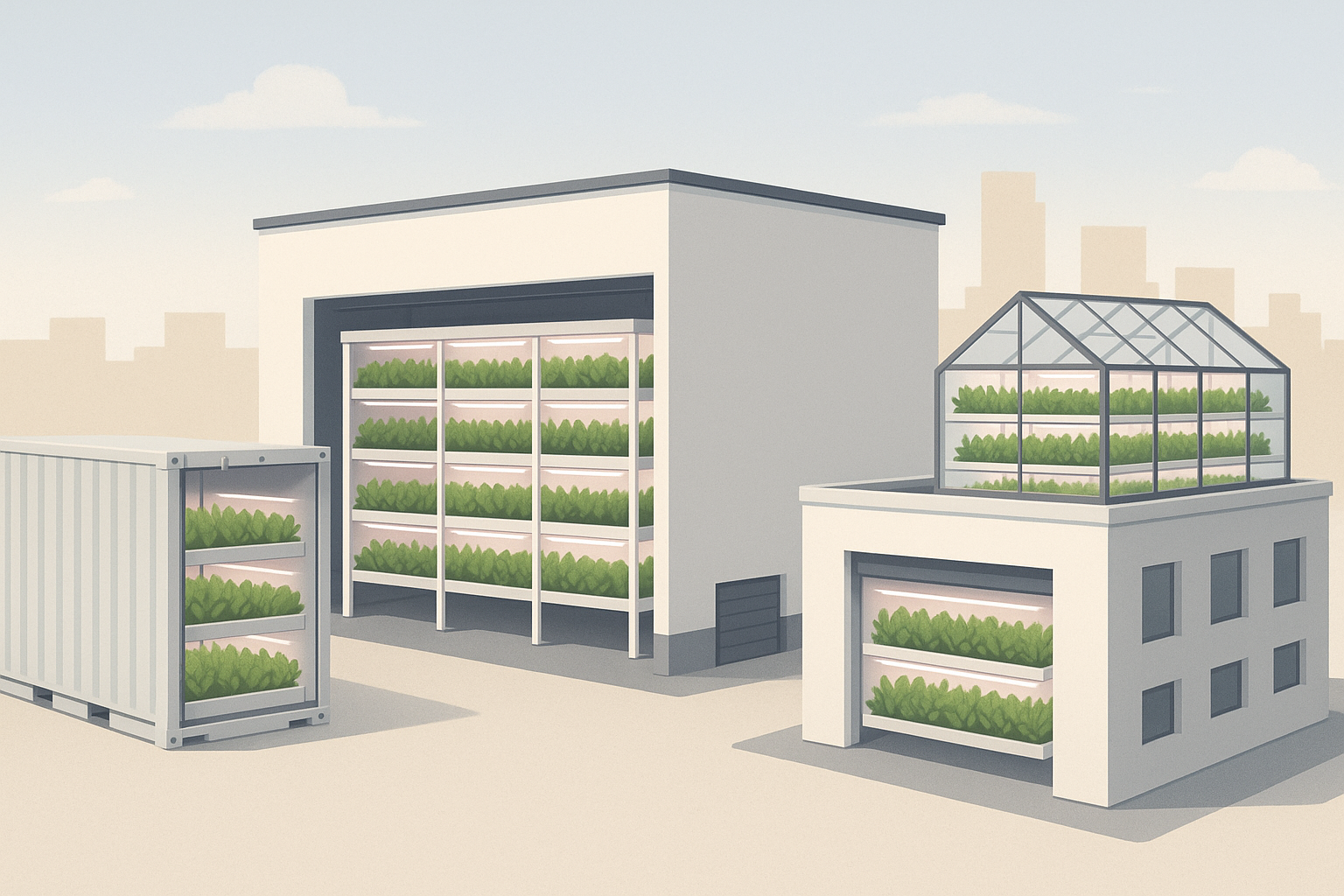
Understanding the relative advantages and limitations of different indoor farming models is one of the most important steps when planning a controlled environment agriculture (CEA) venture. A clear vertical farming system comparison helps prospective growers, investors, and policy-makers to understand which approach best suits their aims. Whilst indoor plant production systems come in many varied forms, the three most common formats discussed are typically container farms, warehouse conversions, and rooftop systems. Each represents a distinctive response to the challenge of producing food in indoor systems, in urban or resource-limited environments, and each carries both opportunities and constraints. As such, these different systems serve as model examples for the types of challenge and opportunity offered by the different system designs.
Why vertical farming formats differ
Vertical farming is a broad term encompassing any food production system that stacks or layers crops within a controlled indoor environment. While the fundamental technologies of lighting, irrigation, and climate control are shared across systems, the type of physical structure used as the growing space has major implications for costs, efficiency, and long-term viability. A container farm, for instance, has a completely different scale and operating profile from a converted distribution warehouse. Similarly, a rooftop system might allow for integration with existing energy or water infrastructure, but faces challenges of load-bearing and microclimate exposure. These differences mean that a system suitable for a university research facility may not work for a commercial-scale salad producer, and a set-up appropriate for a dense city centre may not translate well to rural contexts. Comparing formats in detail enables stakeholders to see beyond the broad enthusiasm for vertical farming and assess the practical realities.
Container farms: mobility and limitations
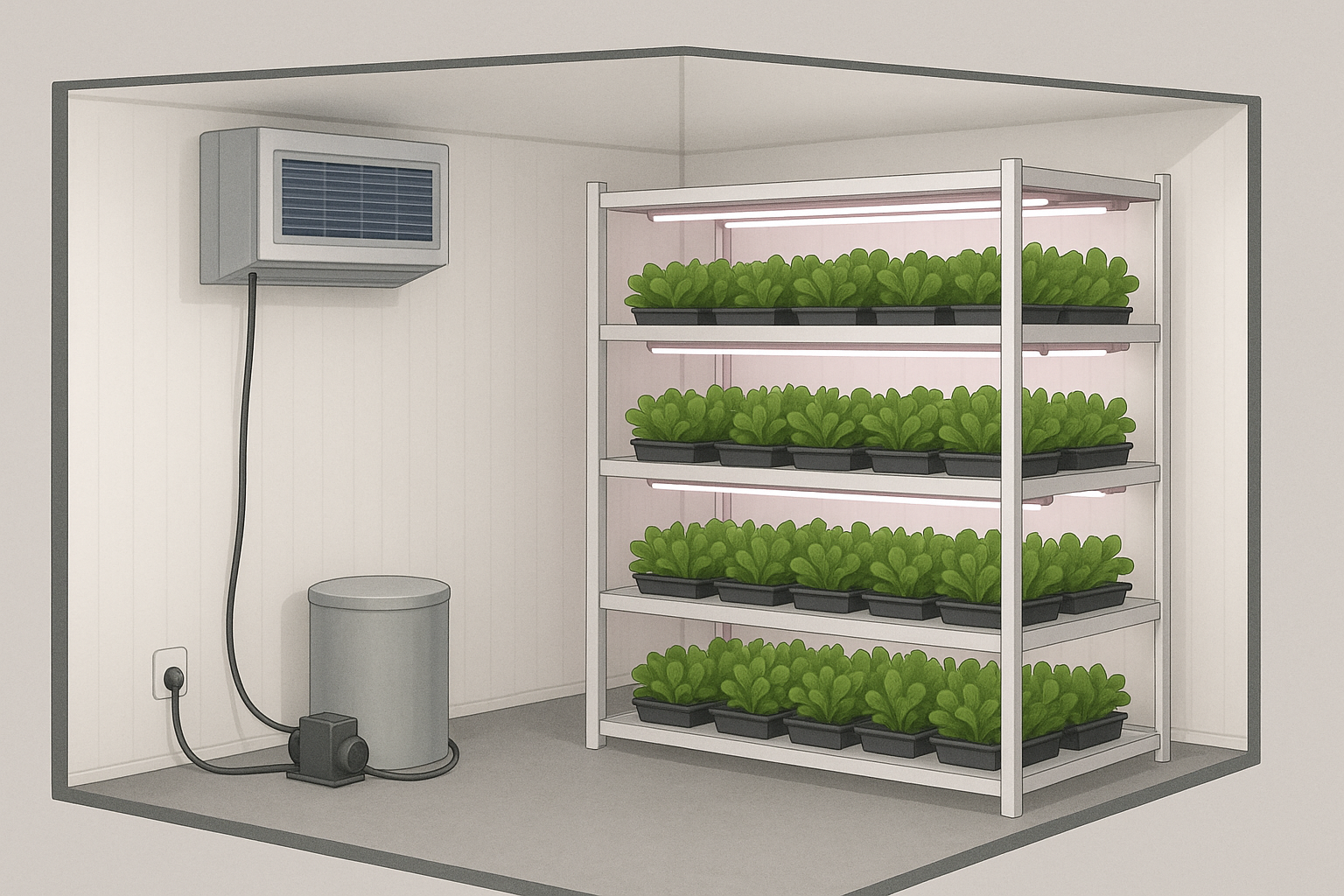
Container farms are typically retrofitted shipping containers equipped with hydroponic racks, LED lighting, climate control, and monitoring systems. They are often promoted as modular and mobile units that can be deployed rapidly with relatively low upfront investment compared to larger facilities. Their compact footprint makes them attractive to schools, restaurants, or small businesses looking to produce high-value crops such as herbs or microgreens close to the point of consumption.
The principal advantages lie in standardisation and mobility: a container is a known unit that can be replicated or moved, reducing planning complexities. However, the drawbacks are equally clear. Energy consumption per kilogram of produce tends to be higher than in larger facilities due to the limited economies of scale. Working conditions inside can be restrictive; the narrow layout reduces flexibility for labour and limits expansion potential. In addition, retrofitted containers often face thermal regulation challenges since they were not originally designed for insulated horticultural use.
Warehouse conversions: scale and complexity
Converting existing warehouses or industrial units into vertical farms has become a prominent model across Europe, North America, and Asia. These spaces offer the benefit of large volumes and floor areas, which allow for multiple tiers of crops and efficient use of automation technologies. They can achieve considerably higher production volumes and lower unit costs compared to containers, provided sufficient demand exists.
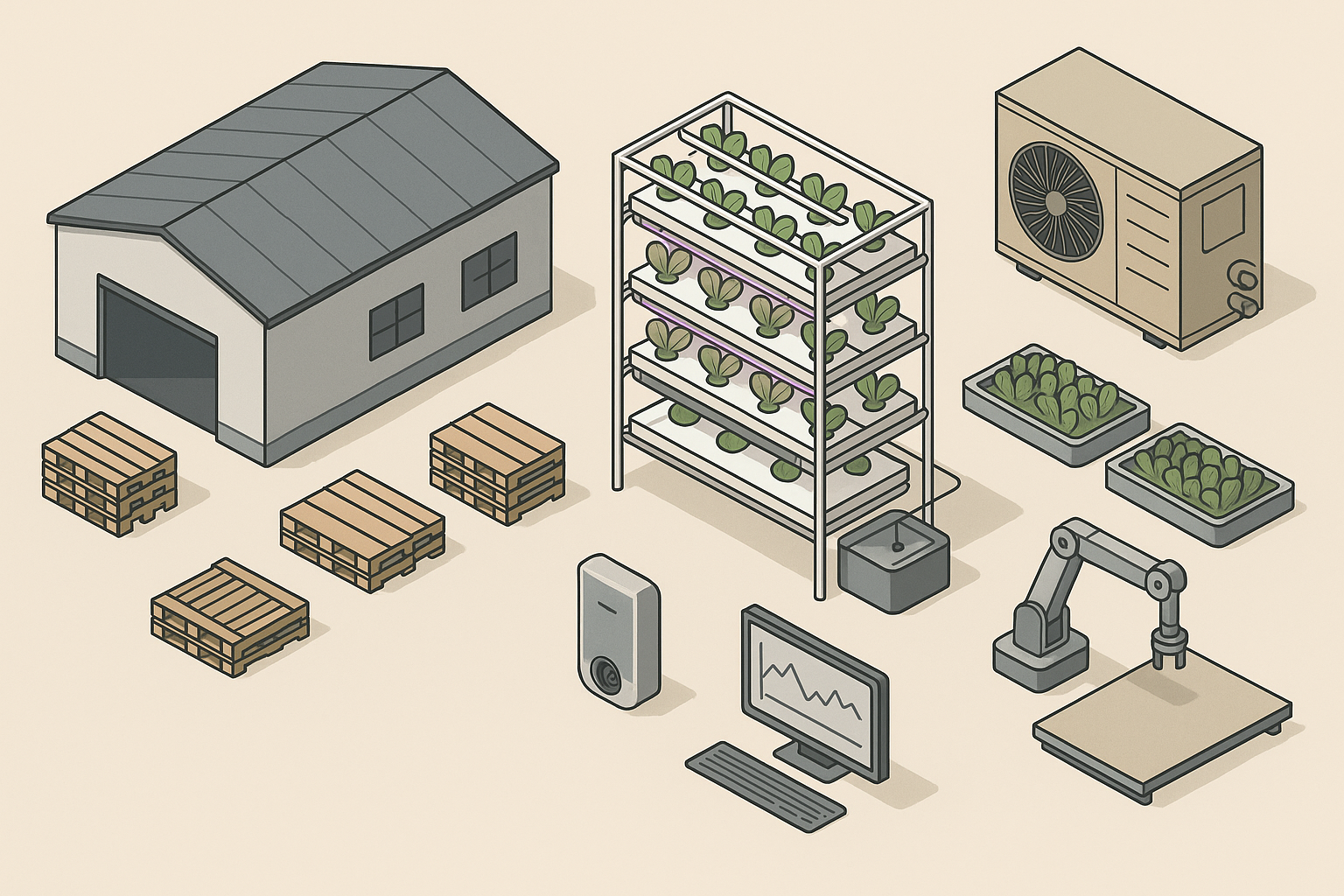
The main challenges are capital intensity and technical complexity. Fit-out costs for HVAC, water treatment, and LED arrays can run into the millions of pounds (for large factory-style systems), and the risks of operational failure are significant if systems are poorly integrated. Warehouses also often occupy valuable urban real estate, which may mean land rates are high, with questions of opportunity cost when competing with other land uses.
Rooftop systems: integration with cities
Rooftop farms are increasingly considered in dense urban areas where land is scarce but demand for fresh produce is high. Unlike containers or warehouses, they integrate directly with existing buildings. This can provide notable synergies: waste heat from a commercial property may be used to stabilise temperatures, or rainwater catchment can feed into the irrigation system. Being close to consumers also reduces transport costs and can support direct-to-market business models.
However, rooftop systems face structural and regulatory hurdles. Building load-bearing capacity often limits the scale of production, and retrofitting waterproofing, drainage, and access infrastructure can be costly. Planning permission and health and safety compliance add further layers of complexity. While the symbolic appeal of growing food on top of city buildings is strong, the actual economic and technical feasibility varies significantly by location and building type. Additionally, such systems are not ergonomically designed for production purposes, which may increase logistical challenges for factors such as goods-in and -out of the production system.
Framing the comparison
When undertaking a vertical farming system comparison, it is important not to assume that one format is universally superior. Rather, each system reflects a set of trade-offs between mobility, scalability, integration, and cost. Container farms are accessible and compact, but limited in capacity. Warehouses offer scale and efficiency, but demand significant capital and technical expertise. Rooftops allow urban integration, but require careful structural and regulatory assessment.
The choice depends upon the specific goals of the project. An educational institution or social enterprise may value the versatility or accessibility of a container farm, while a commercial operator seeking economies of scale will favour warehouse conversions. Rooftop systems may be most appropriate where urban sustainability goals align with niche production and local branding.
Why this matters for the future of CEA
As governments and investors look to controlled environment agriculture to strengthen food security and reduce supply chain vulnerabilities, understanding the pros and cons of different formats becomes essential. Without a realistic appraisal of system suitability, projects risk underperformance or failure. By engaging with the distinctions outlined above, stakeholders can make decisions that balance ambition with feasibility, and tailor vertical farming models to their local contexts.
Ultimately, comparing container farms, warehouses, and rooftop systems is not about choosing a winner but about recognising that vertical farming is not a single technology. It is a spectrum of approaches and potential system configurations, each suited to a set of particular needs. Clarity on these differences helps the sector progress from generic enthusiasm to practical, evidence-based adoption.