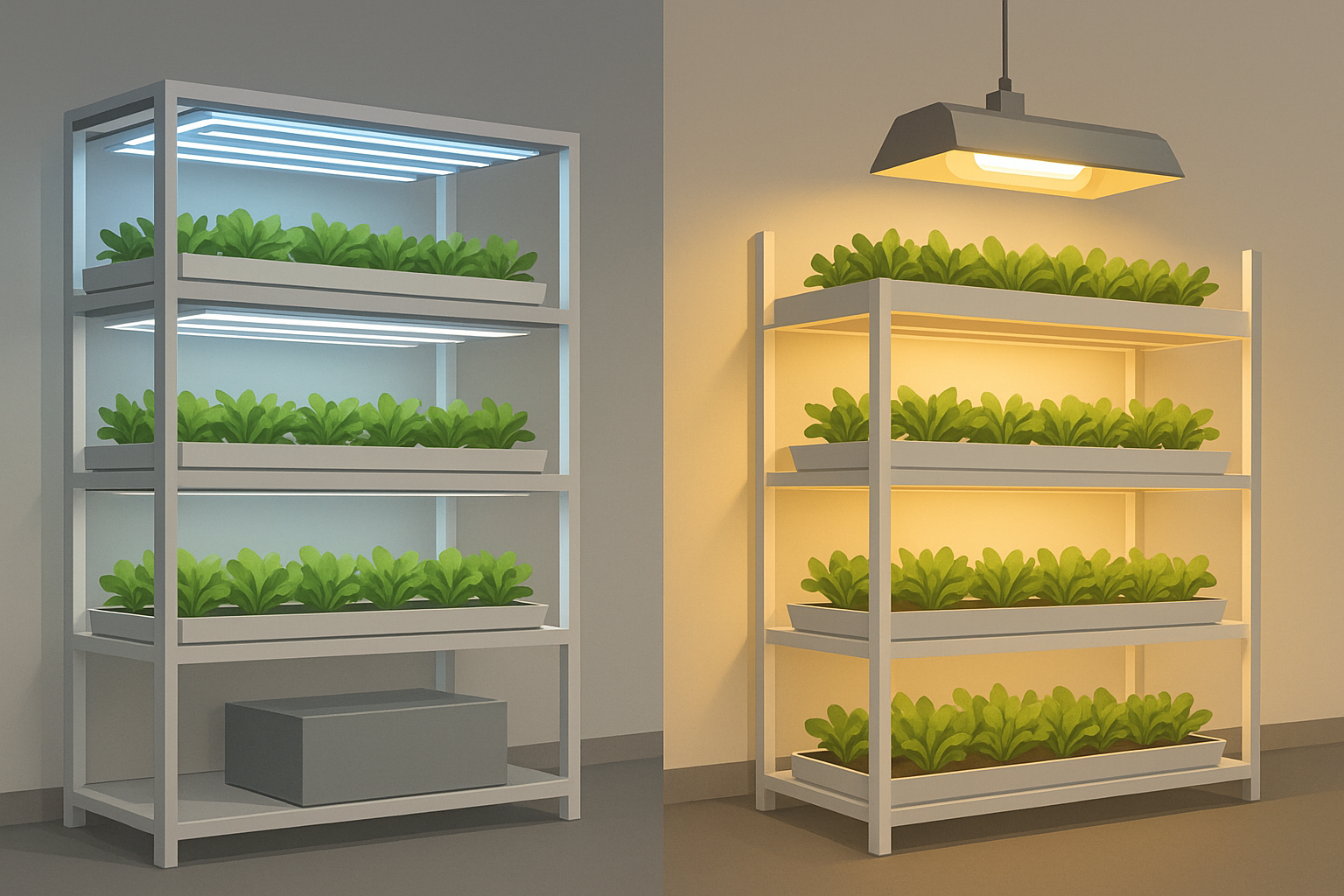
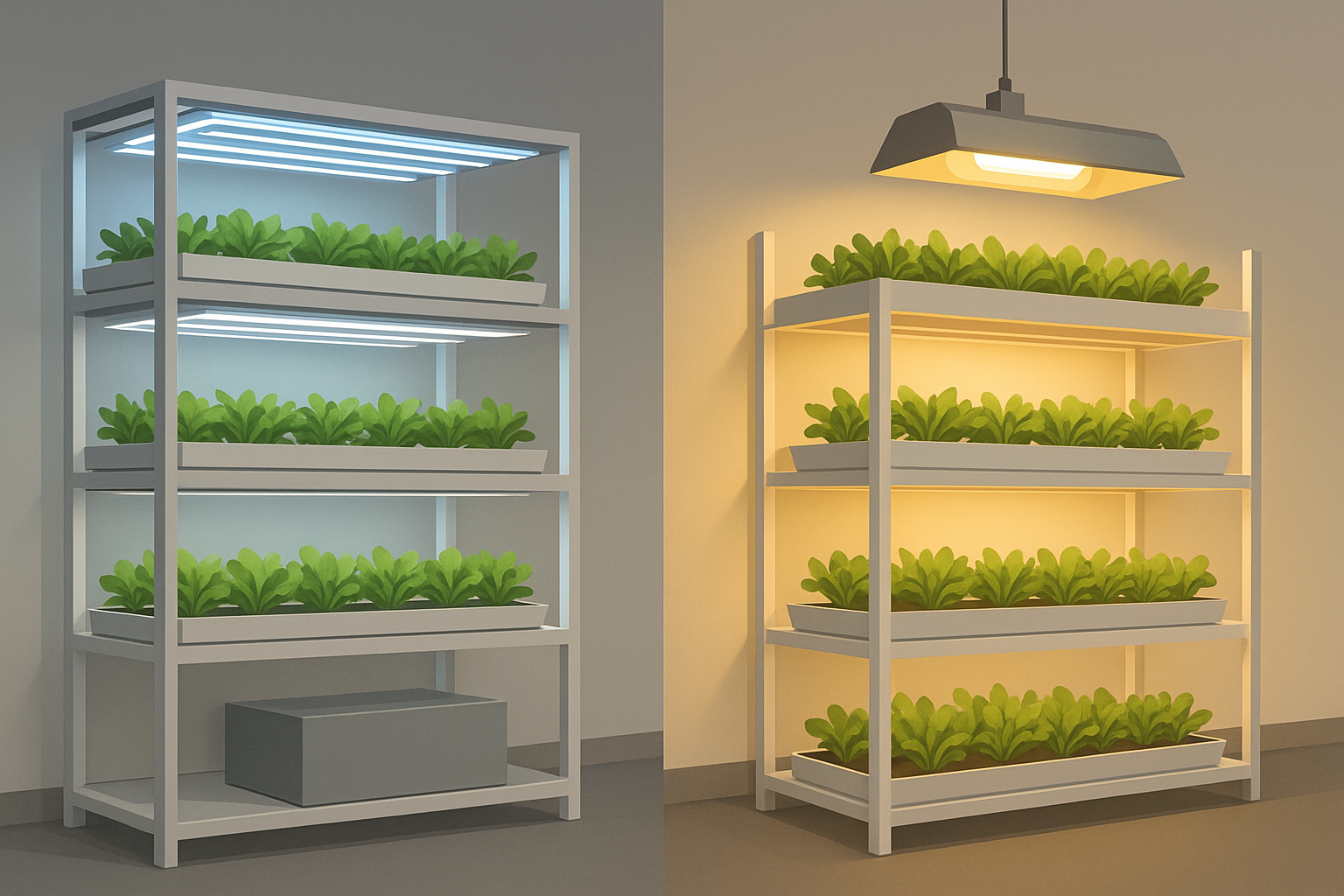
The choice of which artificial lighting approach is one of the most critical decisions in controlled environment agriculture (CEA). Nowhere is this more apparent than in vertical farms, where the growing environment is entirely dependent on the integration of artificial light with climate control and nutrient delivery. The long-running debate of LED (light emitting diode) vs HPS (high pressure sodium) lighting in indoor farming is largely settled at this stage, as LEDs have continued to improve, but captures the evolution in recent horticultural technology for those planning new facilities. This decision between lighting types has implications for crop yield, energy efficiency, operational costs, and even the sustainability profile of an indoor farming enterprise.
Historical Background and Context
For decades, HPS lamps were the dominant choice for greenhouse and indoor horticulture. Their relatively low upfront cost and proven ability to drive photosynthesis made them a standard tool for growers. The characteristic orange glow of HPS lighting became synonymous with large-scale commercial cultivation, particularly in high-value crops such as tomatoes and peppers. However, as vertical farming developed into a distinct model of crop production, the limitations of HPS lamps in compact, multilayered environments became increasingly evident. High heat output, limited spectral flexibility, and relatively short service life led growers and researchers to investigate alternatives.
LEDs were first introduced to horticulture in the 1990s, initially as experimental tools for studying plant responses to specific light wavelengths. Over the past twenty years, technological advances in efficiency, cost, and spectrum tuning have transformed LEDs from a niche research instrument into the leading lighting solution for indoor farms. By the late 2010s, LEDs had overtaken HPS in many high-tech greenhouse and vertical farm projects, not only because of their energy savings but also because of their ability to deliver precise light recipes tailored to crop physiology.
Energy Efficiency and Heat Management
One of the primary considerations in the LED vs HPS lighting debate for indoor farming is energy efficiency. HPS lamps typically convert around 30 – 40% of electrical energy into photosynthetically active radiation (PAR), with the remainder lost as heat. LEDs can exceed 50% efficiency under optimal conditions, with some modern horticultural LEDs reaching photon efficacies above 3.5 µmol/J. This difference translates directly into lower electricity bills, which is significant since energy costs often account for the largest share of operational expenditure in vertical farms.
Heat management is equally important. HPS fixtures emit substantial radiant heat, which in a vertical farm environment can raise the ambient temperature and increase the demand for cooling. This not only adds to energy consumption but also risks creating uneven microclimates between crop layers. By contrast, LEDs produce less radiant heat and allow closer placement to plant canopies, enabling more compact vertical rack designs and higher production density.
Spectrum and Crop Quality
Another major distinction between LED and HPS lighting is spectral output. HPS lamps emit a spectrum dominated by yellow and red wavelengths with limited blue light. While sufficient for many crops, this imbalance can restrict growth forms and influence morphology. For example, HPS-grown plants may become elongated and less compact, requiring additional support or pruning.
LEDs, in contrast, can be engineered to deliver specific combinations of red, blue, green, and far-red light, along with optional ultraviolet or infrared supplementation. This tunability allows growers to influence plant architecture, flavour, nutritional content, and even shelf life. A practical example can be seen in leafy greens: higher proportions of blue light encourage compact leaves and richer pigmentation, while red-dominant spectra promote faster biomass accumulation. For strawberries, a mix of red and far-red can enhance flowering, while carefully balanced blue and UV light can intensify colour and flavour.
Lifespan and Maintenance
HPS lamps typically last for around 10,000–20,000 operating hours before significant lumen depreciation occurs. Regular replacement is therefore necessary to maintain consistent light levels, leading to both cost and labour implications. LEDs, by comparison, can maintain useful output for 50,000–70,000 hours or more, significantly reducing maintenance requirements. Although LED fixtures are more expensive to purchase initially, the extended lifespan often offsets this investment over time, especially in large-scale vertical farms where replacement labour and downtime can affect profitability.
Economic Considerations
Cost remains the central issue in the LED vs HPS lighting debate. The lower upfront price of HPS fixtures makes them attractive to new growers with limited capital. However, economic models that account for total cost of ownership over the lifespan of the system generally favour LEDs in vertical farming. Savings from reduced energy use, lower cooling demand, and less frequent replacement often outweigh the initial expense within three to five years. Moreover, the potential to improve crop quality and yield consistency with tailored LED spectra can enhance revenue, offering an indirect economic advantage.
Environmental and Sustainability Impacts
From a sustainability perspective, LEDs offer clear benefits. Reduced energy use lowers carbon emissions where electricity is sourced from fossil fuels, and longer operational life reduces waste associated with lamp replacement. Furthermore, HPS lamps contain small amounts of mercury, raising concerns around safe disposal and environmental risk. As environmental regulation becomes more stringent, particularly under European and UK frameworks such as the Waste Electrical and Electronic Equipment (WEEE) Directive, LEDs align more closely with long-term sustainability goals for the indoor farming industry.
Current Research and Future Directions
The scientific community continues to study how different light spectra affect plant metabolism, stress resistance, and nutrient composition. For example, recent studies have demonstrated that supplementing LED light recipes with far-red can accelerate growth in lettuce, while other work highlights how spectral adjustments can enhance secondary metabolites such as anthocyanins or terpenes. These developments are particularly relevant to vertical farms seeking product differentiation through flavour or nutritional quality.
In addition, digital integration is advancing rapidly. Smart LED systems can be connected to environmental sensors and digital twins, enabling dynamic lighting strategies that respond in real time to plant needs. This represents a further step beyond the binary choice of LED vs HPS lighting, moving towards a more integrated, data-driven form of crop production.
Conclusion
The debate over LED vs HPS lighting in indoor farming reflects the evolution of CEA technology from energy-intensive methods towards more efficient, flexible, and sustainable systems. HPS remains a viable option in certain contexts, particularly in greenhouses where its radiant heat can reduce heating costs during colder months. However, for vertical farms that rely entirely on artificial lighting in enclosed spaces, LEDs offer advantages that extend beyond energy savings: spectral flexibility, reduced cooling loads, longer service life, and alignment with sustainability objectives.
In practice, the decision is rarely about technology alone. It must take account of the grower’s economic model, target crops, and long-term strategy. Nonetheless, the prevailing trend is clear: LEDs are becoming the standard for vertical farming, not simply because they are more efficient, but because they unlock new possibilities in precision agriculture, allowing growers to shape plant growth and quality in ways that HPS technology cannot.