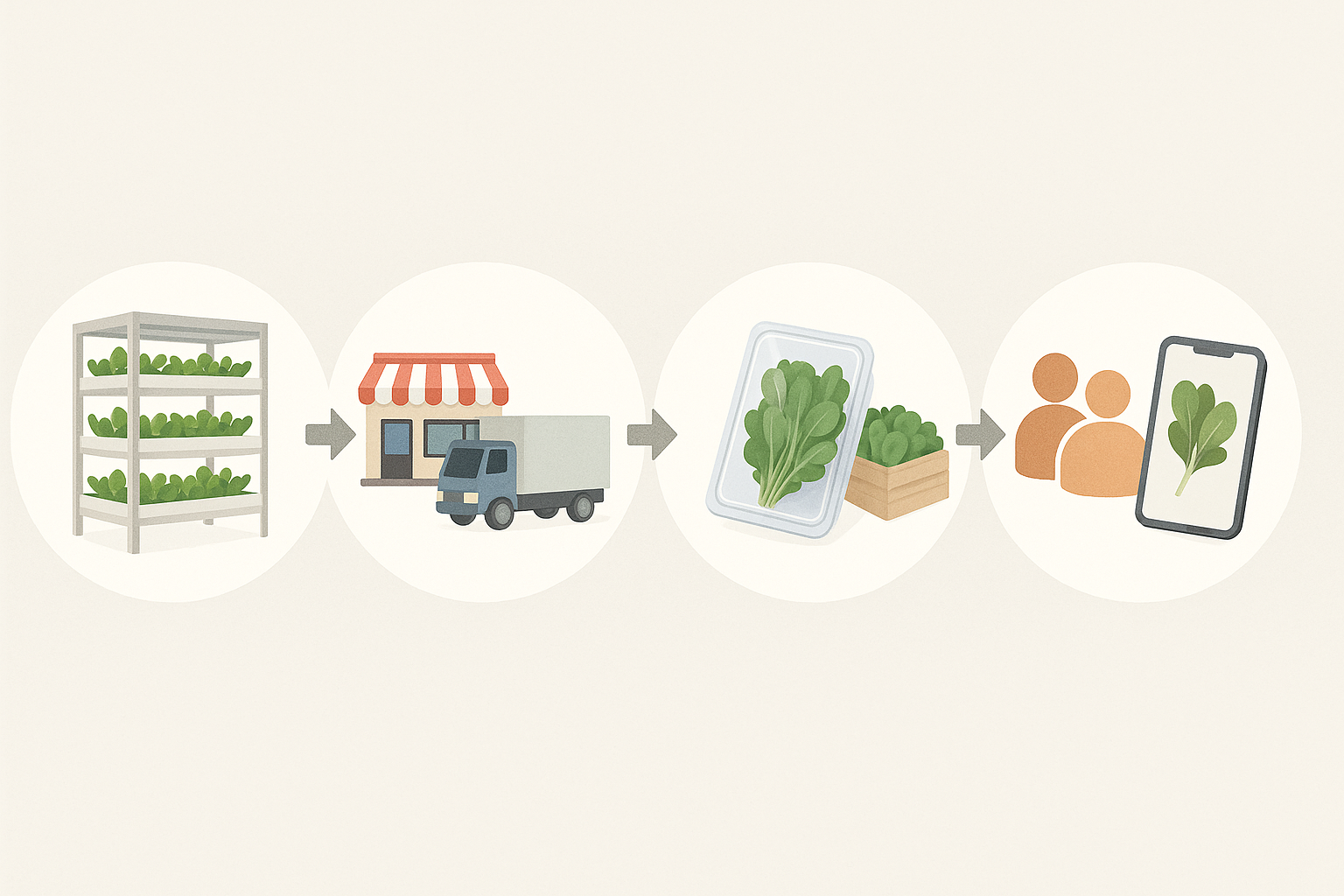
The future of food production is not only shaped by technology but also by how produce reaches consumers. Controlled Environment Agriculture (CEA) and vertical farming can generate fresh, consistent, and high-quality crops throughout the year. Yet without clear routes to market and carefully designed strategies, even the most advanced indoor farms will struggle to become commercially viable. Effective marketing approaches for vertical farm produce are therefore just as critical as the growing systems themselves, bridging the gap between the controlled environment and the consumer’s plate.
Why Marketing Matters for Indoor Farming
Marketing in this context is more than a matter of packaging or slogans: it involves understanding where produce fits in the food system, identifying customer needs, and creating efficient channels that connect farms with buyers. Indoor farms differ from conventional agriculture in several ways. They often grow smaller volumes of speciality crops such as microgreens, herbs, or salad leaves; they operate with higher production costs; and they emphasise freshness, traceability, and sustainability. These differences shape how products are positioned in the market. While traditional farms may rely on large wholesale contracts or commodity markets, vertical farms often succeed through niche branding, direct relationships, or innovative distribution models.
Understanding the Customer Landscape
Different customers value different aspects of indoor farm produce. Restaurants and high-end food service buyers often prioritise freshness, flavour intensity, appearance, and reliability of supply. Supermarkets and retail chains demand consistent volumes and adherence to strict quality and safety standards. Community groups, local markets, and subscription schemes may be more interested in supporting sustainable food production and local provenance. Students of agricultural economics sometimes describe this as segmentation: the process of recognising that not all buyers are the same, and therefore that selling strategies must be tailored.
For example, a vertical farm specialising in high-quality basil may choose to work directly with chefs who appreciate its aroma and flavour, while another producing mixed salad leaves might prefer to supply local shops where rapid turnover ensures freshness. Each choice entails a different set of marketing tools and messages, from professional branding and packaging to personal relationship-building with buyers.
Routes to Market: From Local Sales to Wholesale
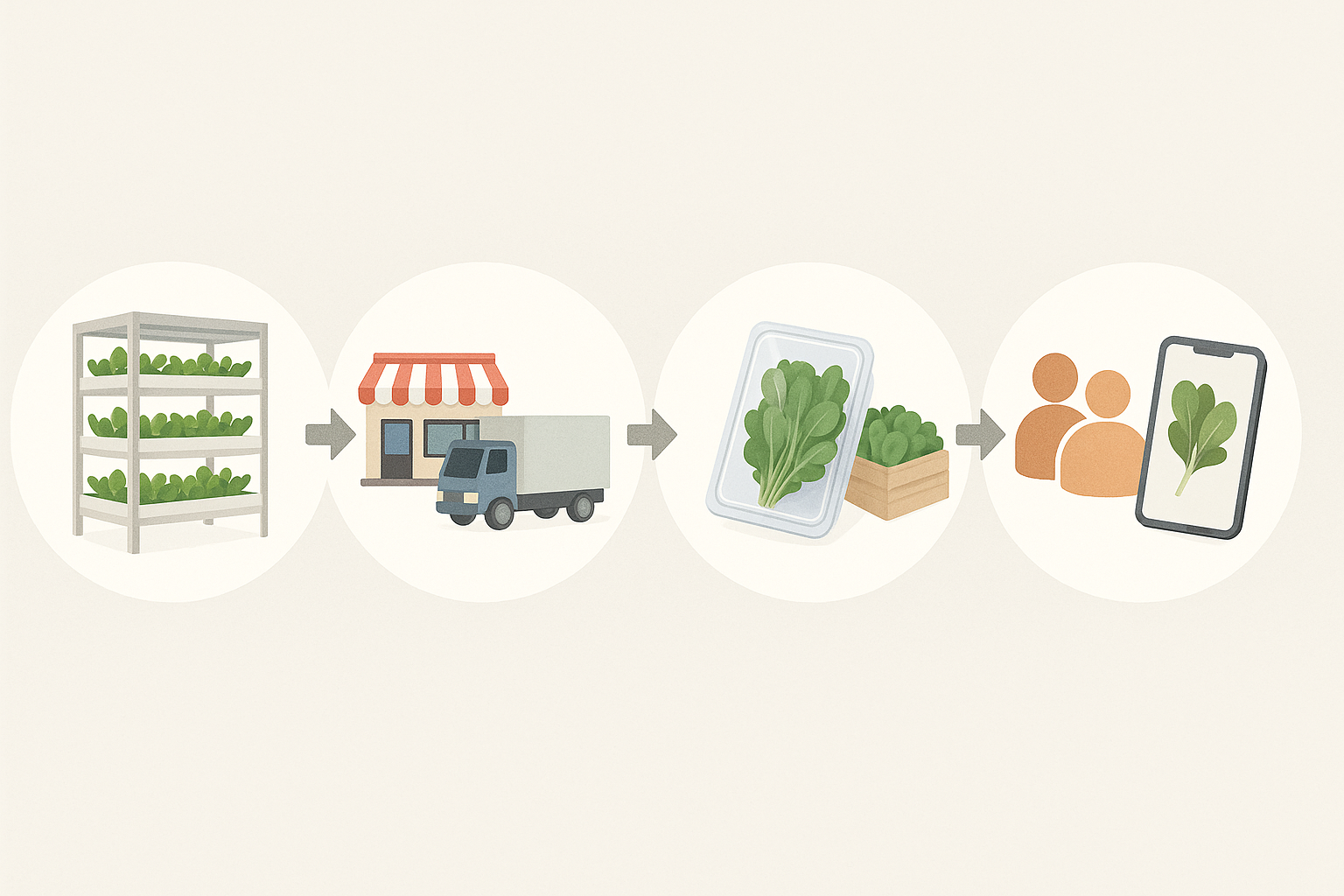
Indoor farms typically have three broad routes to market. The first is direct-to-consumer sales, which can involve farmers’ markets, farm shops, or subscription boxes. This option provides higher margins per unit sold but demands more investment in branding, logistics, and customer engagement. The second is business-to-business sales, such as supplying restaurants, retailers, or hospitality venues. This approach requires reliability and standardisation but offers more stable demand. The third is integration into wider wholesale or distribution networks, which can move large volumes but often reduce the grower’s influence over how products are presented and priced.
Some vertical farms combine these routes, balancing the stability of contracts with the flexibility and visibility of direct sales. For instance, an indoor farm might commit half its output to a supermarket chain under contract, while selling speciality herbs through a local online platform. This dual strategy mitigates risk while ensuring brand recognition.
The Role of Storytelling and Provenance
Although CEA products often command higher production costs, consumers are increasingly prepared to pay a premium for food that carries a strong story. Provenance, freshness, and environmental responsibility can all be used to differentiate produce from vertical farms. In practice, this may involve transparent labelling, farm tours, or digital traceability systems that allow customers to learn about where and how crops are grown.
A farmer might emphasise the absence of pesticides, the year-round availability of fresh greens, or the use of renewable energy in production. These narratives must be authentic: overstating sustainability claims risks reputational damage. The academic literature on food marketing stresses that credibility and trust are central to consumer acceptance. For vertical farms, this often translates into honest communication and visible demonstration of production methods.
Packaging, Branding, and Presentation
The physical presentation of crops also plays a major role. In many cases, vertical farm produce is perishable and delicate, requiring careful packaging that maintains freshness while minimising environmental impact. Compostable or recyclable materials are increasingly favoured, although they can add cost. Branding decisions, such as the choice of name, design, or colour scheme, influence how produce is perceived on shelves or menus. A professional, consistent brand identity reassures buyers about quality and reliability.
Academic studies on consumer behaviour suggest that small visual cues, such as clean design or clear messaging about freshness, can significantly influence purchasing decisions. Indoor farms therefore benefit from investing early in packaging and brand identity, even when starting at a small scale.
Pricing Strategies and Value Propositions
Setting prices for indoor farm crops requires careful balance. On the one hand, costs of production are often higher than those of traditional field-grown crops; on the other, customers will only pay what they perceive as fair. Effective marketing approaches for vertical farm produce therefore include both cost-based and value-based pricing. In cost-based pricing, the focus is on recovering expenses and achieving a margin; in value-based pricing, the emphasis is on the premium customers assign to freshness, sustainability, or locality.
For example, microgreens grown in an urban farm may be priced significantly higher per kilogram than lettuce grown in open fields. Yet the microgreens are not competing directly with field lettuce: they are positioned as a speciality product with a distinct role in culinary presentation. Such framing helps to justify higher prices while aligning with customer expectations.
Digital and Community Engagement
Online platforms play an increasingly important role in marketing vertical farm produce. Websites, social media channels, and e-commerce marketplaces allow farms to reach customers directly, provide updates, and demonstrate transparency. Digital content such as short videos showing the growing process or recipes using the produce can create stronger customer relationships.
Community engagement also matters. Partnerships with local schools, food banks, or sustainability initiatives can build goodwill and awareness. Academic research on local food systems highlights that community integration can enhance both brand reputation and customer loyalty, particularly for urban farms.
The Challenge of Scaling Up
As vertical farms expand, their marketing strategies must adapt. Selling directly to a dozen restaurants may work at a small scale, but supplying hundreds of outlets demands logistical sophistication, formal contracts, and potentially partnerships with distributors. This shift from artisanal to commercial operation requires indoor farmers to professionalise not only their production but also their sales operations. Consistency of supply, traceability, and compliance with food standards regulations become critical at scale.
Conclusion
The success of vertical farming depends not only on technological innovation but also on effective integration into the food economy. Indoor farms that invest in clear marketing strategies, strong relationships with buyers, and credible storytelling are more likely to secure sustainable markets. Effective marketing approaches for vertical farm produce involve more than promotion: they encompass customer segmentation, distribution choices, branding, pricing, and community engagement. When combined, these factors transform indoor farming from an interesting experiment into a commercially viable and resilient part of the food system.