Controlled Environment Agriculture (CEA) relies on precise environmental regulation to optimise plant performance. At the heart of this approach is CEA climate and environmental control: a critical discipline that governs temperature, humidity, and carbon dioxide (CO₂) levels to support consistent, high-quality crop yields. In vertical farms and other enclosed growing systems, managing these core climate variables is not only a matter of operational efficiency; it underpins the very viability of the system as a substitute for, or supplement to, conventional agriculture.
Why Environmental Control Is Foundational in CEA
Unlike traditional field agriculture, CEA eliminates external variables by placing crops within fully or partially enclosed spaces. This autonomy creates the opportunity to control environmental parameters with precision; however, it also introduces new demands. Without external weather fluctuations, the burden of temperature regulation, humidity moderation, and atmospheric gas balance falls entirely on the grower and the system’s engineered infrastructure.
Plant physiology is deeply affected by the surrounding environment. Stomatal function, transpiration rate, photosynthetic efficiency, and nutrient uptake are all responsive to the temperature-humidity-CO₂ nexus. If even one of these parameters falls outside optimal bounds, growth slows, susceptibility to pathogens increases, and yields decline. Managing all three in concert is therefore essential for production success.
Temperature: The Catalyst of Metabolic Activity
Temperature controls the metabolic rate of plants. For every 10°C increase, metabolic processes roughly double in speed, up to a physiological limit. This principle, known as the Q10 coefficient, underlines the importance of thermal regulation. In most vertical farming contexts, the target temperature range for vegetative growth in crops such as leafy greens typically lies between 20°C and 24°C, with some fruiting crops requiring warmer conditions. However, these ranges are not absolute; they must be matched to species-specific developmental stages and lighting regimes.
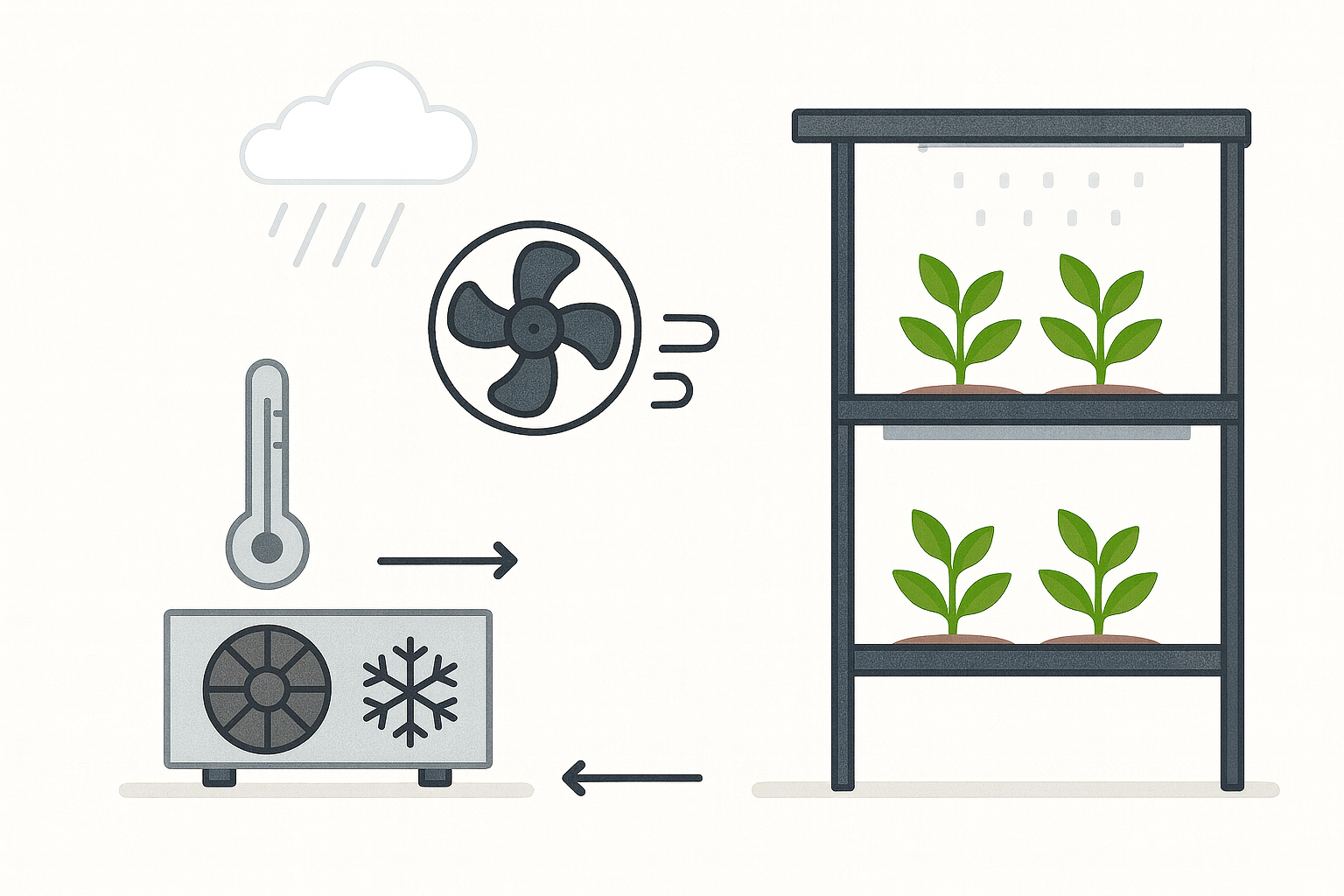
Thermal load in CEA systems is strongly influenced by artificial lighting, particularly in LED-intensive vertical farms where radiant heat is often minimal but ambient heat can accumulate rapidly. Poor temperature regulation can result in heat stress, bolting, or inefficient respiration, where plants expend more energy than they generate. Cooling systems, whether passive ventilation, active HVAC units, or water-cooled LED arrays, must therefore be carefully integrated into facility design and operation.
Temperature also interacts directly with other variables. For example, warmer air holds more water vapour, shifting the relative humidity and thereby altering the vapour pressure deficit (VPD), a key determinant of plant transpiration. This interdependence makes single-variable adjustments ineffective unless considered holistically.
Humidity: Balancing Transpiration and Disease Risk
Humidity management is often more nuanced than temperature control, particularly because it directly affects both plant health and system hygiene. Relative humidity (RH) governs the vapour pressure gradient between the leaf interior and the surrounding air; this gradient drives transpiration, through which plants regulate temperature, draw up nutrients, and sustain gas exchange.
Optimal RH levels typically range from 50% to 75%, though precise targets depend on the crop species, growth stage, and the facility’s airflow dynamics. Low humidity can lead to excessive transpiration and nutrient imbalances, while high humidity can suppress transpiration and encourage fungal pathogens such as Botrytis cinerea or Pythium.
In vertical farms with stacked layers, localised humidity pockets can form, especially if airflow is inconsistent. Horizontal airflow fans, vertical ducting, and compartmentalised dehumidifiers are used to ensure homogeneity. More sophisticated systems may use sensor arrays linked to VPD calculators to dynamically modulate both temperature and humidity via integrated control systems.
Dehumidification is often an energy-intensive process, particularly in cooler climates or sealed indoor farms. Heat recovery from the condensation process, along with real-time VPD mapping, can significantly improve efficiency and crop quality.
CO₂: The Invisible Yield Limiter
Carbon dioxide enrichment is one of the most powerful, yet frequently misunderstood, tools in the CEA climate control arsenal. As the primary substrate for photosynthesis, CO₂ directly limits the rate at which plants convert light energy into biomass. Under standard atmospheric conditions (~400 ppm CO₂), many fast-growing crops are already operating below their photosynthetic potential. Enrichment to levels between 800 and 1,200 ppm can lead to yield increases of 20% to 30% in certain crops, provided that light and nutrient availability are not limiting.
However, CO₂ enrichment must be managed with caution. In closed systems, concentrations can fall rapidly during the photoperiod as plants consume CO₂, particularly under high light intensity. Maintaining elevated levels therefore requires active supplementation, commonly through compressed gas tanks, combustion generators (if heat is also needed), or on-site CO₂ scrubbing and recirculation systems.
Sensor placement and calibration are critical. CO₂ is denser than air and can stratify in poorly mixed environments, leading to pockets of low or excessive concentration. Uniform distribution ensures that enrichment benefits all plant layers equally; a particular challenge in vertical farms with high racking density. Moreover, CO₂ enrichment is only effective during the light period; at night, respiration dominates and enrichment is both unnecessary and potentially harmful.
Integrated Control: Towards Climate Synchronisation
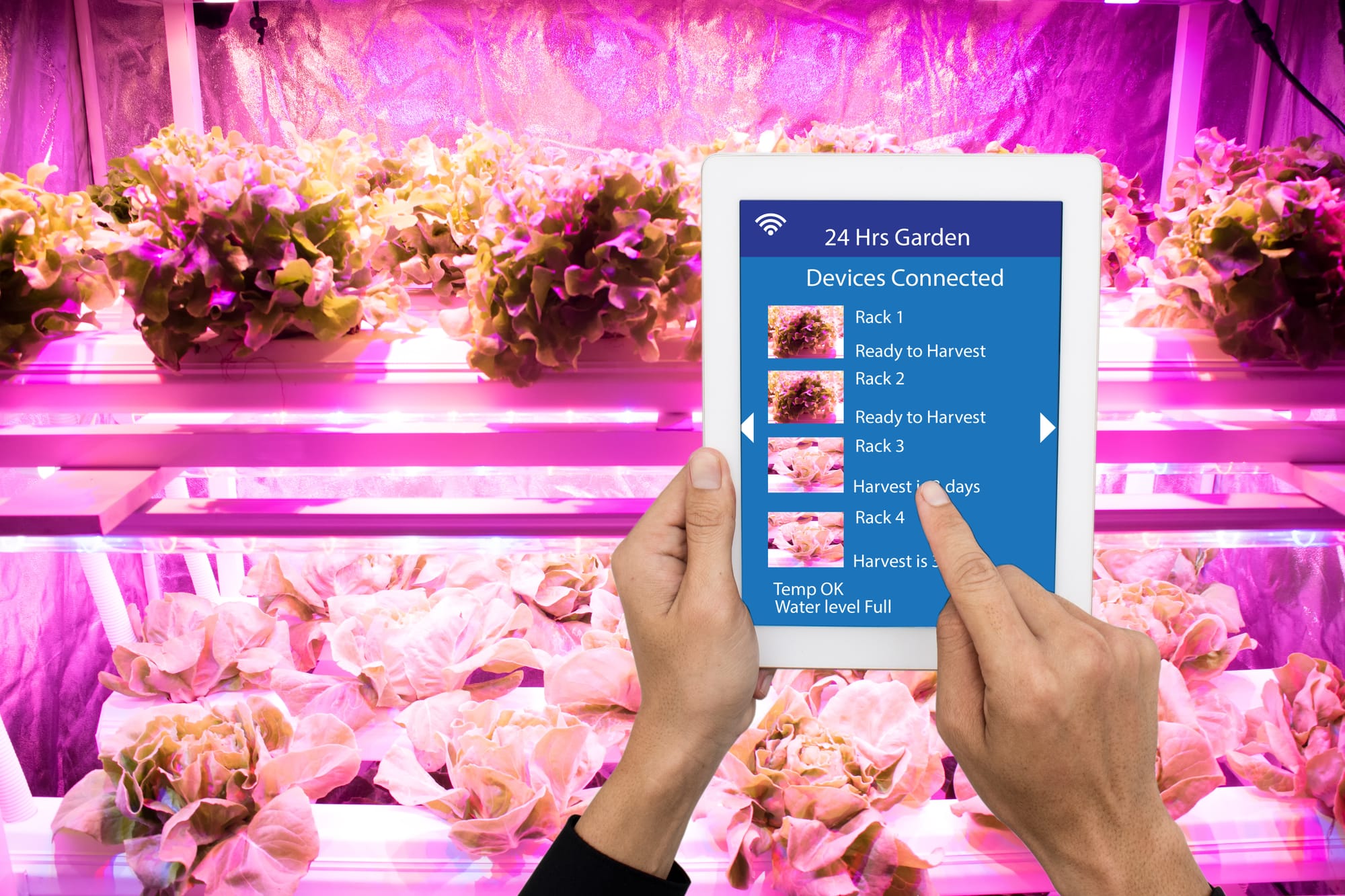
The most effective CEA operations treat temperature, humidity, and CO₂ as an interdependent triad. Environmental control systems must not only monitor these variables independently but must also integrate them into a unified logic that reflects plant physiological needs. This requires real-time sensor data, predictive algorithms, and automated mechanical systems (fans, dampers, chillers, heaters, dehumidifiers, and CO₂ injectors) working in concert.
Energy efficiency and cost management are also major concerns. Environmental control can account for over 50% of operational energy use in some vertical farms. Consequently, the most advanced systems employ dynamic control strategies that adjust settings in response to real-time plant growth models, external weather data, and energy pricing forecasts. Machine learning approaches are beginning to supplement traditional PID (Proportional–Integral–Derivative) controls, offering promise for predictive adjustments and fault detection.
The future of climate control in CEA may lie in increasingly autonomous, sensor-rich systems that use plant feedback as well as environmental data. Phenotyping tools such as infrared thermography, chlorophyll fluorescence imaging, and sap flow sensors are being explored to allow systems to respond to plant status in real time rather than rely solely on environmental proxies.
Conclusion: Climate as the Engine of Productivity
In controlled environment agriculture, managing temperature, humidity, and CO₂ is not a background task: it is central to the operation's success. CEA climate and environmental control systems create the physical conditions under which crops thrive or fail. Achieving the correct balance demands not only sophisticated equipment, but also a clear understanding of plant physiology and system dynamics.
As vertical farming matures, those operations that invest in integrated, responsive, and efficient climate management will be best placed to deliver consistent, high-quality produce year-round. This page offers the foundation for exploring the specific methods and technologies used to achieve that goal in practical, cost-effective ways.