Understanding who to sell to is one of the most important decisions for any controlled environment agriculture (CEA) or vertical farming venture. Identifying the right audience not only ensures that produce finds a willing market, but also shapes the type of crops grown, the scale of operations, and the business model adopted. Target customers for vertical farming are often defined less by broad demographics and more by their specific needs: freshness, sustainability credentials, year-round supply, or unique crop varieties. This page explores why customer targeting matters, how different segments can be approached, and the broader implications for profitability and resilience.
Why customer targeting matters
Vertical farming is resource intensive, with high capital and operational costs compared to open-field production. This makes it essential to sell to customers who are prepared to pay a premium for quality, reliability, or distinct attributes. Unlike commodity farming, where large volumes are traded at wholesale prices, vertical farms tend to succeed when they align with buyers who value differentiation: consistent taste, local provenance, reduced food miles, or assured supply during off-season periods. Clear customer targeting reduces the risk of overproduction, wasted crops, or unsustainable pricing.
Key customer segments in context
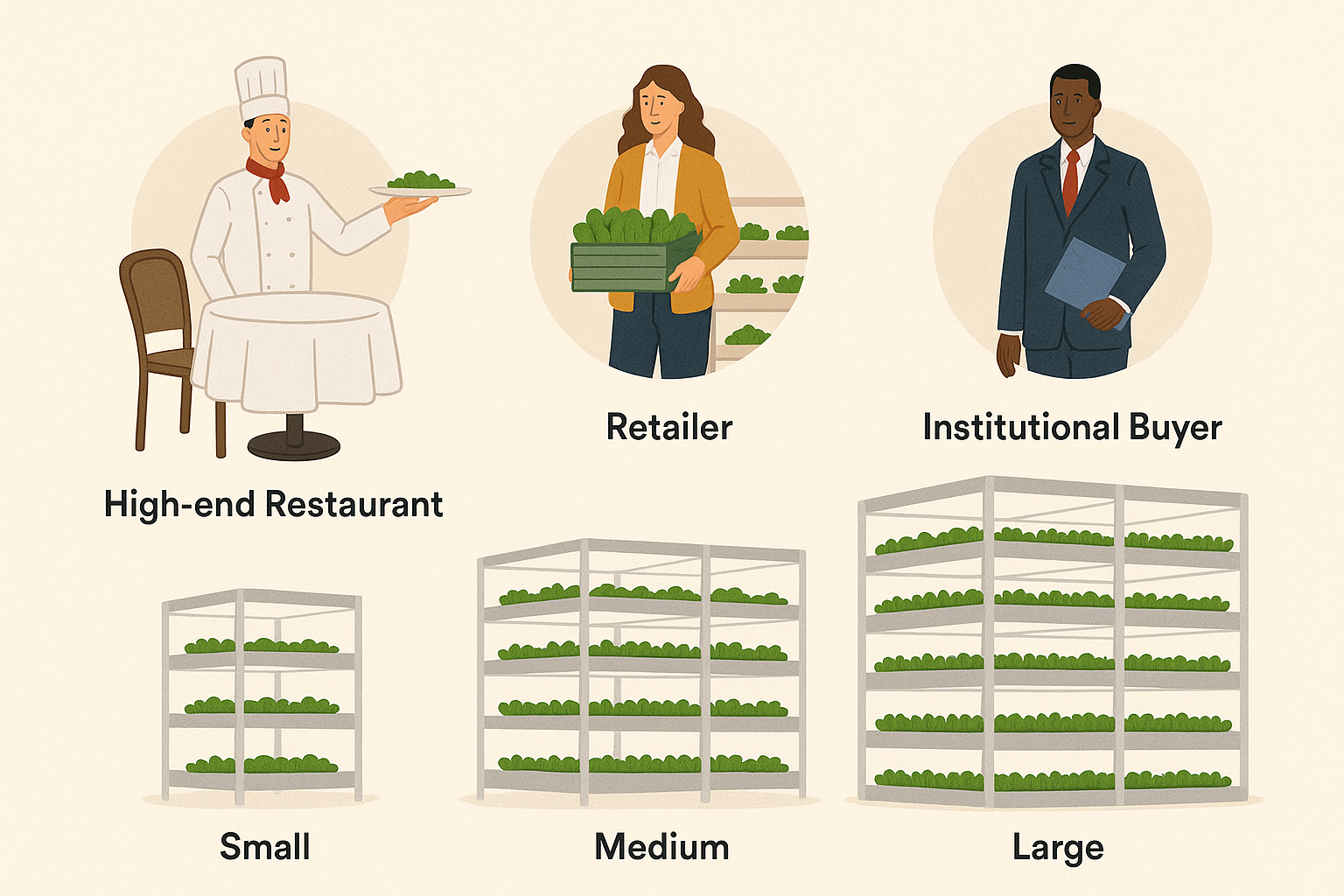
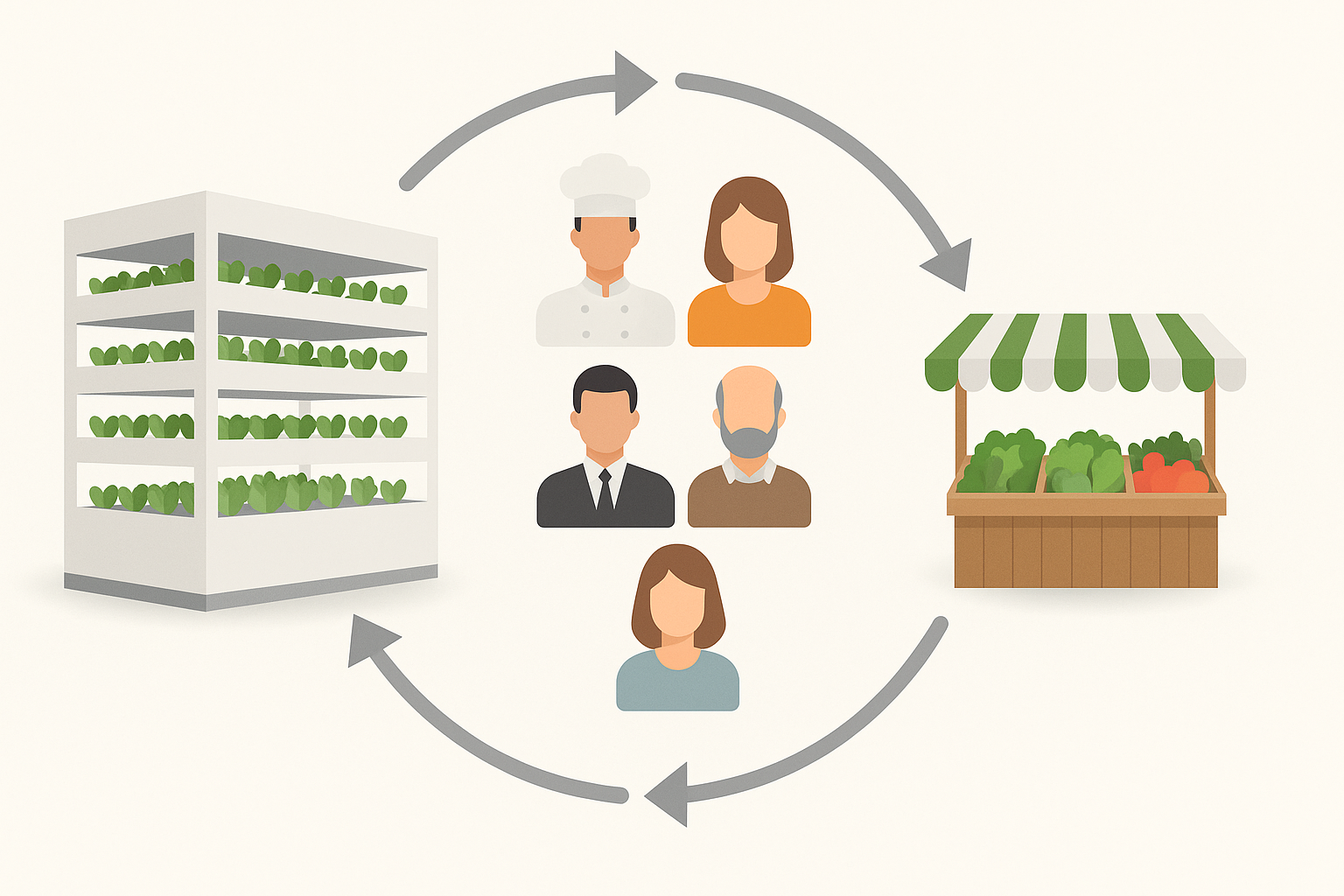
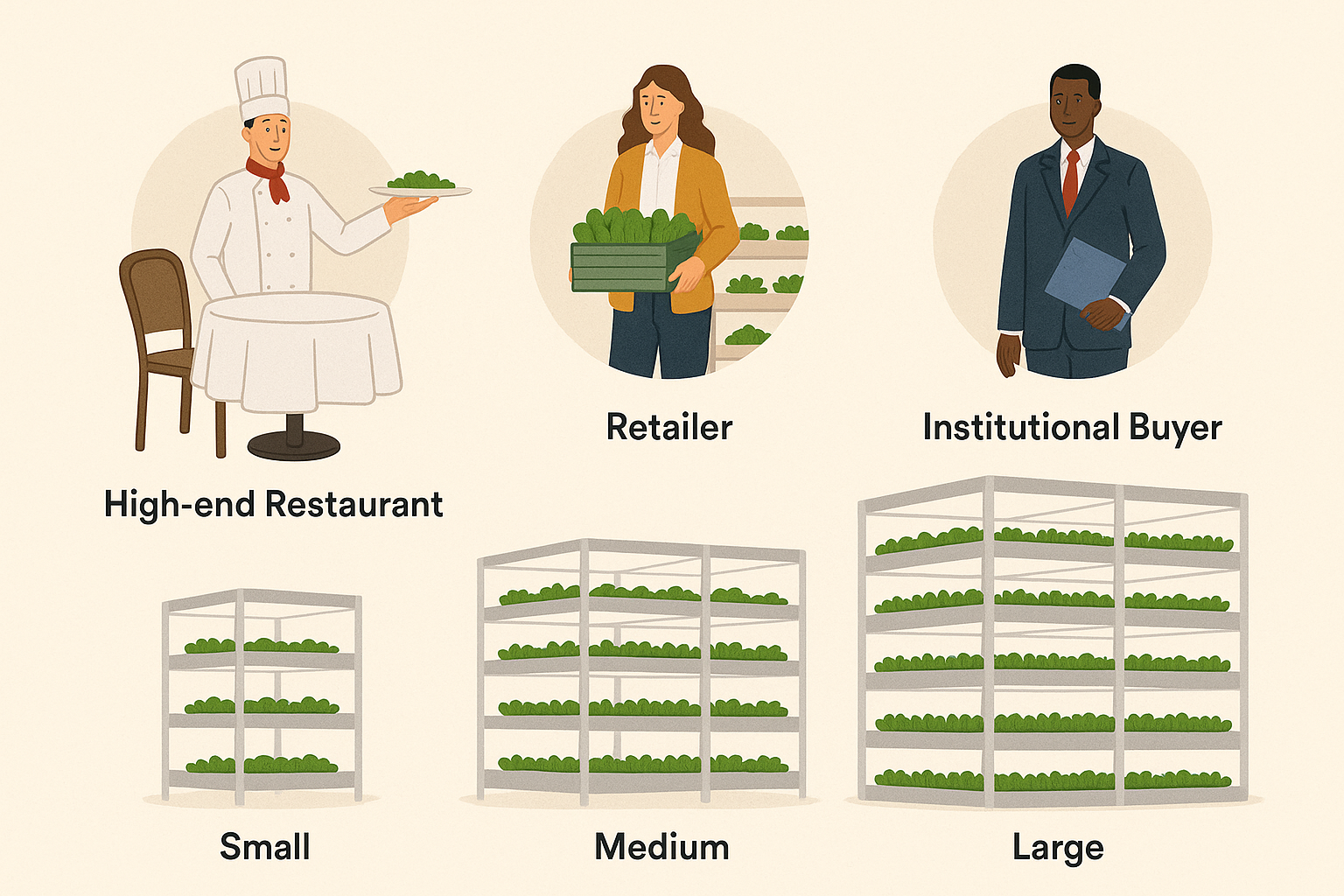
Although customer profiles vary by geography and farm scale, several common groups emerge across Europe, North America, and increasingly in Asian markets. High-end restaurants often form a primary outlet: chefs value consistent flavour and appearance, alongside the ability to request customised varieties or microgreens that are difficult to source elsewhere. Retailers represent another major segment, particularly supermarkets keen to demonstrate sustainability commitments and secure local year-round produce for consumers. In urban settings, direct-to-consumer sales through subscription models or farmers’ markets have also become viable, particularly for small farms cultivating salad leaves and herbs. At the larger end of the spectrum, institutional buyers such as hospitals, schools, and corporate canteens may represent steady demand once reliability and price competitiveness are demonstrated.
Balancing volume, value, and logistics
Targeting the right customers is not solely about identifying interest. A vertical farm must balance the scale of demand with its production capacity, while accounting for transport and handling. Supplying restaurants, for example, offers high margins but requires flexibility and frequent small deliveries. Supplying retailers involves larger, more stable contracts but with rigorous quality and safety standards. Direct-to-consumer channels provide strong branding opportunities but often demand investment in marketing and logistics infrastructure. In each case, matching the farm’s physical output with the customer’s purchasing pattern is as important as the relationship itself.
The role of sustainability and provenance
Consumers increasingly make purchasing decisions based on more than price. For vertical farms, attributes such as reduced pesticide use, efficient water consumption, renewable energy integration, and local employment can strengthen the customer relationship. However, sustainability narratives must be backed by evidence: life cycle assessments, transparent carbon accounting, or third-party certification can provide credibility. Target customers for vertical farming are often those who care about provenance and are prepared to invest in products that align with their values. This has been particularly visible in UK retail, where provenance labelling and local sourcing commitments form part of wider corporate environmental strategies.
Examples from practice
Urban farms in London, Paris, and Copenhagen have successfully targeted restaurants, building strong reputations through exclusive supply agreements. In the United States, large-scale vertical farms such as AeroFarms and Plenty have pursued contracts with major supermarkets, focusing on reliability and branding. In Singapore, state-backed vertical farming initiatives have supplied institutional buyers to enhance food security. Each case illustrates the principle that market alignment, rather than technology alone, determines commercial success.
Strategic implications for new entrants
For those considering investment or start-up ventures, early clarity on the customer base is essential. The crops selected, the growing system design, and even the location of the farm should be chosen with the intended buyers in mind. A farm targeting restaurants may prioritise proximity to urban centres, while one targeting retailers may need larger facilities near distribution hubs. Similarly, the decision to focus on high-value microgreens or mainstream salad leaves depends on whether the customer values exclusivity or scale. By embedding customer needs into business planning from the outset, growers reduce the risk of strategic misalignment and improve long-term resilience.
Conclusion
Targeting customers for vertical farming is not a one-off marketing exercise but an ongoing strategic commitment. The right audience provides not only sales but also feedback that shapes crop choices and innovations. As the sector matures, customer targeting will become ever more important, particularly as larger farms compete with traditional horticulture and smaller farms carve out niche markets. Successful ventures will be those that identify their customers early, understand their priorities, and design operations around delivering consistent value. In this way, vertical farming can shift from technological novelty to a commercially and socially integrated component of modern food systems.