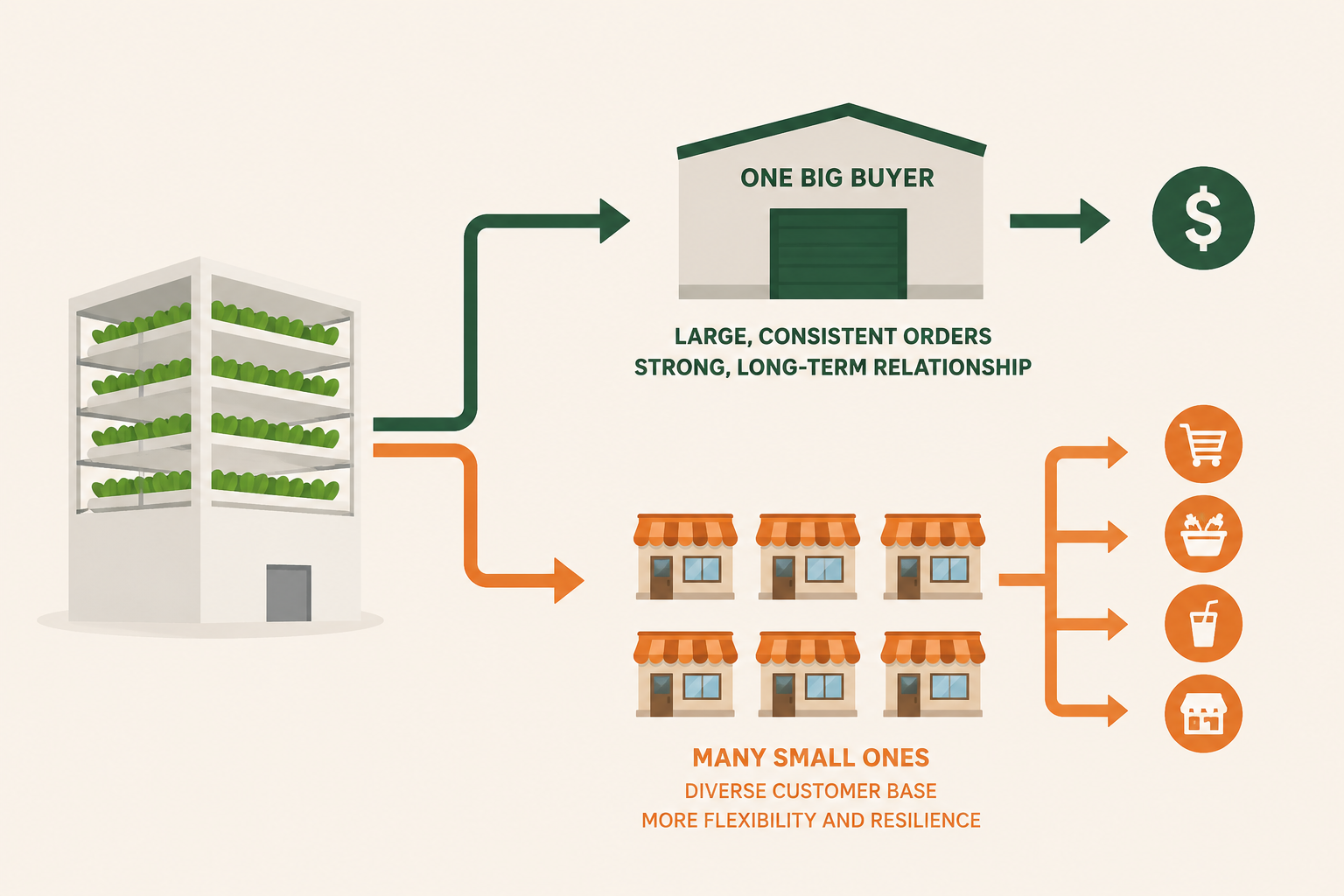
Designing a vertical farm customer strategy is as critical as perfecting the growing system itself. For many prospective growers, the central dilemma is whether to sell produce to a single large buyer, such as a supermarket chain or a major distributor, or to pursue a more diversified approach through many smaller customers, such as local restaurants, cafés, greengrocers, or direct-to-consumer models. Both approaches carry opportunities and risks; understanding these is essential for anyone considering an investment in CEA or vertical farming.
This question is not simply about sales, it is about the long-term resilience, scalability, and financial security of an indoor farming venture. Whether or not a farm succeeds often depends on how well its commercial strategy matches its production capacity, costs, and the realities of the market it seeks to serve.
The Appeal of One Large Buyer
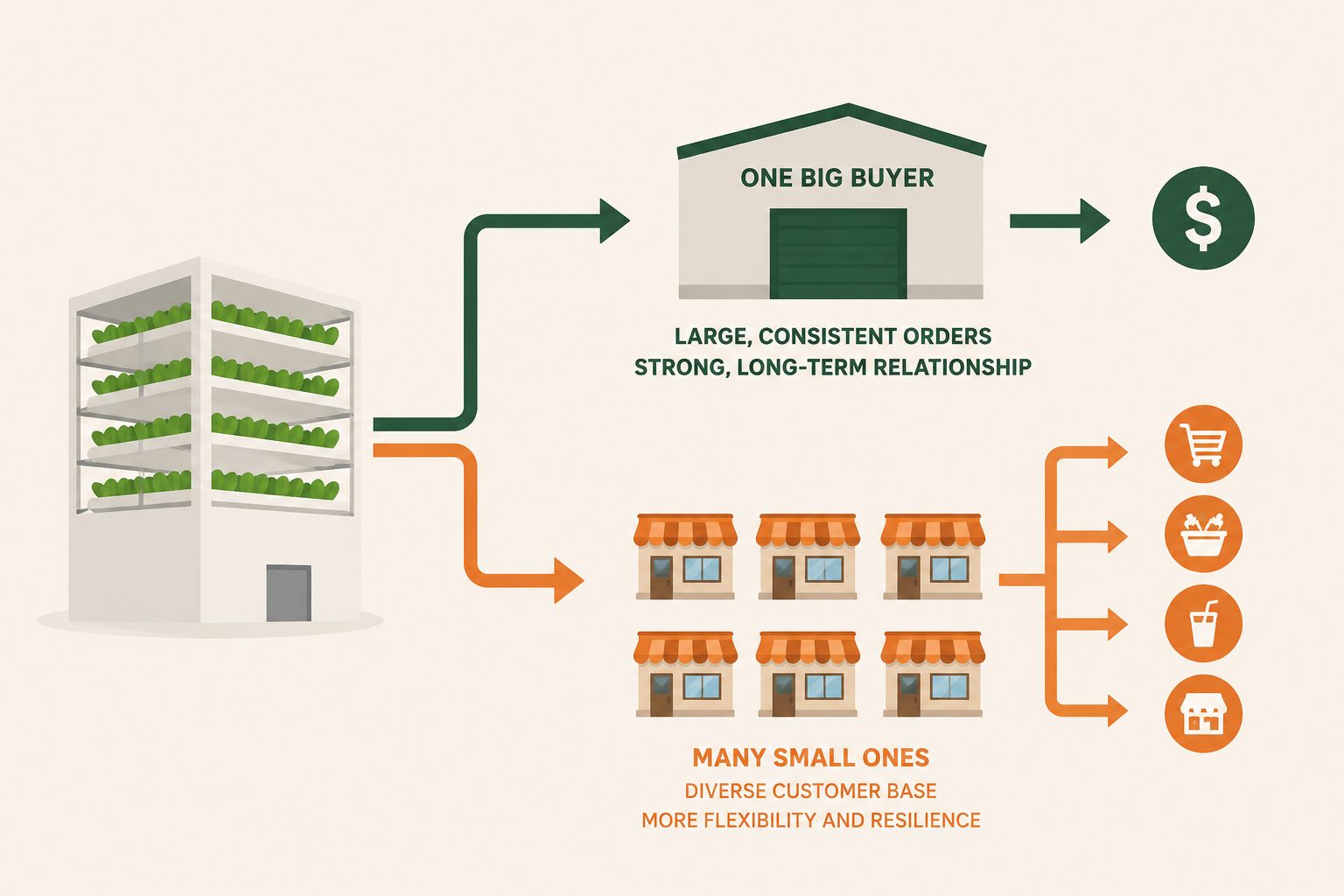
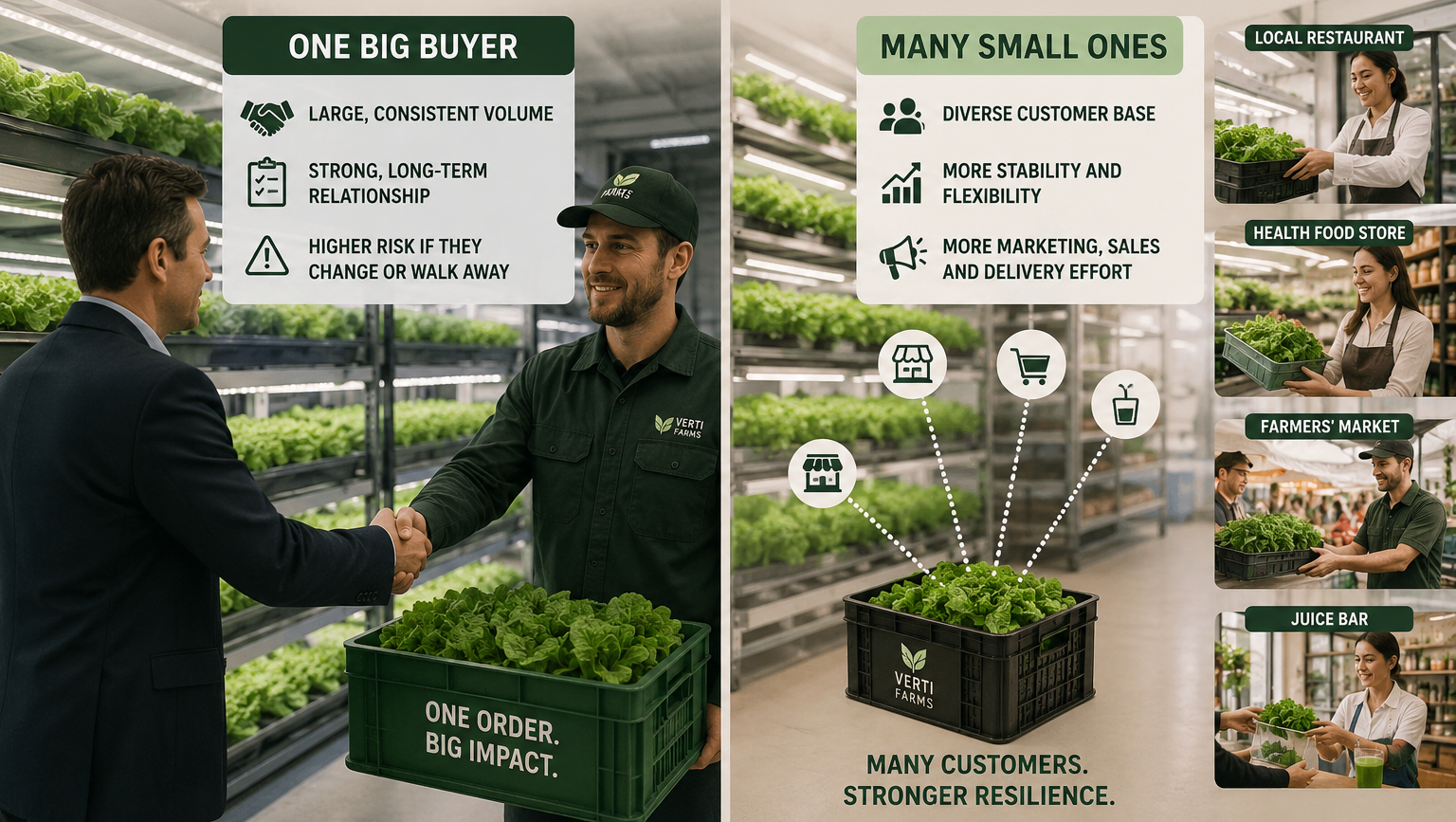
Securing a contract with a large buyer can be extremely attractive for a vertical farm operator. Such agreements may provide a guaranteed volume of sales, predictable income, and a streamlined supply chain that allows the grower to focus on production rather than the logistics of managing many smaller accounts. This stability can help underpin investment cases when raising finance, since lenders and investors often value the perceived security of long-term contracts.
However, there are challenges. Large buyers frequently demand lower prices due to their purchasing power, and may insist on strict quality, packaging, and delivery standards. Meeting these expectations can raise costs and reduce profit margins. Dependence on a single customer also creates risk: if that relationship ends, the farm could lose its entire market overnight. For smaller or new enterprises, this concentration risk can be especially destabilising.
The Benefits of Many Smaller Customers
Selling to multiple smaller customers offers greater flexibility and resilience. A vertical farm supplying a mix of restaurants, farm shops, subscription boxes, and community food networks spreads risk across different channels. If one customer reduces orders or ceases trading, the overall business impact is limited. Smaller buyers may also value freshness, provenance, and sustainability over rock-bottom prices, allowing growers to command a premium for high-quality crops.
This approach can, however, be more complex to manage. Multiple buyers require more time spent on sales, delivery logistics, and customer service. Order volumes may be inconsistent and payment terms can vary widely. It demands a robust operational structure that can balance marketing, distribution, and relationship management alongside the technical tasks of crop production.
Aligning Strategy with Farm Size and Scale
Choosing between one large buyer and many smaller customers is rarely a purely theoretical exercise. Much depends on the size of the farm and the economies of scale it can achieve. A large facility with significant production capacity may find it difficult to sell all its produce through small local outlets alone, making larger contracts essential. Conversely, a smaller urban farm located close to restaurants and speciality retailers may thrive on diverse, short supply chains that emphasise quality and personal connection.
It is also worth considering the farm’s growth trajectory. Many growers begin by supplying local outlets before scaling up to pursue larger contracts once capacity and operational reliability are proven. This stepwise approach can build brand reputation and provide valuable experience before entering high-volume supply chains.
Risk, Resilience, and Market Volatility
Market volatility is another important consideration. The food sector is vulnerable to changes in consumer preferences, inflationary pressures, and supply chain shocks. A vertical farm customer strategy that relies solely on one buyer may expose the business to sudden and severe impacts if that buyer changes sourcing policies or renegotiates prices. By contrast, a diversified portfolio of smaller buyers spreads exposure and allows more flexibility to adjust to market conditions.
That said, diversification should not be confused with fragmentation. Managing too many very small customers without adequate systems in place can strain resources and reduce profitability. Effective strategy requires balance: spreading risk without overcomplicating operations.
Policy and Regional Context
In the UK and across Europe, food policy is increasingly attentive to local sourcing, sustainability, and shorter supply chains. Public procurement, school meals, and local authority food strategies are beginning to open opportunities for small and medium-scale producers, including vertical farms. At the same time, supermarket consolidation and the dominance of large distributors remain central features of the market. Understanding these dynamics is essential when planning customer strategies, as policy shifts can reshape demand patterns.
Conclusion
There is no universal answer to whether vertical farms should prioritise one big buyer or many small ones. The most effective approach depends on production scale, financial goals, market positioning, and the grower’s tolerance for risk. Large buyers offer volume and stability but can enforce tight margins and create dependency; smaller buyers allow flexibility, closer community connections, and potential price premiums, but require more intensive management.
For most new entrants, a mixed strategy may prove most resilient: building relationships with smaller customers to establish reputation and cash flow, while gradually pursuing larger contracts as production systems and financial capacity mature. Ultimately, a successful vertical farm customer strategy is one that aligns with the realities of the farm’s resources, the needs of its local market, and the broader shifts in food systems and consumer expectations.