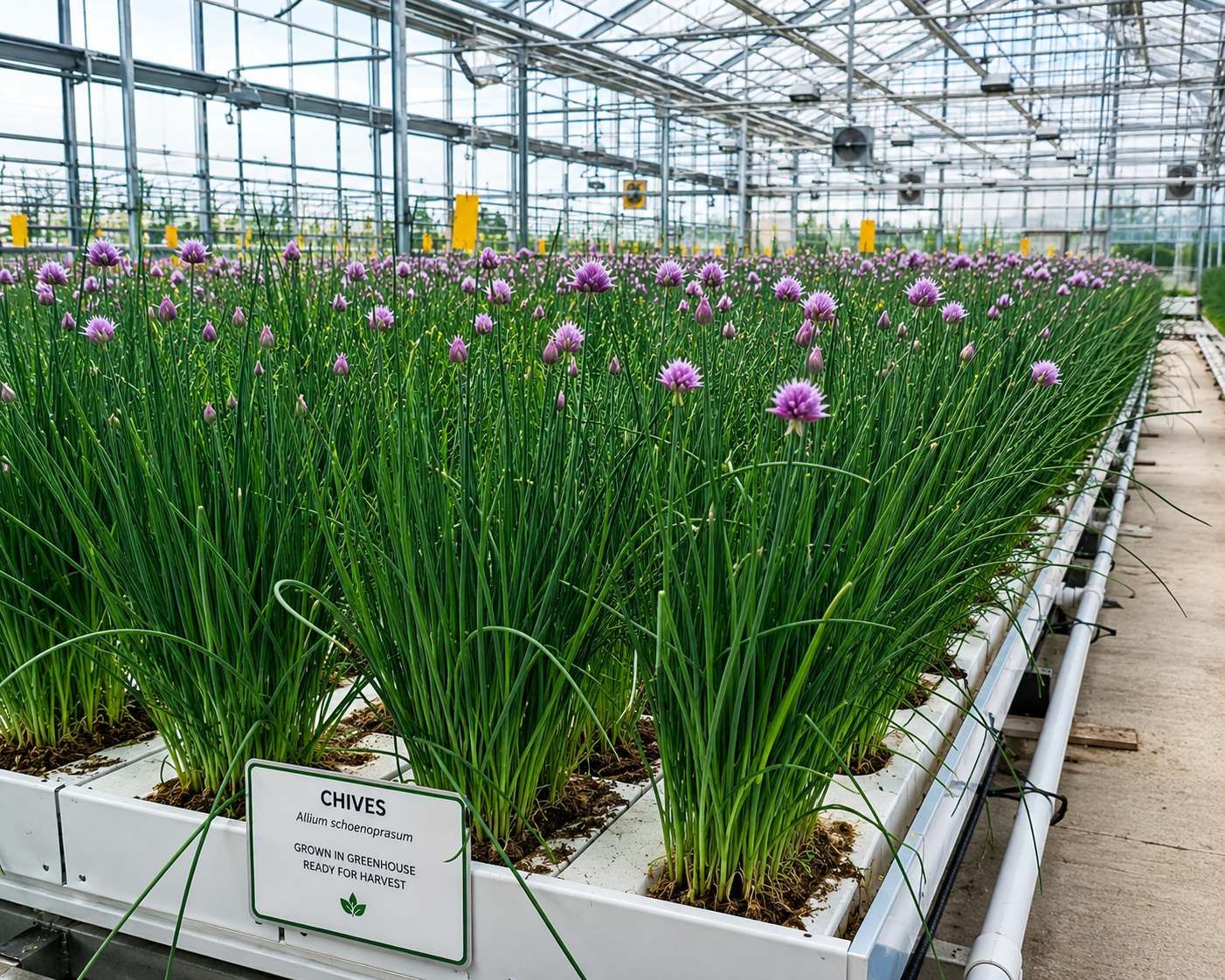
Chives (Allium schoenoprasum) is a perennial plant, meaning its lifespan lasts longer than 2 years, found in the wild across North America and Eurasia. It is a member of the genus Allium, one of the largest of all plant genera with over 1,000 valid species. Other members of this genus include cultivated plants such as garlic, onions, leeks, scallions and shallots. It should also be noted that chives are not the same as garlic chives, Allium tuberosum.
They are commonly used as a herb in cooking, as both the leaves and flowers are edible. The plants have a taste similar to onions, but substantially more mild. Both the immature, unopened flower buds and the long curly shoots (known as staves) are usually diced and used in a variety of dishes such as omelettes, soups, sauces and so on.
The staves are often added to cream cheese, and sour cream and chive is a common condiment and flavouring. In France, chives are considered part of the “Fines herbes”, a combination of herbs that are considered mainstays of French cuisine (the other herbs being tarragon, chervil and parsley).
Chive production in controlled environments (brief literature review)
High salinity levels have been shown to have a negative impact on the yield of chives both when grown in soil and using hydroponics. In an experiment using soil and irrigation water of different salinity values from 0.38 to 8.0 dSm−1, chives were found to have a threshold of 1.13 dSm−1. At values higher than this, the relative yield decreased by 6.19% per unit increase of salinity [1].
This finding is supported by results from a hydroponic-based experiment in which chives were grown in nutrient solutions ranging from 1.0 to 5.0 1.13 dSm−1. As the salinity increased, it negatively impacted plant growth and the concentration of various compounds [2]. Priming the seeds with hydrogen peroxide was shown to increase plant yield, but higher salinity values negated its impact, as the highest bulb length was achieved using the highest hydrogen peroxide concentration tested (0.60 mM) with the lowest electrical conductivity value (1.0 dSm−1) [2]. Overall, these results suggest that using a low salinity nutrient solution of 1.0 dSm−1 or less is optimal for growing chives.
Different ratios of red and blue lights have been tested for growing chives and were found to have only a limited impact. Using a ratio of red and blue lights of 2:1 did result in significantly higher hue angle and Chlorophyll a content, but also resulted in significantly lower total phenolic content [3]. As such, the specific light spectra used to grow chives does not seem especially impactful, though research on this topic does seem to be somewhat limited.
The impact of photoperiod on chives is complex, especially as it interacts with the temperature used. One study investigated the impact of both day length and temperature on chives and day length on the concentration of several compounds in various plants, including chives. While, overall, both factors only had a limited impact on chives, they did impact the concentration of specific compounds. In some case, such as citric acids, the impact of different day lengths varied depending on whether a low or high temperature was used [4]. As such, finding the right combination of day length and temperature will depend entirely on which compounds you want to promote in the microgreens.
The best growth medium for chives is also difficult to assess. One study investigated four different fibre mats for growing chives, specifically BioStrate, hemp, jute, and MicroMat. They conducted two repeats of the study and the results showed wide variation between the experiments. For example, in experiment 1 there was very little difference in fresh and dry shoot weight, with hemp producing the highest fresh weight and MicroMat the lowest. However, in experiment 2 there was much more variety, with hemp and micromat being reversed for fresh shoot weight [5]. As such, further investigation is needed to determine the best substrate for this plant.
Grower insights:
Chives contain sulphur compounds which act as a repellent to most insects, though their flowers attract bees. As such, they can also be cultivated as a form of pest control, though they are vulnerable to the leek moth larvae, which bore into the leaves and bulbs of the plant. The Romans also used chives for medicinal purposes, believing they could relieve sore throat and sunburn, increase blood pressure and act as a diuretic.
References
- Arslan, H., Kiremit, M.S. and Güngör, A., 2018. Impacts of different water salinity levels on salt tolerance, water use, yield, and growth of chives (Allium schoenoprasum). Communications in Soil Science and Plant Analysis, 49(20), pp.2614-2625.
- Silva, P.F.D., Santos, B.D.B.D., Dantas Neto, J., Melo, A.S.D., Matos, R.M.D., Bonou, S.I., Silva, T.J.A.D., Bonfim-Silva, E.M., Berilli, A.P.C.G. and Duarte, T.F., 2023. Effect of electrical conductivity levels and hydrogen peroxide priming on nutrient solution uptake by Chives in a hydroponic system. Agriculture, 13(7), p.1346.
- Bantis, F., 2021. Light spectrum differentially affects the yield and phytochemical content of microgreen vegetables in a plant factory. Plants, 10(10), p.2182.
- Høyen, B.E., 2017. Light and Temperature Effects on Metabolite Concentration in Selected Herbs and Microgreens (Master's thesis, NTNU).
- Li, T., Arthur, J.D., Bi, G. and White, S., 2024. Hydroponic Fiber Mats Altered Shoot Growth and Mineral Nutrient Composition of Five Herbal Microgreens. Horticulturae, 10(12), p.1298.