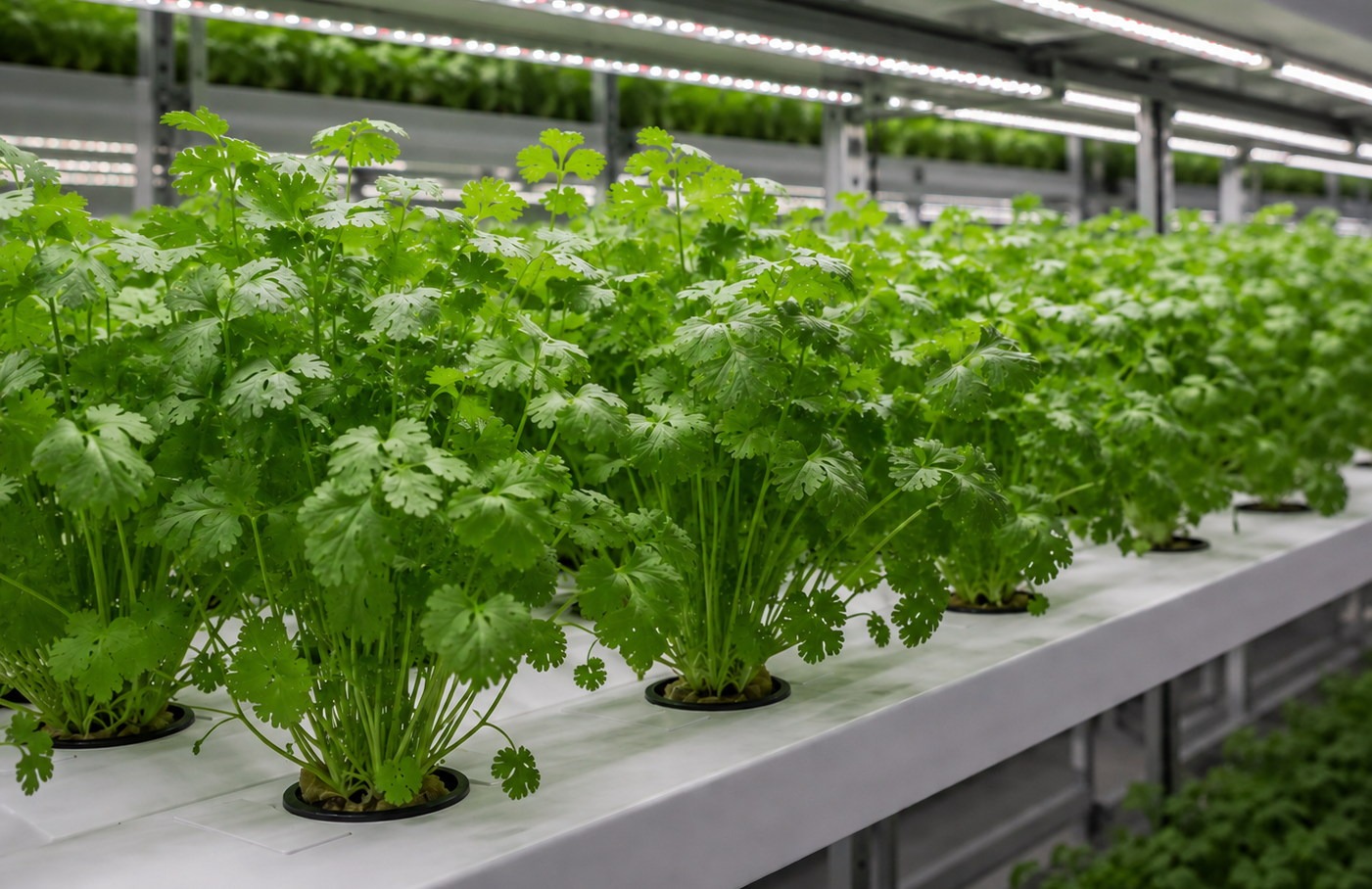
Coriander (Coriandrum sativum) - known as Cilantro in the US - is a small herb with an annual life cycle. It grows as a wild herb over a large area across southern Europe and South Asia, making its exact origin difficult to determine. Nevertheless, it is commonly used in many cuisines across the world, including in India, Mexico and Southeast Asia.
All parts of coriander plants can be eaten, but the leaves and seeds are the most commonly consumed. The seeds have a warm citrusy flavour and are actually the dried fruit of the plant. They are found either whole or ground; ground coriander seeds are part of the Indian spice mix garam masala, along with mace, fennel, cumin. This spice mix is used in a large variety of different dishes such as curries.
Coriander leaves are commonly used as garnishes for meat and fish, and also as a flavouring in salads or soups. Because they lose their taste quickly when cooked, in many cuisines they are added raw, just prior to serving. However, in Asian cuisines they are often used in large amounts in a variety of recipes and cooked until the flavour has dissipated.
Coriander production in controlled environments (brief literature review)
High levels of salinity in the hydroponic nutrient solution have been shown to be detrimental to coriander growth. An investigation studied the impact of using nutrient solutions at 1.6, 3.2, 4.8, and 6.4 dS m-1 using three different salts: NaCl, CaCl2.2H2O, and MgCl2.6H2O [1]. The researchers found that in all three cases, increased salinity negatively impacted reaction centres, photochemical activity, and carboxylation efficiency, which in turn reduced stomatal conductance, CO2 assimilation rate, and therefore, in the biomass production of coriander.
This finding was supported by another study which tested nutrient solution at 0.26, 2.47, 4.91 and 7.0 dS m-1 [2]. At 25 days after transplanting, plant height, shoot fresh weight and dry weight were reduced by 2.95, 6.08 and 3.32% per unit increase of ECw (in dS m-1) respectively. That said, water consumption did decrease by 5.85% per unit increase of ECw in the period of 1-24 days after transplanting. The study also tested two intervals of nutrient solution (0.25 and 2 h), and found that a 2h recirculation resulted in a 64% reduction in electricity usage while having no significant negative effect on the plants.
The length of photoperiod used has a complex impact on the metabolites (molecules produced via the metabolism of an organism) found in coriander. This is especially true when the interaction of temperature and photoperiod are considered. One study [3] found that for most cases, metabolites were produced at higher concentrations when a longer photoperiod of 18 hours was used. However, for certain compounds such as Decanal a shorter photoperiod of 12 hours was better. Furthermore, some compounds were produced at higher concentrations at lower temperatures (15 °C), while for others a higher temperature was optimal (25 °C).
However, longer photoperiods are only beneficial up to a certain point, and this also depends on the light intensity used. Another piece of research [4] tested the impact of different light intensities (133, 200, and 400 μmol m−2 s−1) and photoperiods (8hrs, 16hrs, and 24hrs) and found that generally speaking 200 μmol m−2 s−1 resulted in the greatest yield, fresh and dry weight and compounds related to photosynthesis. Which photoperiod was best varied from factor to factor. For example, a 16 hour photoperiod with 200 μmol m−2 s−1 resulted in the greatest leaf area and stem diameter, but using a 24 hour photoperiod with 200 μmol m−2 s−1 resulted in the greatest yield and plant height. However, using a 24 hour photoperiod had a significantly lower energy use efficiency.
The impact of light intensity can also depend on the spectra of the light used. One study [5] investigated the impact of using different combinations of red, green and blue lights, specifically having no red or blue, an even combination of all colours (50 μmol m−2 s−1of each), or 200 μmol m−2 s−1of one colour and 50 μmol m−2 s−1of the others. For most characteristics, it was determined that having an even intensity of all three colours was best.
This was because having high or low intensity might be the most beneficial for certain factors, for others they had a detrimental effect. Meanwhile the even split usually resulted in no significant difference from the highest values, and in some cases the equal combination resulted in significant improvement over the other colour combinations. The two main exceptions to this were Flavonoid content (which seemed to be significantly positively correlated with a high amount of blue light) and Phenolic Acid content (which saw significant improvements when either high levels of red or blue light were used) [5].
Finally, regarding growth media, a study investigated the impact of five different substrates on coriander, specifically agave fiber, coconut fiber, peat moss, capillary mat and cellulose sponge [6]. Generally speaking, peat moss was found to be the best substrate for enhancing the morphological characteristics of plants such as yield and plant height, while also increasing the concentration of several key nutrients such as Calcium and Sodium. However, peat moss also resulted in the lowest production of phenolic compounds.
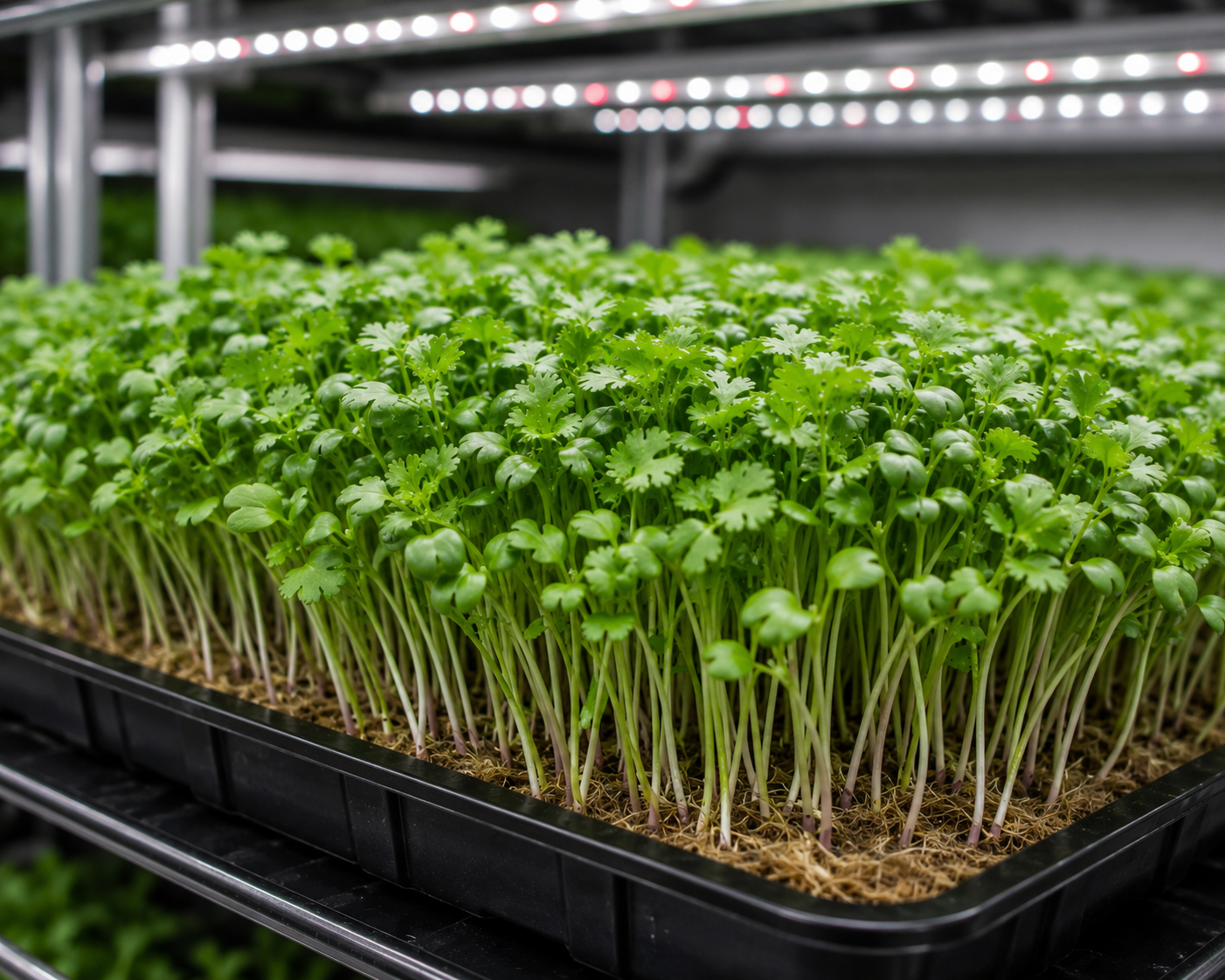
From the information stated above, the recommended growth conditions for coriander, specifically to get the highest yield, are as follows:
· Electrical conductivity of nutrient solution below 1 dS m-1.
· Photoperoid of 16 to 20 hours.
· Total light intensity of 200 μmol·m−2·s−1.
An even ratio of red, blue and green LED lights.
Grower insights:
The flavour of the leaves differs from person to person. For most people, they exhibit a refreshing citrus like flavour. However, for a minority of people, the leaves have an unpleasant soapy or rotten taste. This is caused by a mutation in the OR6A2 gene, which is a gene related to the detection of aldehydes in taste. Coriander taste and smell is mostly generated by aldehydes, and it is thought that the mutation makes people overly sensitive to these aldehydes while being unable to detect the more pleasant flavours. The frequency of the mutation varies between populations. In areas where coriander is a major part of local cuisine, such as South Asia, it is around 4 to 7%, while in other populations it is around 14 to 21%.
It is unclear when or where coriander was first cultivated, but it is thought to be over 3,000 years ago. Coriander mericarps (part of the fruit when it splits open) were discovered in the tomb of Tutankhamun, which could suggest they were cultivated in Ancient Egypt as the plant does not grow there naturally. There is also evidence for potential cultivation in Mycenaean-era Greece, as bronze age tablets refer to coriander being cultivated for the manufacture of perfumes, and large quantities of coriander have been found in sites from the same era. Coriander seeds are also thought by many to be one of the ingredients in the secret recipe of coca-cola.
References
1) Navarro, F.E., Santos, J.A., Martins, J.B., Cruz, R.I., Silva, M.M.D. and Medeiros, S.D.S., 2022. Physiological aspects and production of coriander using nutrient solutions prepared in different brackish waters. Revista Brasileira de Engenharia Agrícola e Ambiental, 26(11), pp.831-839.
2) Silva, M.G.D., Soares, T.M., Gheyi, H.R., Santos, C.C.D. and Oliveira, M.G.B.D., 2022. Hydroponic cultivation of coriander intercropped with rocket subjected to saline and thermal stresses in the root-zone. Revista Ceres, 69, pp.148-157.
3) Høyen, B.E., 2017. Light and Temperature Effects on Metabolite Concentration in Selected Herbs and Microgreens (Master's thesis, NTNU).
4) Wang, F., Gao, Q., Ji, G., Wang, J., Ding, Y. and Wang, S., 2024. Effects of light intensity and photoperiod on morphological development and photosynthetic characteristics of coriander. Horticulturae, 10(3), p.215.
5) Lin, H.H., Lin, K.H., Yang, M.J., Nguyen, H.C., Wang, H.J., Huang, H.X. and Huang, M.Y., 2022. Physiological responses and antioxidant properties of coriander plants (Coriandrum sativum L.) under different light intensities of red and blue lights. Scientific Reports, 12(1), p.21139.
6) Kyriacou, M.C., El-Nakhel, C., Pannico, A., Graziani, G., Soteriou, G.A., Giordano, M., Palladino, M., Ritieni, A., De Pascale, S. and Rouphael, Y., 2020. Phenolic constitution, phytochemical and macronutrient content in three species of microgreens as modulated by natural fiber and synthetic substrates. Antioxidants, 9(3), p.252.