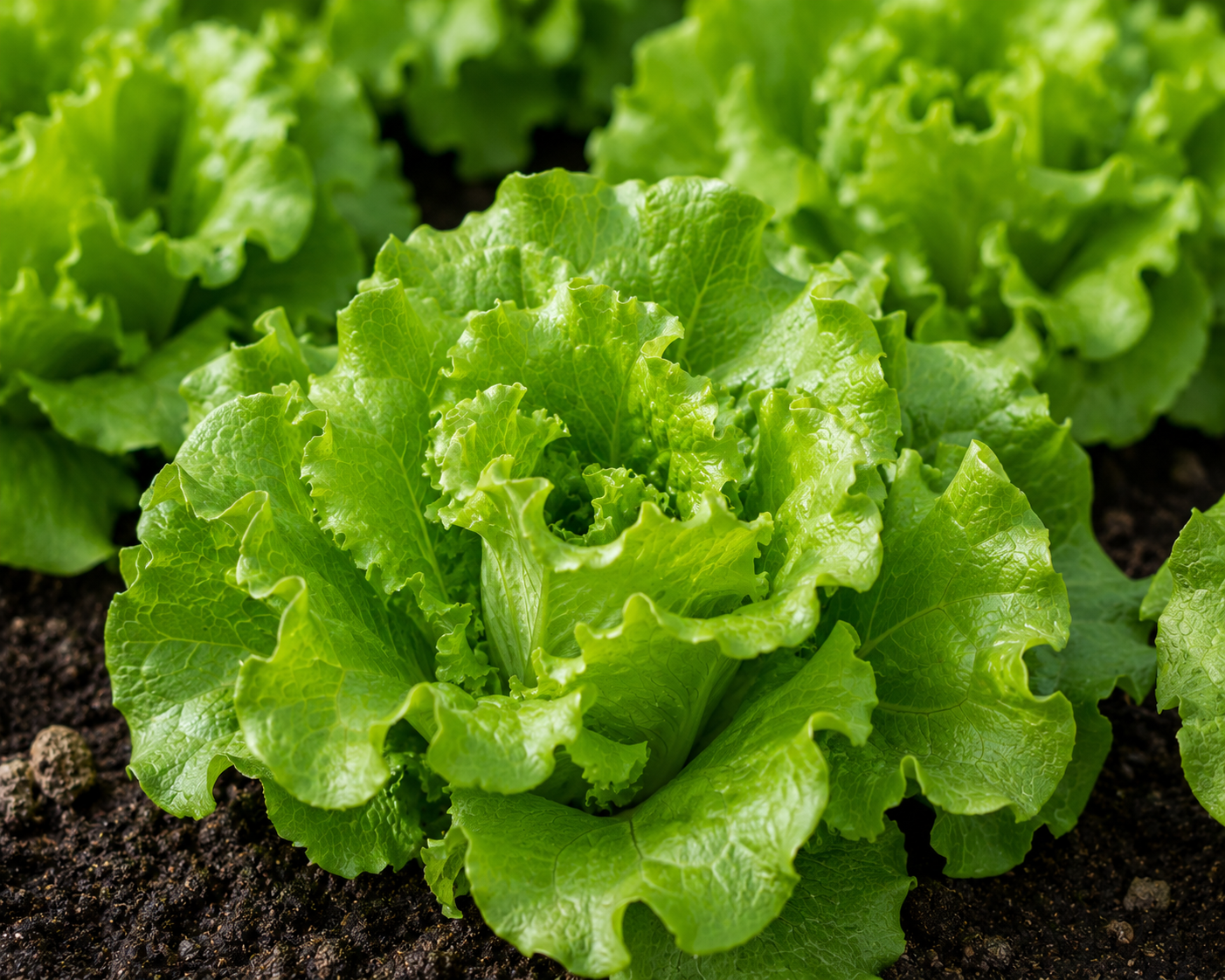
Lettuce is an annual plant, which is believed to have originated from a wild ancestor in the Caucasus. It was then brought through the middle East to Egypt, where it was first cultivated as early as 2600 BCE. At first, lettuce was probably grown to extract oil for cooking from its seeds. However, over time it was selectively bred to have edible leaves, which is its primary use today.
Lettuce leaves are most often eaten raw, commonly eaten in salads, wraps and sandwiches, though it can also be grilled. Certain cultivars of lettuce are primarily grown for their stem rather than their leaves, the most notable of which is Celtuce. Lettuce stems can also be eaten raw, cooked or pickled. In China, pickled lettuce stems are commonly used as a side dish.
Different cultivars of lettuce have leaves with different properties. Red leaf lettuce, as the name suggests, have dark red leaves instead of the usual green. Romaine or Cos lettuce grow with sturdy dark green leaves in tall upright heads and is more tolerant of heat. Iceberg or Criphead are popular (especially in the USA), but are low in nutritional content compared to other varieties, being around 96% water.
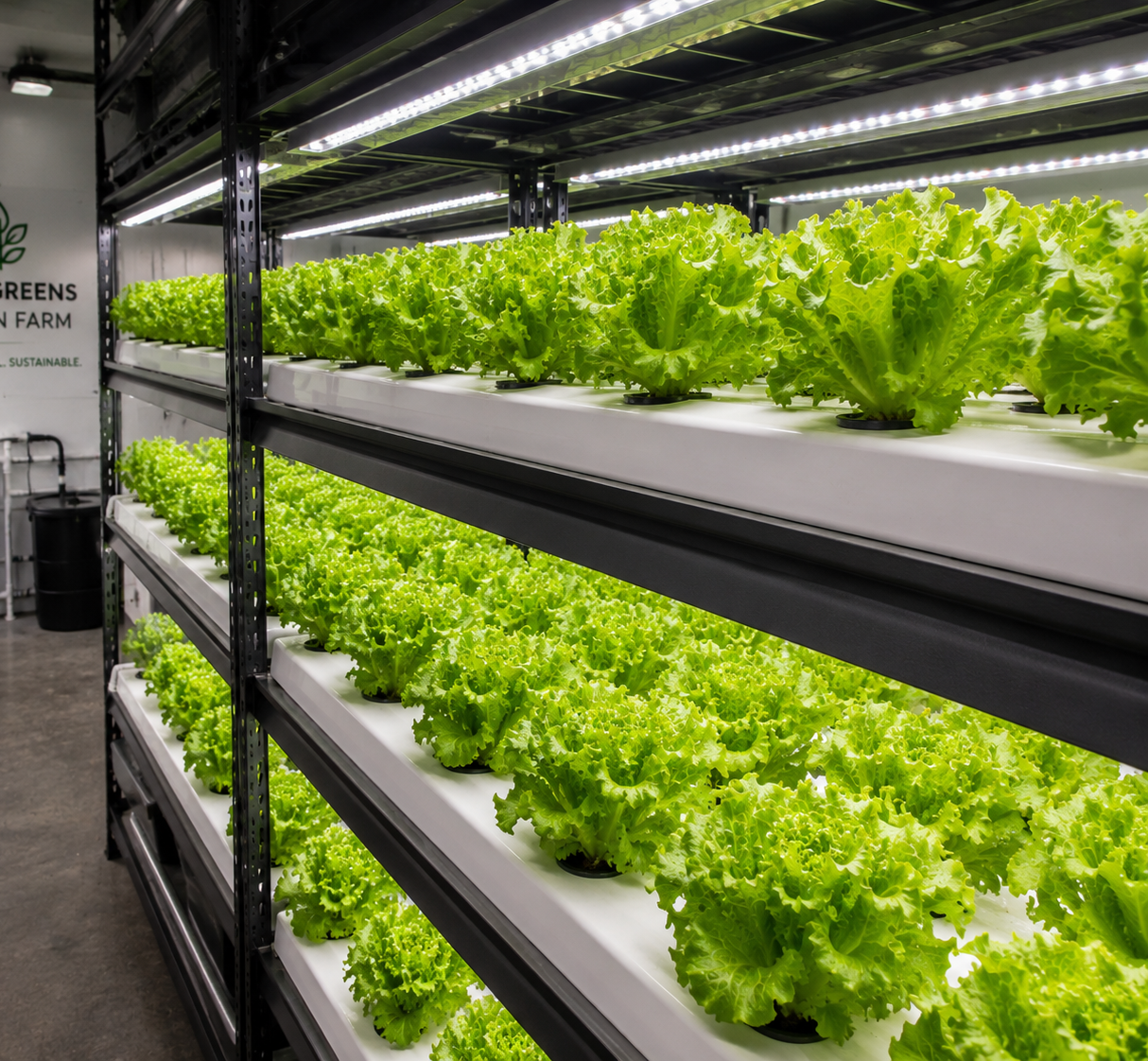
Lettuce production in controlled environments (brief literature review)
The salinity of the nutrient solution used to grow lettuce is an important factor in their growth. There is evidence that increasing the salinity by a small amount can actually be beneficial for lettuce. A study investigated the impact of increasing the salinity of the nutrient solution from 1.0 to 2.2 dS m-1 on two lettuce cultivars, and found that yield, leaf area and levels of carotenoids and chlorophyl increased with salinity [1].
That said, higher levels of salinity have been found to be somewhat detrimental to the plant. Another study added 20 mM of sodium chloride, 20 mM of potassium chloride or 13.3 mM of calcium chloride to a nutrient solution with an electrical conductivity of 2.0 dS m-1 [2]. The study found that increased growth can cause significant decreases in yield quality.
However, the larger impact on biometric factors was the time at which the plants were harvested [2]. At around 25 to 29 days, the leaf area, fresh yield, dry biomass and leaf dry mass were significantly reduced compared to the control, with the plants redirecting energy to produce phytochemical compounds. However, by 43 to 45 days, this had switched to physical growth and expansion. This indicates that under high salinity conditions, the time of harvest can be an important factor in determining the qualities of the lettuce crop.
There are also ways to mitigate the negative effects of high salinity on lettuce, specifically by using biostimulants. A study added 50 mM of salt to control nutrient solution, and also added varying amounts of biostimulants [3]. The control had a yield of 18.11 g/m2, which decreased to 10.23 when just the salt was added. However, using Plant Growth-Promoting Rhizobacteria (PGPR) and Vermicompost brought this back up to 17.92 and 17.90 respectively. Additionally, using Arbuscular Mycorrhizal Fungi (AMF) or PGPR with the salt increased plant height more than the control, and biostimulants also increased the levels of bioactive compounds in the lettuce.
Regarding the light spectra used for lettuce, a study tested various combinations of red and blue lighting for growing lettuce [4]. They found that generally a combination of deep red, deep blue and far red lighting had the best results, with this lighting having the best results for leaf width, leaf area index, fresh weight, dry weight, and significantly highest content of nitrogen, phosphorous, potassium, calcium, magnesium, sulphur, iron and copper.
The ratio of blue and red light is also important. Another study investigated the impact of different light intensities, light spectra and continuous lighting on lettuce [5]. They found that under continuous lighting, the best light spectra for increased growth was a 3:1 ratio of red and blue light, and growth increased as light intensity increased. The study also found that continuous lighting improved growth relative to a 12 hour photoperiod, suggesting longer day length would be beneficial in a production context.
Studies have also investigated the best growth media for lettuce. One study compared the impact of wood fibre, sheep wool, coco peat, mineral wool and perlite [6]. They found that generally for physical size (leaf biomass, leaf area etc), coco peat was the best option. However, for achieving higher content of antioxidants, phenols and nitrates, sheep wool was the best option.
Another study used media made up of a mixture of different substrates [7]. They found that for the first 7 to 14 days, there isn’t too much significant difference in plant height and leaf length. However, after this period, 60% rice husk + 30% coconut coir + 10% vermicompost resulted in the highest plants, and also resulted in the largest biomass after 45 days.
Overall, if yield and the physical size of the plants is your aim, then the best conditions appear to be as follows: Substrate either of coco peat or 60% rice husk + 30% coconut coir + 10% vermicompost, a continuous photoperiod with 300 μmol m−2 s−1 using LEDs with a high ratio of red lights, and a nutrient solution of 2.2 dS m-1.
Grower Insights
The Romans often consumed lettuce by cooking the leaves and then serving them with an olive oil and vinegar dressing. Although lettuce was introduced to Chinese cuisines by interactions with the west, today China is by far the largest lettuce producer in the world, producing over 15 million tonnes per year as of 2022. The next largest producer, the USA, produced only 3.3 million tonnes. Typically, the stems of lettuce leaves have a greater fibre content, while the leaf portion has a higher concentration of micronutrients.
References
- Silva, P.F., Matos, R.M., Bonou, S.M., Sobrinho, T.G., Borges, V.E., Dantas Neto, J. and Melo Júnior, A.P., 2019. Yield of the hydroponic lettuce under levels of salinity of the nutrient solution. African Journal of Agricultural Research, 14, pp.686-693.
- Carillo, P., Soteriou, G.A., Kyriacou, M.C., Giordano, M., Raimondi, G., Napolitano, F., Di Stasio, E., Mola, I.D., Mori, M. and Rouphael, Y., 2021. Regulated salinity eustress in a floating hydroponic module of sequentially harvested lettuce modulates phytochemical constitution, plant resilience, and post-harvest nutraceutical quality. Agronomy, 11(6), p.1040.
- İkiz, B., Dasgan, H.Y., Balik, S., Kusvuran, S. and Gruda, N.S., 2024. The use of biostimulants as a key to sustainable hydroponic lettuce farming under saline water stress. BMC Plant Biology, 24(1), p.808.
- Pinho, P., Jokinen, K. and Halonen, L., 2017. The influence of the LED light spectrum on the growth and nutrient uptake of hydroponically grown lettuce. Lighting Research & Technology, 49(7), pp.866-881.
- Liu, W., Zha, L. and Zhang, Y., 2020. Growth and nutrient element content of hydroponic lettuce are modified by LED continuous lighting of different intensities and spectral qualities. Agronomy, 10(11), p.1678.
- Ferby, V., Kopta, T., Komorowska, M. and Fidurski, M., 2023. Evaluation of alternative substrates for hydroponics based on biological parameters of leaf lettuce (Lactuca sativa L.) and its stress response. Folia Horticulturae, 35(1), pp.77-90.
- Rahman, M.J., Chawdhery, M.R.A., Begum, P., Quamruzzaman, M., Zakia, M.Z. and Raihan, A., 2019. Growth and yield of hydroponic lettuce as influenced by different growing substrates. Azarian Journal of Agriculture.