Introduction: Why Economics Matter in Indoor Farming
Developing a viable and successful economic model for a vertical farm or CEA system is a challenging but necessary action in order to build a stable business enterprise. Economic models for indoor farms are not simply financial projections; they should integrate biological performance, technological efficiency, and market realities. Unlike conventional agriculture, where centuries of practice have established expected yields, costs, and risks, vertical farming and other CEA systems require new approaches that account for controlled environments, high energy inputs, and the interplay between technology and crop biology. For potential growers, investors, and policy-makers, a clear view of these economic frameworks is essential if stable production models are to be achieved
Understanding Cost Structures in CEA
Economic planning for indoor farms begins with recognising the cost structures that differ from field agriculture. Capital expenditure is typically front-loaded: lighting, HVAC, irrigation, sensors, and automation represent significant investments before a single crop is harvested. Operating expenditure, meanwhile, is dominated by energy costs, labour, nutrient inputs, and system maintenance. For example, studies from Wageningen University and the University of Arizona have shown that energy alone can account for 30–50% of variable costs in LED-based vertical farms. These high recurring costs must be offset by productivity gains, premium crop pricing, or efficiency in scale.
Revenue Streams and Market Positioning
A robust economic model is not limited to costs: it must also capture potential revenue streams. The most common products of vertical farms are leafy greens, herbs, and microgreens due to their rapid turnover and relatively high market value. However, the global expansion of CEA has also seen farms producing strawberries, tomatoes, and even specialty mushrooms. Each crop type demands a tailored model; strawberries, for instance, require longer production cycles and greater energy input but can command premium retail prices in urban markets. Business planning must therefore align crop selection with local demand, distribution networks, and pricing strategies.
Scaling and Economies of Efficiency
A recurring theme in the economics of indoor farming is scale. Small-scale operations, often set up as owner-operator businesses or community-focused initiatives, may prioritise direct to consumer models, avoiding selling to third party wholesale or retail outlets. At the other end of the spectrum, large-scale vertical farms seek economies of scale through automation, bulk purchasing, and streamlined logistics. Smaller operations may achieve earlier profitability via higher potential sales vales, whereas larger operations may face logistical and capital risks but achieve greater efficiency per unit of output. Thus, economic modelling must consider not only present costs but also how scaling decisions affect long-term financial sustainability.
Investment Models and Funding Pathways
Indoor farming has attracted a wide range of investors: venture capital, corporate food companies, and even public-sector funds seeking sustainable food solutions. Economic models are crucial for presenting credible pathways to return on investment. Key performance indicators often include yield per square metre, energy use efficiency, labour productivity, and market penetration. Some farms pursue hybrid models, combining commercial sales with research contracts or public funding, particularly in regions where food security is a strategic priority. Businesses previously have used a range of approaches, from venture-backed scaling to modular decentralised systems, though truly successful economic model have yet proved elusive.
Risk, Resilience, and Sensitivity Analysis
A rigorous business plan must acknowledge risks. Energy price volatility, supply chain interruptions, or market saturation can all destabilise indoor farming ventures. Sensitivity analysis within economic models allows planners to test how shifts in variables such as electricity rates or crop failure affect overall viability. Academic research has emphasised that resilient farms are those that model multiple scenarios and maintain flexibility in both crop choice and technological design. By incorporating contingency planning into the financial model, indoor farms can adapt more effectively to uncertainty.
Linking Economics with Sustainability
Economic models are not solely about financial return. Increasingly, they integrate environmental and social dimensions, such as carbon footprint, water savings, and urban employment opportunities. For policy-makers, this wider framing is crucial in justifying public investment or supportive regulation. A vertical farm may, for example, demonstrate reduced food miles and water use compared to imported produce. When captured in a business plan, such benefits strengthen the case for investment, partnerships, and long-term acceptance within the food system.
Case Study Approaches in Practice
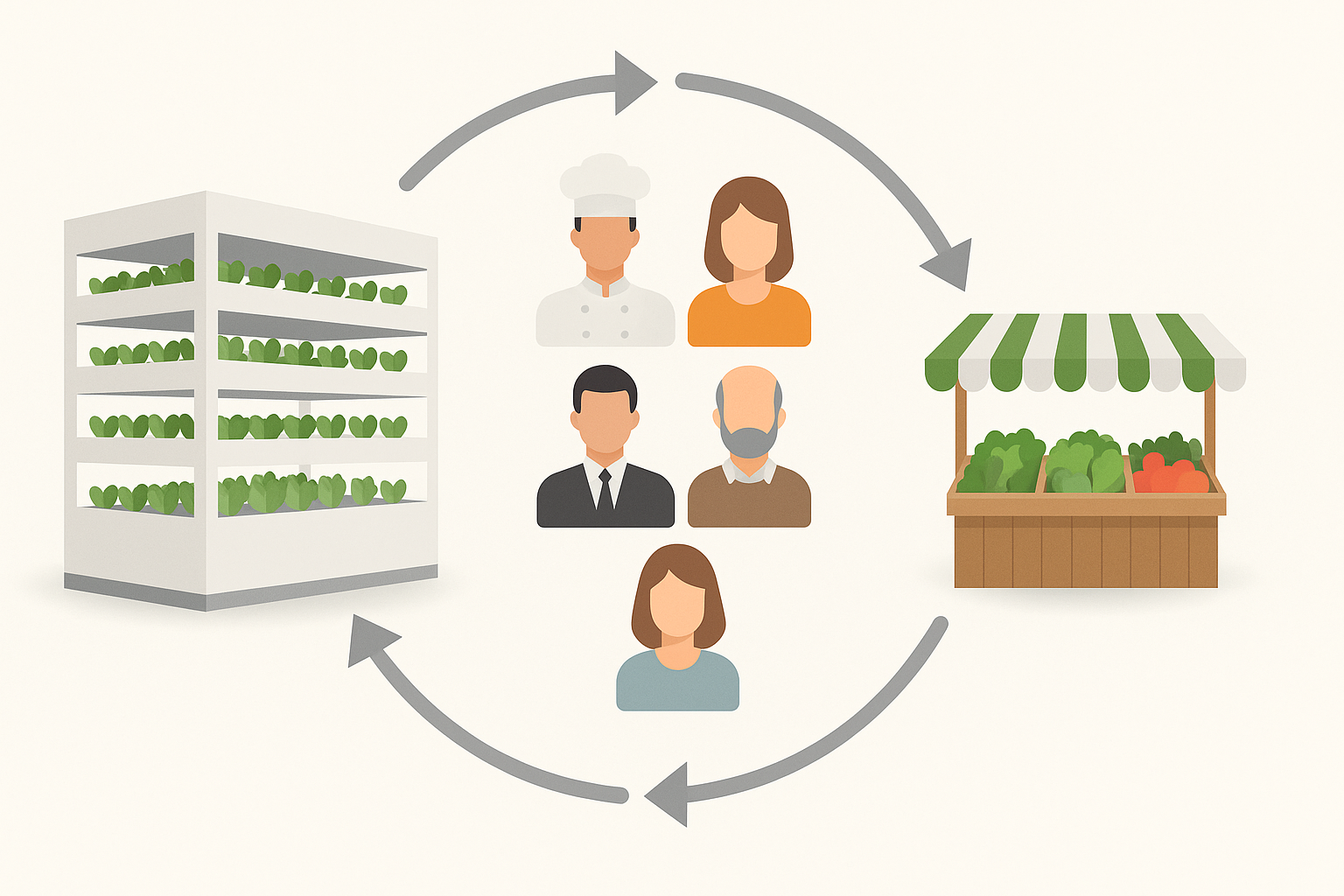
Real-world case studies illustrate how different approaches to economic modelling shape business planning. A small urban microgreens enterprise may rely on direct-to-consumer or restaurant sales and brand identity, keeping overheads low by using repurposed buildings and minimal automation. In contrast, a large rural facility producing salad crops for supermarkets might emphasise scale, precision technology, and contracted supply agreements. Each case study provides insight into the trade-offs between cost, efficiency, risk, and market positioning. Together they demonstrate that there is no single model for success: rather, economic models must be adapted to context, objectives, and scale.
Conclusion: Towards a Mature Framework for Indoor Farm Economics
As CEA and vertical farming mature, economic models are evolving from speculative projections into structured, evidence-based frameworks. For startups, these models provide the foundation of credible business plans; for investors, they inform decisions on capital allocation and risk; for policy-makers, they support strategies for sustainable food security. By studying diverse case studies and refining the assumptions that underpin them, the sector is gradually building a more predictable path from innovation to profitability. Indoor farming will not replace all forms of agriculture, but robust economic planning ensures it can contribute meaningfully and sustainably to future food systems.