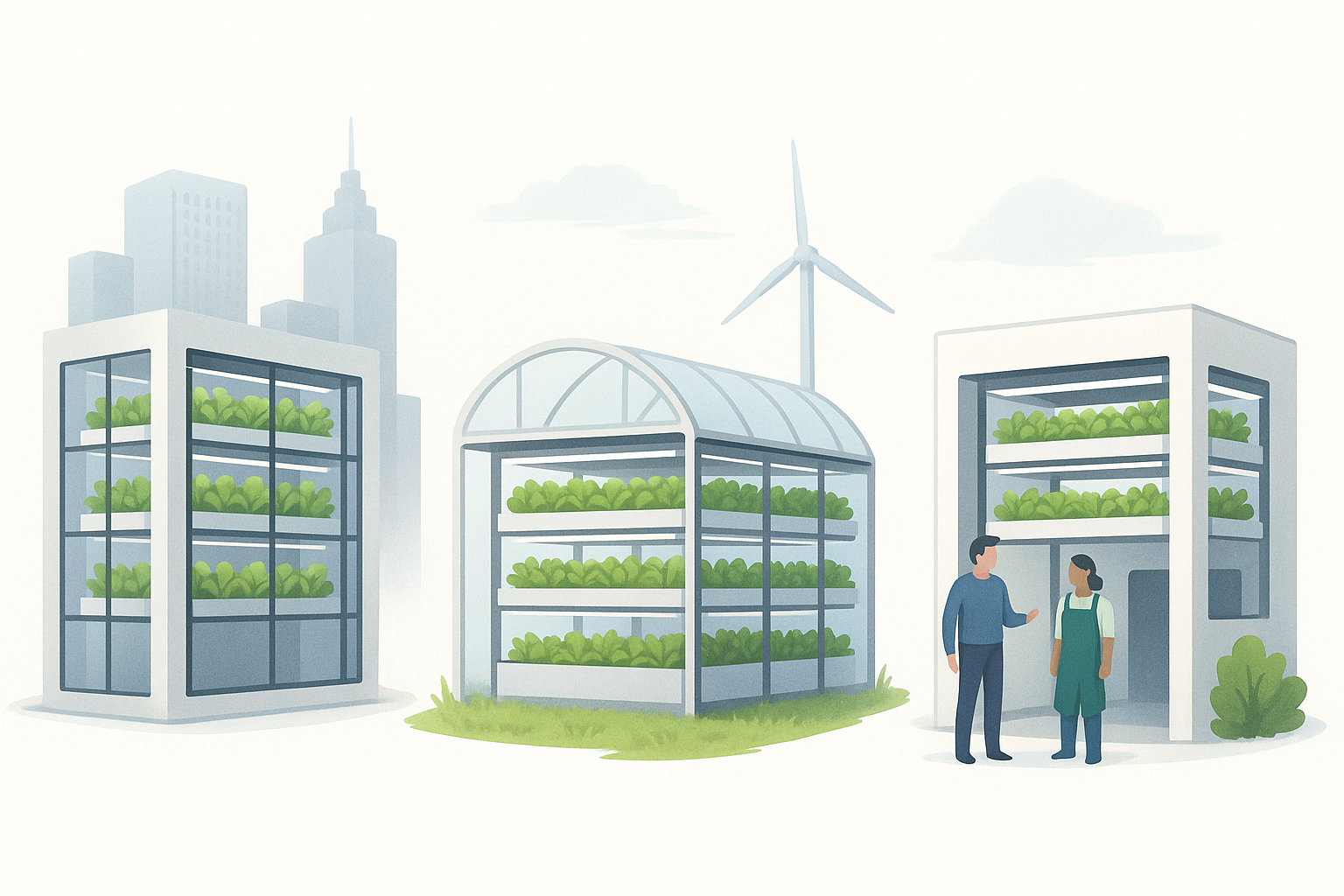
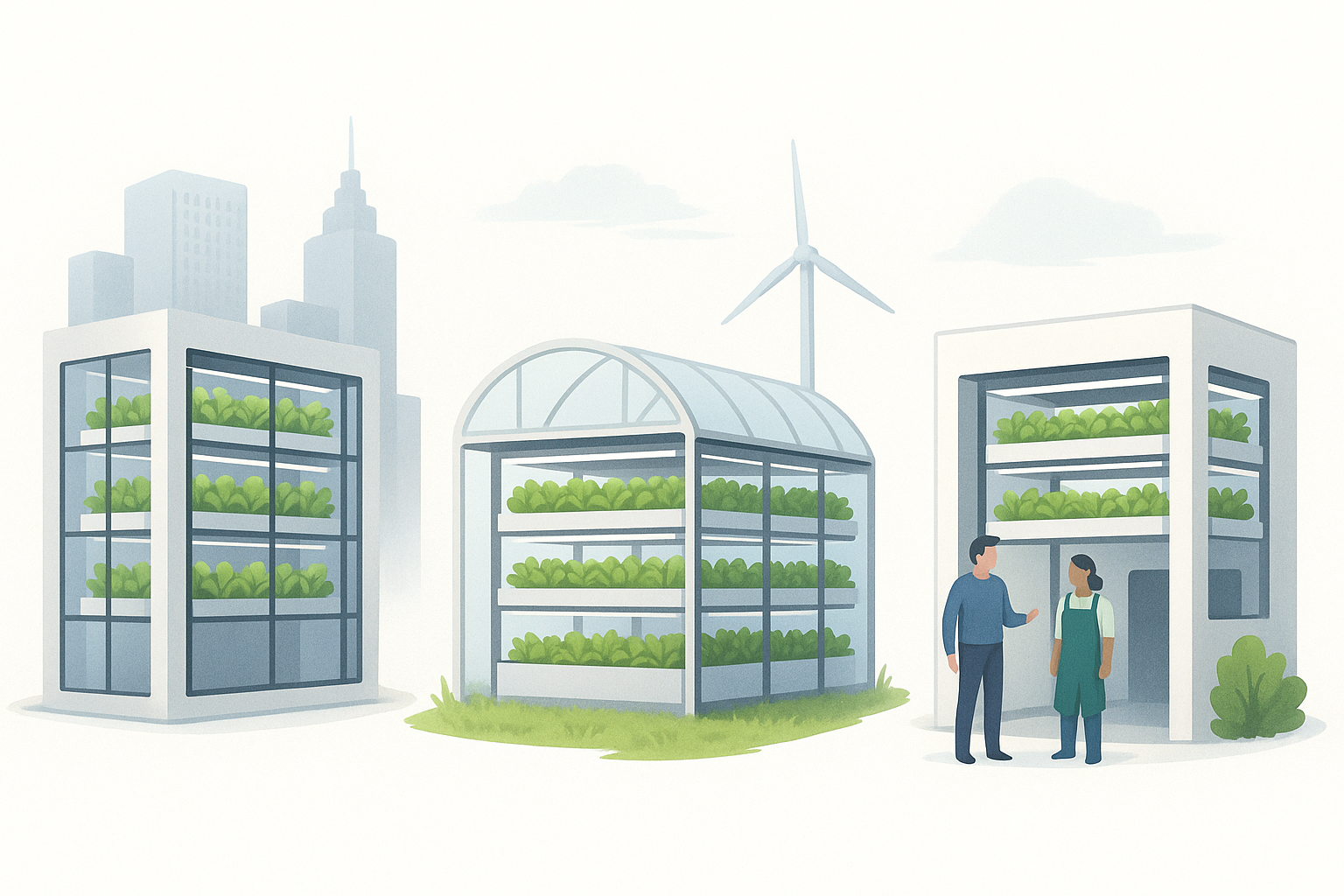
Understanding the range of different vertical farm types is useful for anyone interested in how controlled environment agriculture (CEA) adapts to its setting, or what challenge it can be an answer for. Vertical farms do not all look alike; their aims, scale, and impact vary significantly depending on whether they are based in city centres, rural landscapes, or within social enterprise models. This page introduces some broadly representative examples of each type, providing context for how vertical farming is being applied in diverse ways to meet local needs, economic goals, and sustainability priorities.
Why Different Approaches in Vertical Farming
Vertical farming is still a relatively young sector. While the technology has advanced rapidly, it is real-world examples that reveal how systems perform outside research settings or pilot projects. Case studies show what works and where challenges remain. They allow growers, investors, policy-makers, and researchers to examine practical evidence rather than relying on theoretical projections. By looking closely at how vertical farms have been established in urban areas, rural regions, and as social enterprises, we gain a clearer sense of the opportunities and trade-offs involved in each model.
Urban Vertical Farms: Growing in the Heart of the City
Urban vertical farms are perhaps the most widely recognised type, as they respond directly to questions of food security in cities where land is limited. They often occupy converted warehouses, disused factories, or purpose-built facilities designed to operate close to consumers.
The main advantage of urban models lies in proximity: produce can move quickly from farm to retailer or restaurant, reducing food miles and preserving freshness. They also make productive use of otherwise underutilised space. Case studies from London, Singapore, and New York show that urban farms can achieve consistent year-round supply of leafy greens and herbs by controlling light, humidity, and nutrient cycles.
However, these models face challenges. Energy demand is often high, and operating costs can be significant given city property values. Urban case studies demonstrate that commercial viability often depends on premium pricing, direct supply agreements with supermarkets or restaurants, or integration into wider urban food strategies.
Rural Vertical Farms: Expanding Agricultural Landscapes
Rural vertical farms may appear counterintuitive, given that rural areas already host extensive farmland. Yet vertical farms can also thrive in these settings. Rural farms often benefit from lower land costs, proximity to renewable energy sources, and access to skilled agricultural labour. Some use vertical systems to supplement traditional field production, providing stable year-round crops such as herbs or strawberries that complement seasonal harvests.
One example comes from rural Japan, where vertical farms have been developed in response to land shortages caused by natural disasters and ageing farming populations. In Northern Europe, several farms use vertical greenhouses adjacent to renewable energy facilities, creating integrated energy-agriculture systems that lower costs and carbon impact. This illustrates how vertical farming in rural contexts can be framed not as competition with traditional agriculture, but as diversification that improves resilience and reduces reliance on imports.
Social Enterprise Vertical Farms: Farming with a Mission
Social enterprise vertical farms add another layer of purpose. These projects use controlled environment systems to achieve social as well as economic outcomes. Examples across the UK, Europe, and North America show how vertical farms are being used to provide training, employment, or community engagement.
One notable UK case study is a vertical farm established to train young people in horticulture and technology skills, preparing them for employment in the wider agri-tech sector. In Canada and the United States, vertical farms have been developed in partnership with food banks and community groups, ensuring fresh produce reaches low-income households. These models demonstrate how vertical farming can support public health, education, and community resilience alongside food production.
Although social enterprise farms may be smaller in scale, they illustrate the adaptability of vertical farming systems. They often rely on charitable funding, government grants, or corporate social responsibility partnerships, yet their outcomes extend far beyond crop yield. Case studies in this category emphasise the broader role of agriculture as a social good, not solely an economic activity.
Comparing the Three Types
Placing urban, rural, and social enterprise farms side by side highlights both contrasts and synergies. Urban farms prioritise proximity to consumers; rural farms leverage land, energy, and integration with traditional agriculture; social enterprise farms use the technology as a tool for wider community impact. Each faces its own constraints, from high energy costs to financial sustainability, yet all demonstrate resilience through innovation.
These different vertical farm types also show that the technology is not monolithic. The same core techniques of hydroponics, aeroponics, and controlled environments with lighting can be applied to very different applications. This adaptability is perhaps the strongest evidence of the sector’s potential to contribute meaningfully to sustainable food systems in diverse contexts.
Why This Matters for the Future of Food
The relevance of these different approaches extends beyond the farms themselves. They provide concrete evidence for governments considering policy support, investors seeking to understand risk and return, and educators looking to prepare students for careers in agri-tech. At a time when climate change, urbanisation, and resource pressures are reshaping agriculture, vertical farms offer one set of responses. Their real-world applications help us move beyond abstract debate into informed decision-making.
In the UK context, these examples are particularly relevant given the dual pressures of reducing reliance on imports and meeting environmental targets. Social enterprise models also highlight how vertical farming can link food production with community development and social justice, issues that are increasingly central to policy discourse.
Conclusion
Examining different vertical farm types allows us to see the full spectrum of possibilities within CEA. From high-tech city farms to community-led projects, each example contributes to a deeper understanding of how vertical farming operates in practice. For potential growers, researchers, or policy-makers, these cases offer valuable lessons: the technology is flexible, but success depends on context, purpose, and careful alignment with local needs.
By comparing urban, rural, and social enterprise approaches, we see not only how vertical farming adapts to different circumstances but also how it can reshape them. These farms are more than production systems; they are laboratories of innovation, resilience, and social change.