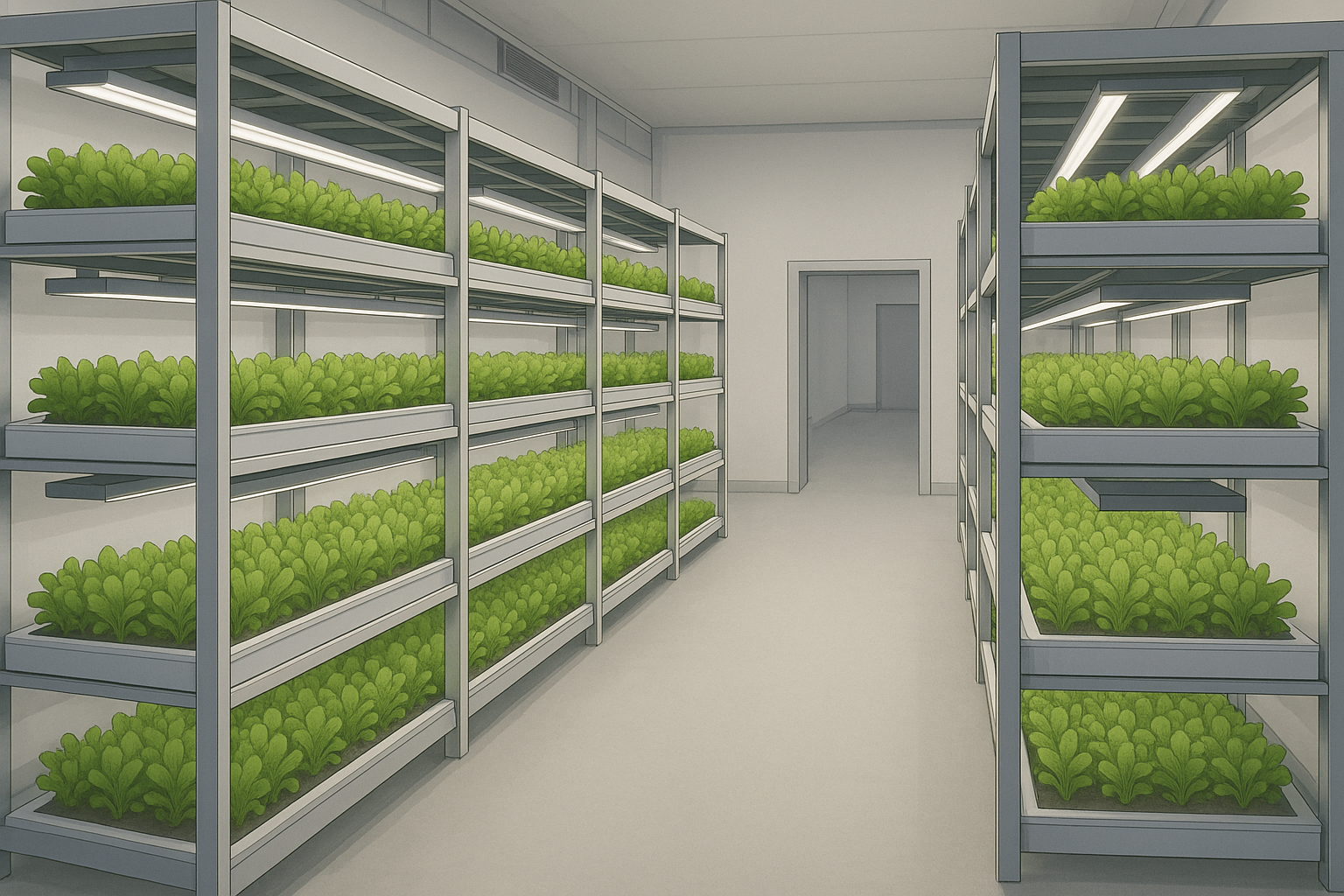
Designing an indoor farm is not simply a matter of fitting racks into a room. The way in which space is organised directly influences productivity, plant health, labour efficiency and long-term profitability. An optimum CEA and vertical farm layout design must balance crop density with ease of access, ensuring that technology, workflow and human intervention can all operate smoothly within a confined space. Although the promise of vertical farming lies in maximising the use of cubic volume rather than flat area, this only succeeds when access for maintenance, harvesting and system monitoring is integrated into the design from the outset.
The importance of spatial planning
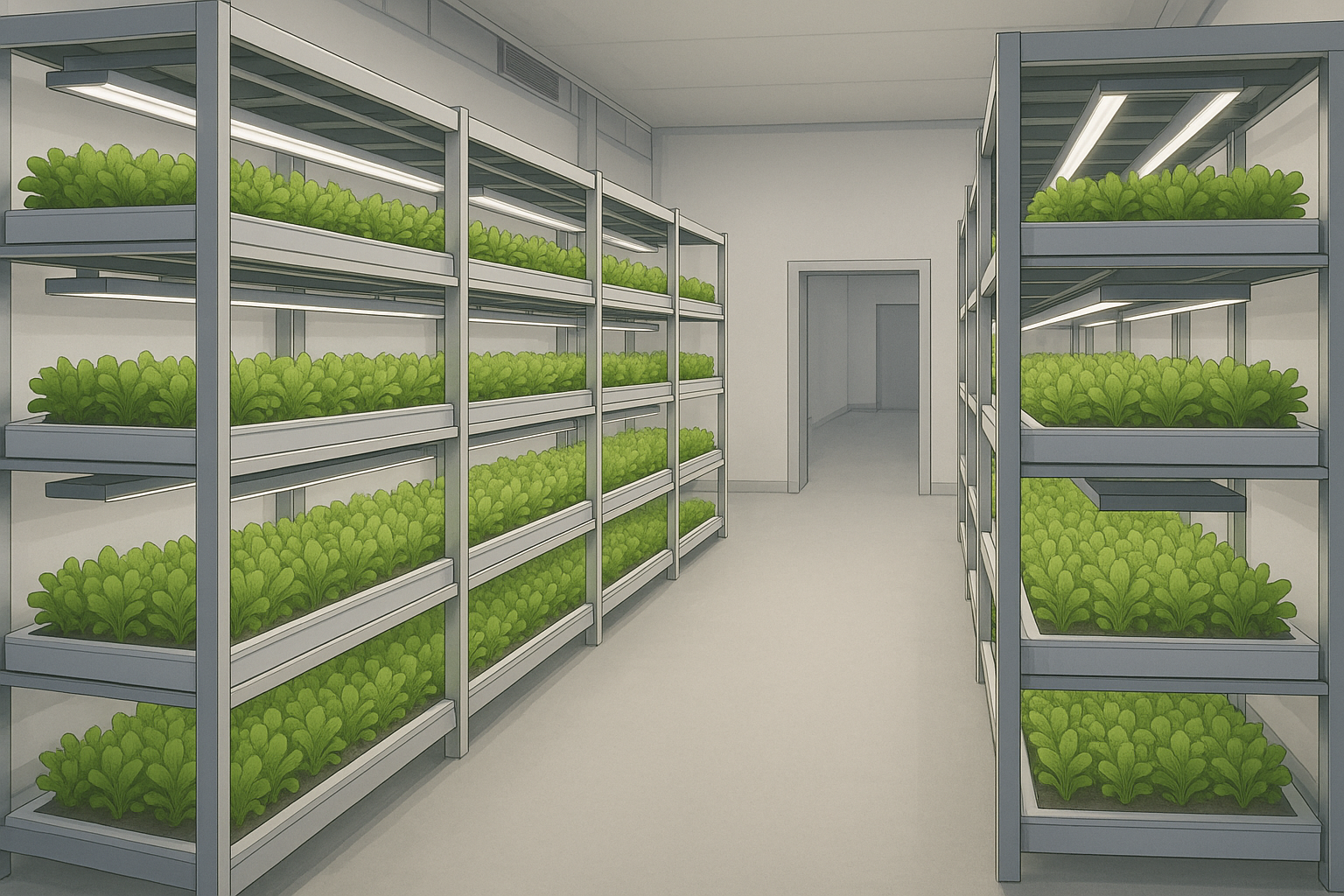
Key components of effective controlled environment agriculture include light, airflow, nutrient delivery and water recycling. Each of these depends on physical arrangements within the farm. For example, vertical racks must be positioned so that artificial lighting systems provide consistent coverage, yet still allow airflow pathways to reduce the risk of microclimate formation and disease pressure. At the same time, operators must be able to reach every crop level without excessive bending, stretching or reliance on unsafe ladders. The most successful facilities are those that treat spatial planning as both a biological and logistical problem: plants thrive when technicians can access them easily, sensors can be serviced promptly and environmental control systems are not obstructed.
Vertical racks and density optimisation
Racks are the defining structural element of most vertical farms. They allow crops to be stacked in layers, multiplying the productive area within the same footprint. Yet density is not always equivalent to efficiency. If racks are placed too close together, air distribution may stagnate and crop uniformity may suffer. Conversely, overly wide aisles can waste valuable cubic metres that could otherwise support growing capacity. Many commercial operations adopt a compromise in which racks are either fixed with carefully planned walkways or mounted on mobile rails, similar to library storage systems, to enable high-density placement with flexible access. The choice between these approaches depends on crop type, expected labour inputs and the degree of automation in use.
Workflow and human access
Although automation is steadily advancing, most indoor farms still rely on human labour for sowing, transplanting, pruning and harvesting. Workflow efficiency is therefore a central consideration in layout design. Routes through the farm should minimise unnecessary movement of people and materials. One suggested innovation often repeated is to mix crop species, with crops that require more frequent intervention, such as herbs or salad leaves, located closer to access points, whereas less frequently handled crops could occupy more remote or higher tiers. This arrangement would potentially improve labour productivity but also reduces the risk of cross-contamination, since workers can move from lower-risk to higher-risk areas in a controlled sequence. However the challenges of managing multiple environmental requirements for different crop species in the same space potentially increases difficulties rather than reducing them. Regardless, a well-planned workflow resembles a loop rather than a series of dead ends: staff should be able to circulate efficiently without backtracking.
Access for maintenance and technology integration
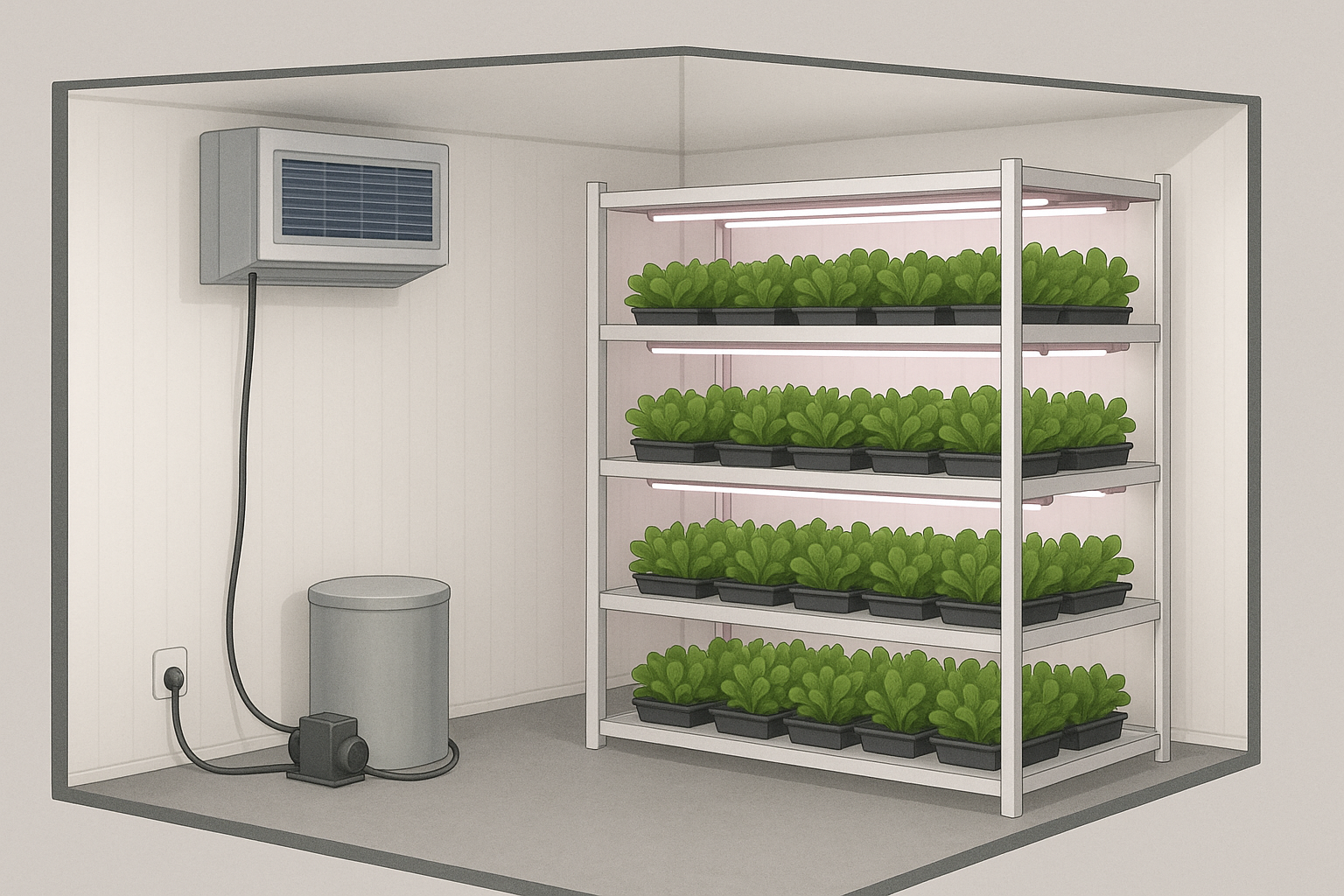
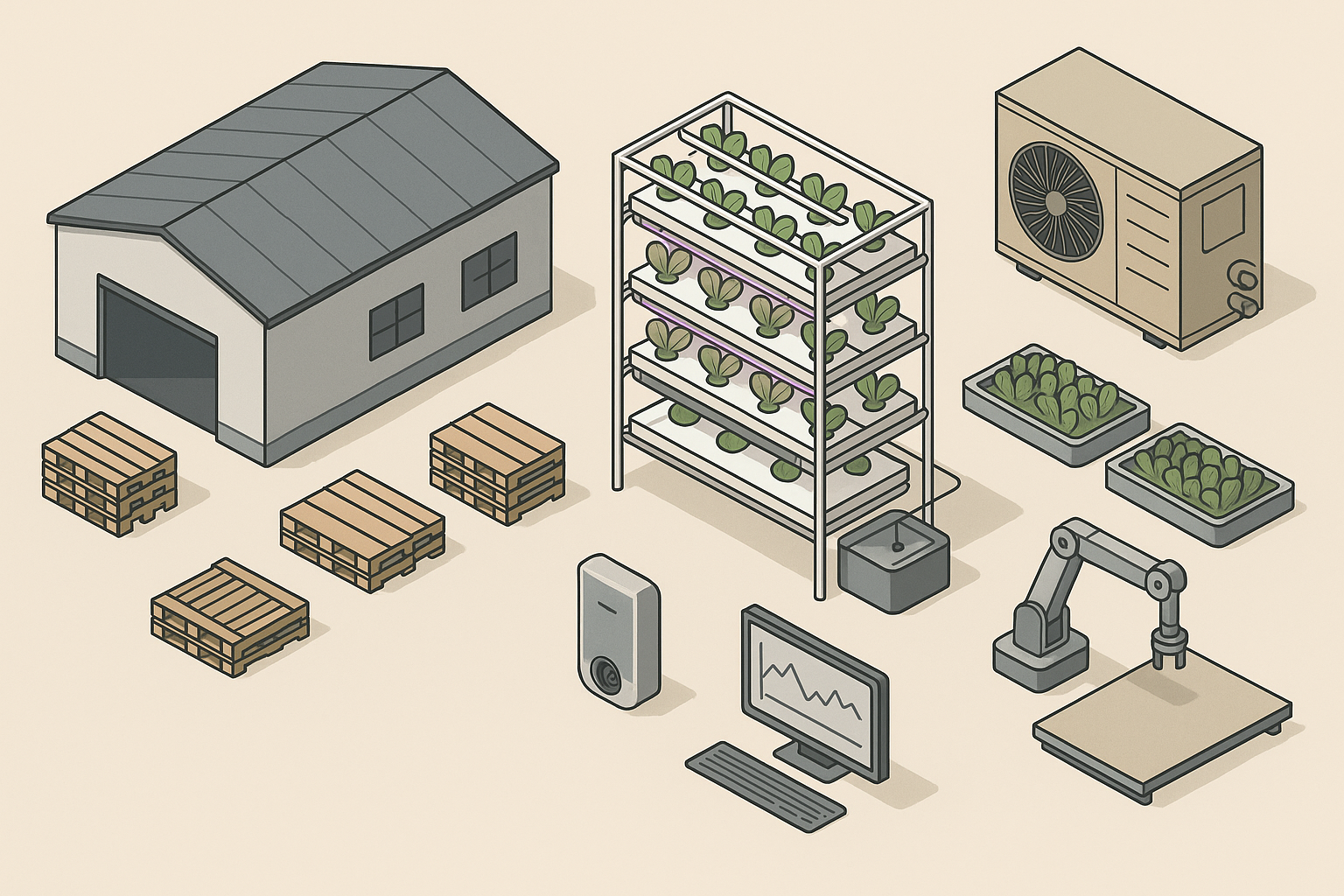
Vertical farms are complex infrastructures that rely on pumps, HVAC units, sensors and LED arrays. Each of these requires maintenance and occasional replacement. If system components are hidden behind immovable racks or squeezed into narrow voids, downtime can be prolonged and operational costs increase. Optimum layout design therefore incorporates service corridors, cable trays, and points of access for technicians and robotic units. Some facilities adopt modular rack systems where an entire section can be moved or swapped out without disrupting adjacent crops. Others employ overhead gantries for lighting and irrigation that can be lowered for inspection. These design choices are not cosmetic; they determine whether a farm can sustain continuous operation with minimal disruption.
Balancing biological and economic constraints
The challenge of designing an indoor farm lies in balancing biological requirements with economic imperatives. From a biological standpoint, crops need light uniformity, air circulation and nutrient stability. From an economic standpoint, the operator needs to maximise yield per cubic metre, reduce labour costs and ensure rapid turnover. The layout mediates between these two sets of demands. A farm optimised solely for density may appear profitable on paper but could suffer from higher disease incidence or worker fatigue. A farm designed only for convenience may be comfortable to operate but financially unsustainable. Effective design emerges from modelling scenarios, calculating potential returns on investment, and simulating microclimatic conditions to anticipate challenges before construction begins.
Case examples and emerging trends
Studies from European and Asian vertical farms highlight the role of movable aisle systems in increasing growing capacity by up to 70% compared with fixed racks, without compromising accessibility (Benke and Tomkins, 2017; Beacham et al., 2019). At the same time, research into human ergonomics within vertical farms suggests that eye-level crop placement and lift-assisted access to upper tiers reduce injury risk and improve worker satisfaction (Despommier, 2020). Digital twins are increasingly being employed to model layouts in advance, allowing operators to test airflow, lighting patterns and workflow efficiency virtually before any physical construction. These examples illustrate that optimum layout design is both a science and an art: it integrates engineering, horticulture and human-centred design.
Conclusion
Optimum CEA and vertical farm layout design cannot be reduced to a standard template. It requires a contextual understanding of the crop portfolio, the scale of investment, the chosen technology stack and the workforce available. What is consistent, however, is the principle that layout is the silent determinant of success. Every plant, every lamp and every aisle is influenced by the original design. To achieve efficiency, resilience and profitability, indoor farms must view layout planning not as a one-off architectural decision but as a dynamic process that evolves with technology and market demands.
References
Beacham, A. M., Vickers, L. H., & Monaghan, J. M. (2019). Vertical farming: A summary of approaches to growing skywards. Journal of Horticultural Science & Biotechnology, 94(3), 277–283.
Benke, K., & Tomkins, B. (2017). Future food-production systems: Vertical farming and controlled-environment agriculture. Sustainability: Science, Practice and Policy, 13(1), 13–26.
Despommier, D. (2020). The Vertical Farm: Feeding the World in the 21st Century. London: Picador.