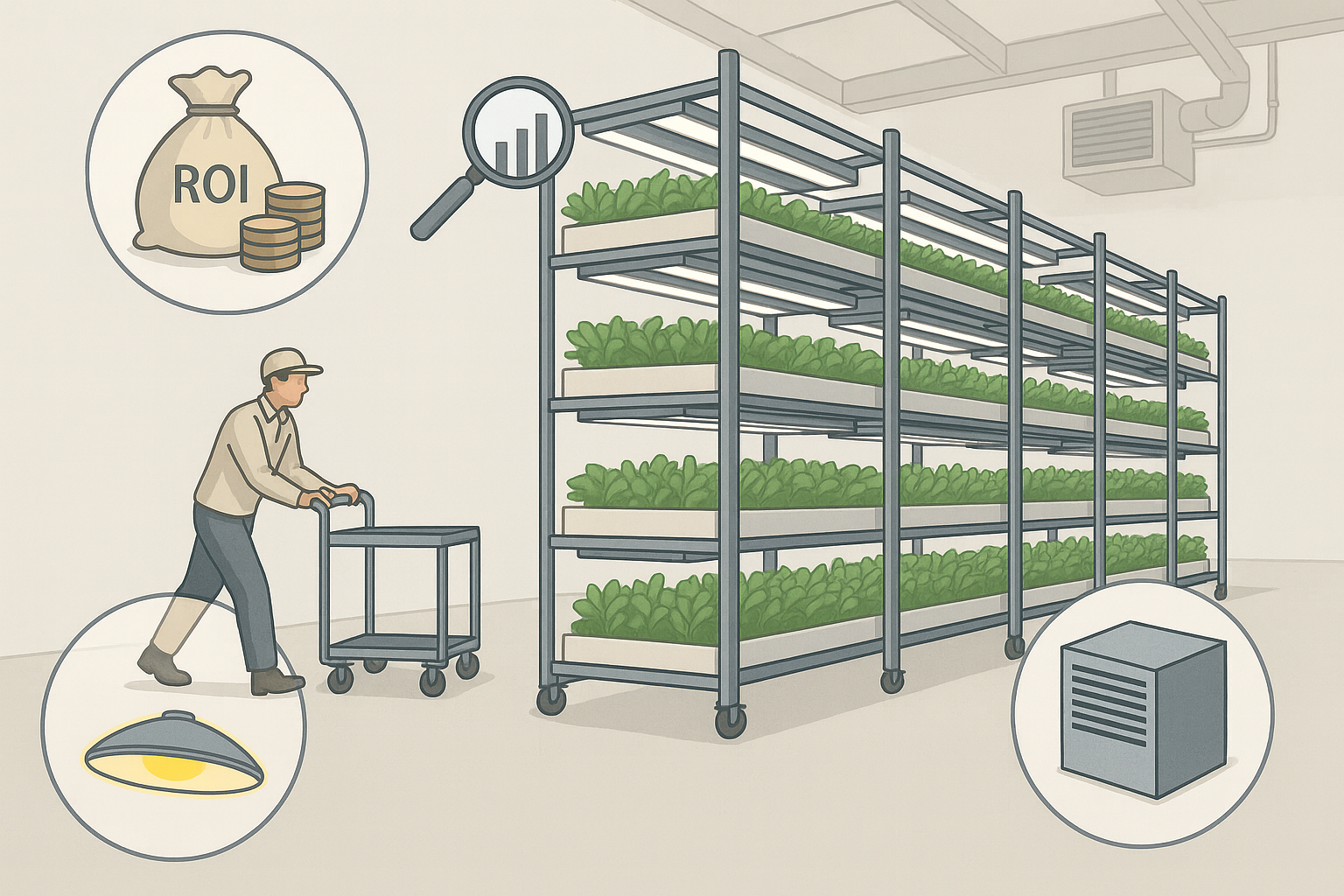
Introduction: The importance of financial performance in CEA
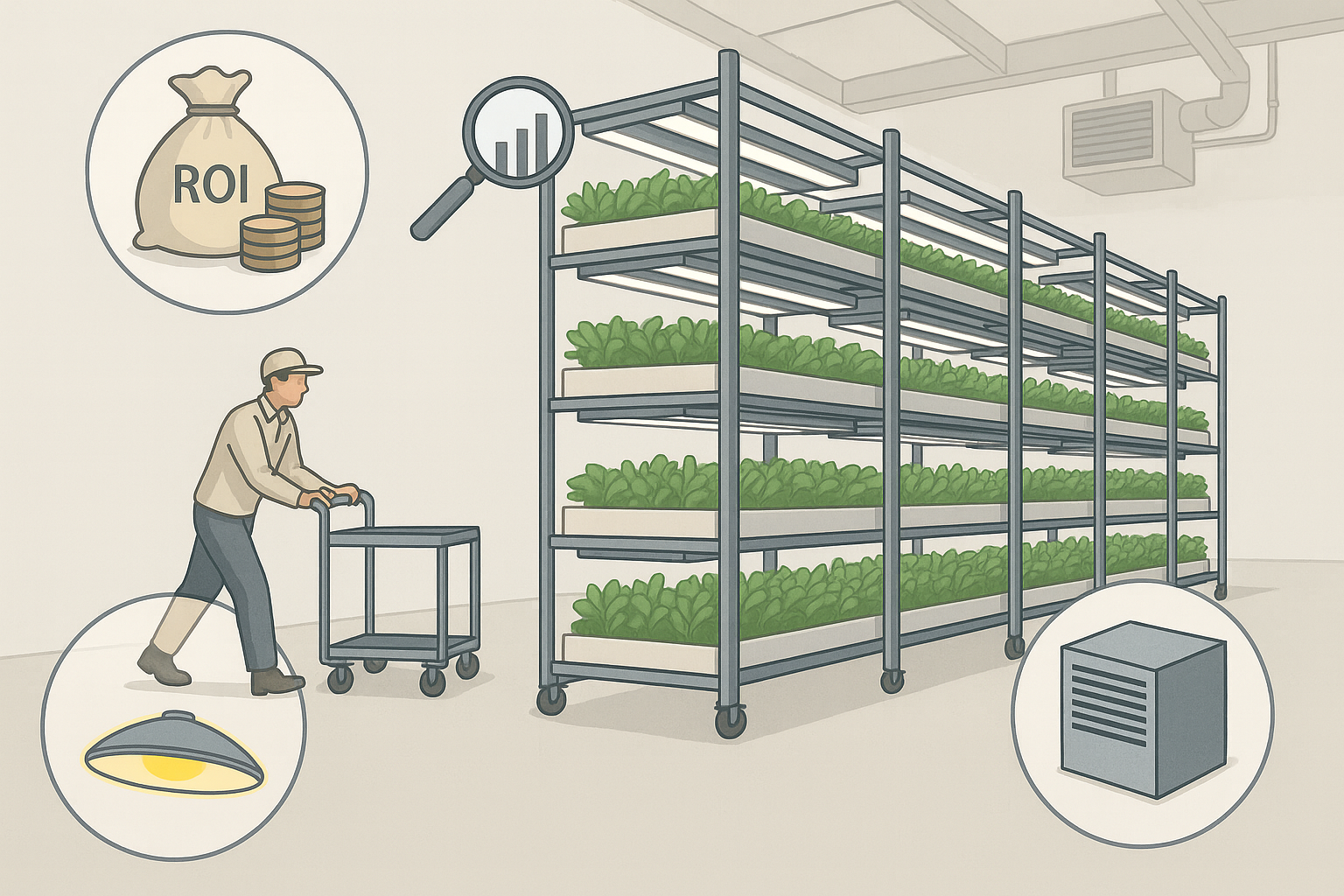
Controlled Environment Agriculture (CEA) and vertical farming are often promoted for their potential to produce high yields in limited space, reduce environmental impact, and provide year-round food production close to consumers. However, for growers, investors, and policy-makers, the central question remains: how to achieve a return on investment (ROI) in CEA and vertical farming in a realistic, sustainable, and measurable way. ROI is the primary indicator of whether an indoor farm can move beyond experimental projects and pilot trials to become a viable business model. Understanding ROI requires more than simple revenue projections; it involves integrating technical performance, operational efficiency, and market dynamics into a coherent strategy.
Defining ROI in the context of indoor farming
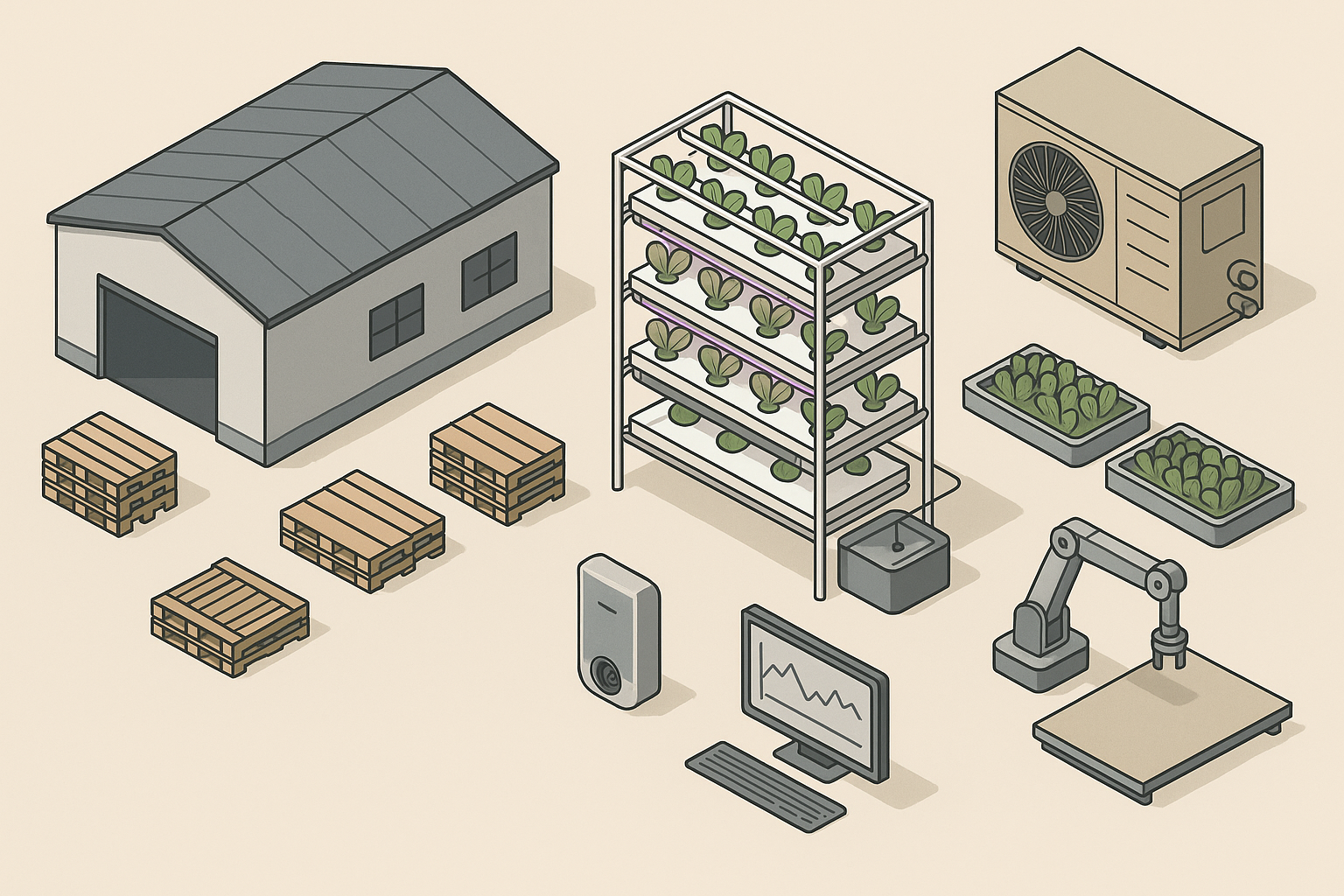
ROI in vertical farming is not just about profit margins. It encompasses the balance between capital expenditure on infrastructure, ongoing operational costs, and the revenues generated from crop sales or service provision. For example, an investor evaluating a 500 m2 warehouse conversion must consider the capital cost of lighting, HVAC, racks, irrigation, and automation alongside recurrent inputs such as electricity, labour, and nutrient solutions. If those costs are not offset by reliable market access and pricing, the project will struggle to deliver a positive return, regardless of its technical performance. This differs from traditional field agriculture, where land and climatic resources are given rather than engineered, and where capital intensity is significantly lower.
Capital investment and depreciation
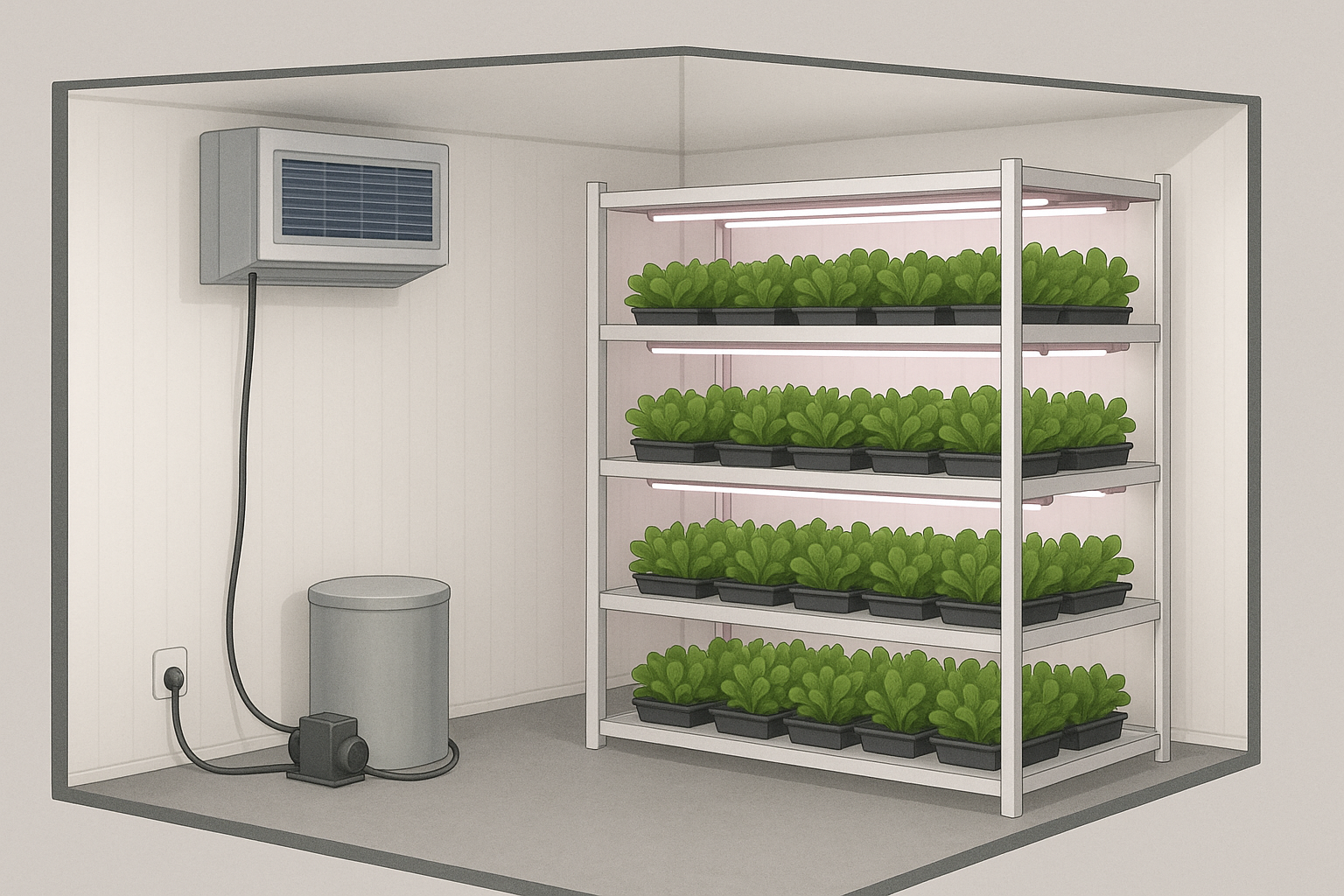
The first step in analysing ROI is to examine the scale of capital investment required. Vertical farms come in all shapes and sizes and can range from small garage or spare-bedroom setups with relatively small initial outlay (<£2000 - 4000k), to containerised modules costing tens of thousands of pounds, to multi-million-pound warehouse facilities. Lighting and environmental control systems typically account for the largest share of upfront costs, while racking, irrigation systems, and automation add further complexity. The expected depreciation of these assets, often over five to ten years, has a direct bearing on financial sustainability. For instance, LED fixtures may be rated for 50,000 operating hours, but if used continuously they may require replacement within six years, which must be factored into long-term ROI calculations.
Operational costs and efficiency
Operational costs are equally critical. Energy is usually the largest recurring expense, representing 30–50% of the operating budget in many CEA systems (Barbosa et al., 2015). Labour efficiency is also pivotal: highly automated systems reduce labour intensity but demand larger upfront capital. Water and nutrient inputs are comparatively minor, but they can still influence profitability when managed at scale. Effective ROI analysis therefore requires detailed modelling of energy demand, labour deployment, and maintenance schedules to identify efficiencies. For example, introducing moveable racks on rails can increase space use efficiency by up to 80% compared to fixed aisles, reducing the cost per kilogram of produce harvested.
Crop choice and revenue streams
Revenue generation depends on aligning crop choice with market demand. High-value crops such as herbs, microgreens, and salad leaves often provide the fastest route to positive ROI because of their short growth cycles, premium retail price, and strong demand from local restaurants and grocers. In contrast, staple crops such as cereals or root vegetables are unlikely to generate viable returns given the current cost structure of vertical farming. Diversification is another important factor: some farms combine fresh produce sales with plant propagation services, agritourism, or educational partnerships, which can spread risk and strengthen income streams. ROI is therefore closely tied to an honest assessment of which markets can sustain premium pricing and which cannot.
Market access and customer relationships
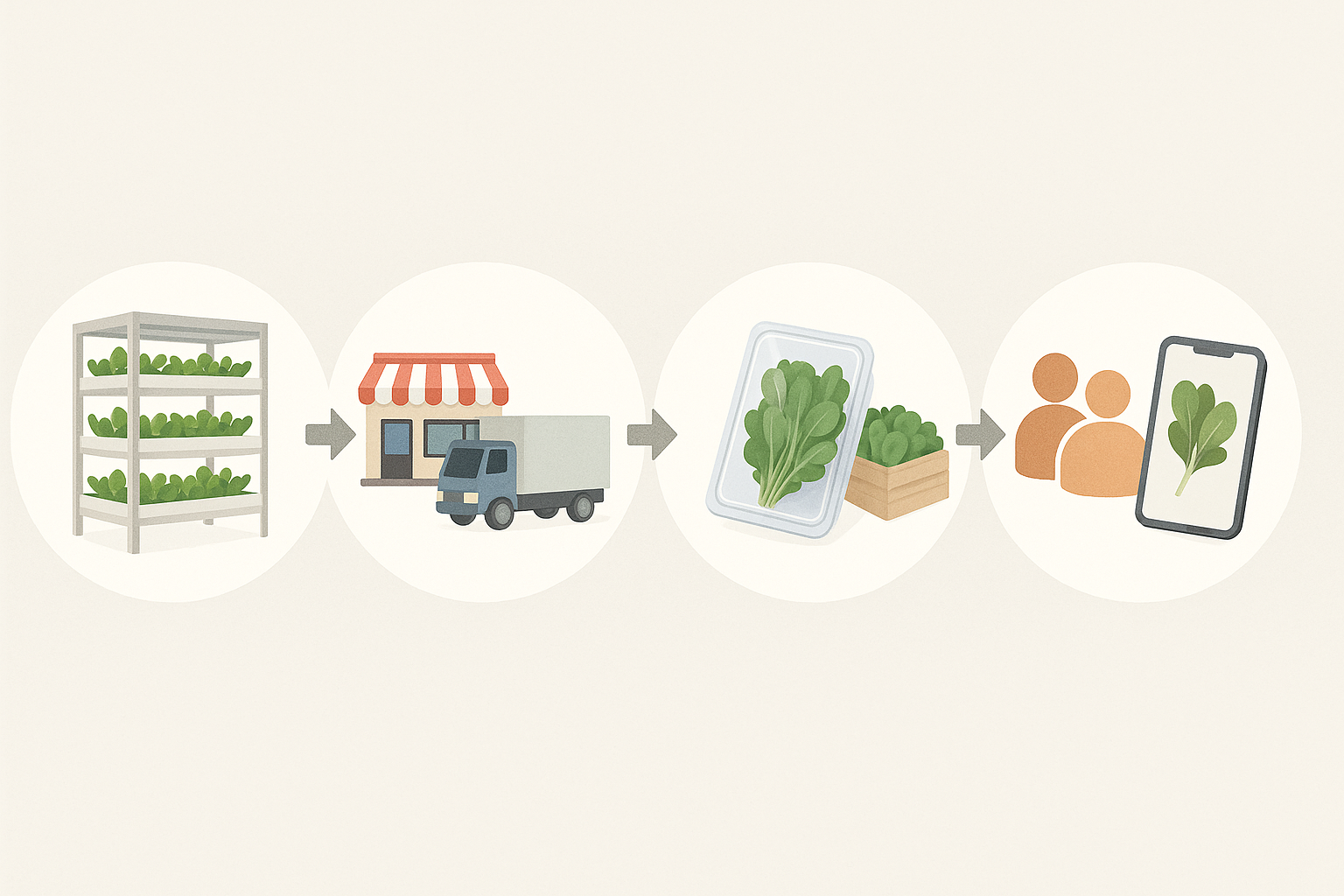
ROI also depends on the strength of customer relationships and the resilience of distribution models. Selling directly to restaurants or through local veg box schemes may offer higher margins than wholesale contracts, but these channels often involve more marketing and logistical effort. By contrast, securing a single large retail contract offers predictable income but exposes the farm to dependency on one buyer. In either case, maintaining consistent quality and delivery schedules is critical. Studies in the UK market have shown that chefs and independent retailers are willing to pay for local, reliable, and pesticide-free supply, but only if the producer can maintain steady output (Graamans et al., 2018). Market access is therefore a structural determinant of ROI.
Risk, resilience, and long-term sustainability
ROI should not be seen as a static metric but as part of a long-term resilience strategy. Energy prices, policy frameworks, and consumer demand can shift rapidly. For example, energy price spikes in 2022–23 exposed vulnerabilities in many indoor farms reliant on grid electricity. Some growers responded by investing in on-site renewable energy generation, which required new capital but improved ROI over time by stabilising operating costs. Similarly, government schemes to support policy interventions may offer grant opportunities that offset capital expenditure, improving financial viability. Factoring in risk mitigation and policy alignment is therefore integral to any serious ROI assessment.
Measuring ROI with precision
Achieving ROI in CEA and vertical farming requires robust financial modelling. Standard ROI formulas (net return divided by total investment) provide a baseline, but sensitivity analysis is needed to test how changes in electricity prices, labour rates, infrastructure depreciation, or crop prices affect outcomes. Digital twins and farm management software are increasingly used to simulate scenarios, test operational adjustments, and track key performance indicators in real time. Such approaches not only improve day-to-day decision-making but also provide investors with transparent data on system performance. Ultimately, precise measurement and honest reporting underpin the credibility of ROI claims in this sector.
Conclusion: Balancing ambition and pragmatism
Maximising ROI in vertical farming is a multi-dimensional challenge. It requires balancing technical efficiency, capital management, crop selection, and market integration with broader considerations of resilience and policy context. The farms that succeed are those that take a realistic, data-driven approach rather than relying on over-optimistic projections. By grounding decisions in rigorous analysis and continuous improvement, vertical farming can demonstrate not only technical feasibility but also financial sustainability. For potential growers, researchers, investors, and policy-makers, understanding ROI is therefore not an afterthought but the central organising principle of CEA.
References
Barbosa, G. L., Gadelha, F. D., Kublik, N., Proctor, A., Reichelm, L., Weissinger, E., Wohlleb, G. M., & Halden, R. U. (2015). Comparison of land, water, and energy requirements of lettuce grown using hydroponic vs conventional agricultural methods. International Journal of Environmental Research and Public Health, 12(6), 6879–6891.
Graamans, L., Baeza, E., van den Dobbelsteen, A., Tsafaras, I., & Stanghellini, C. (2018). Plant factories: Crop transpiration and energy balance. Agricultural Systems, 153, 138–147.