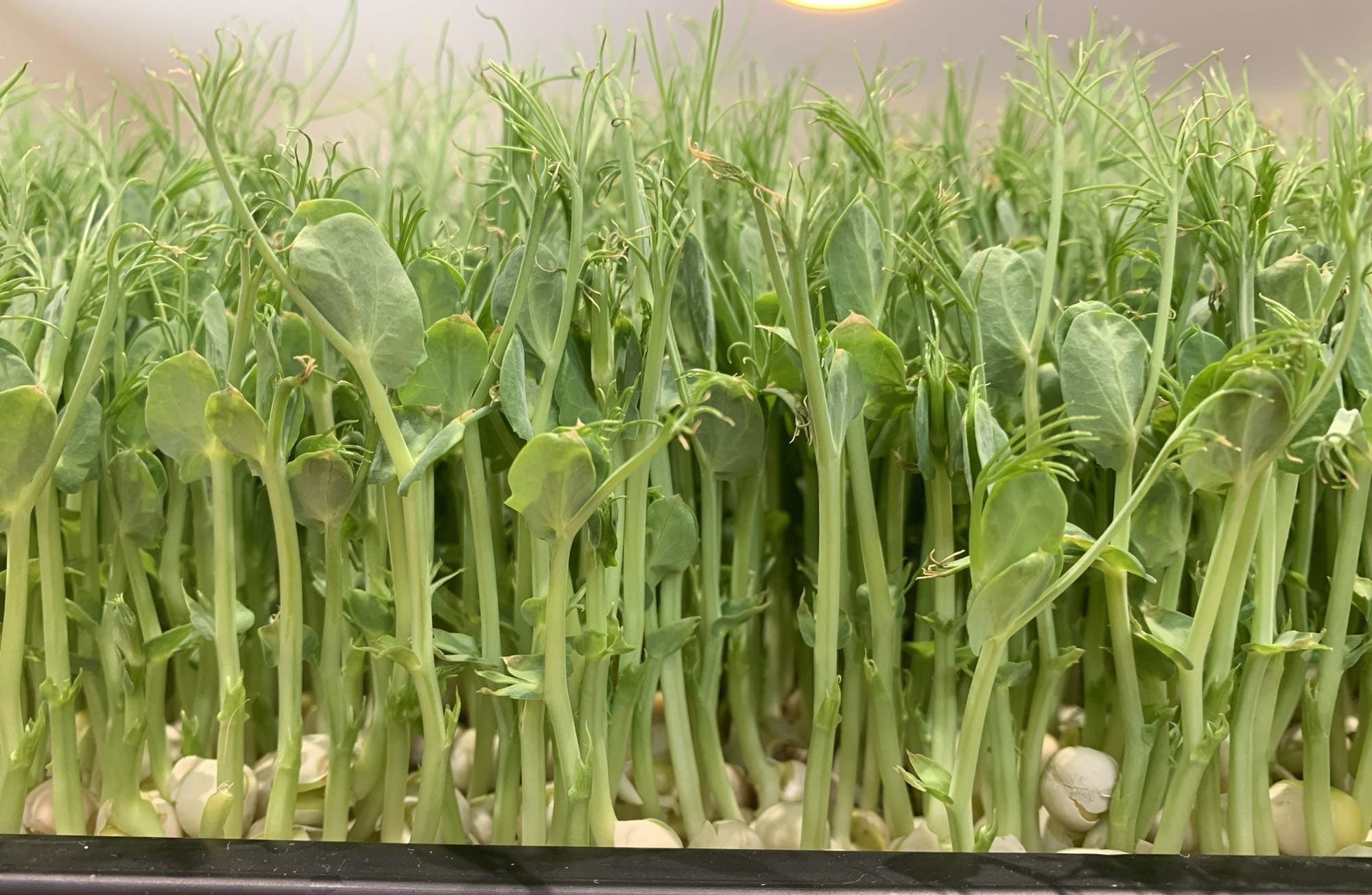
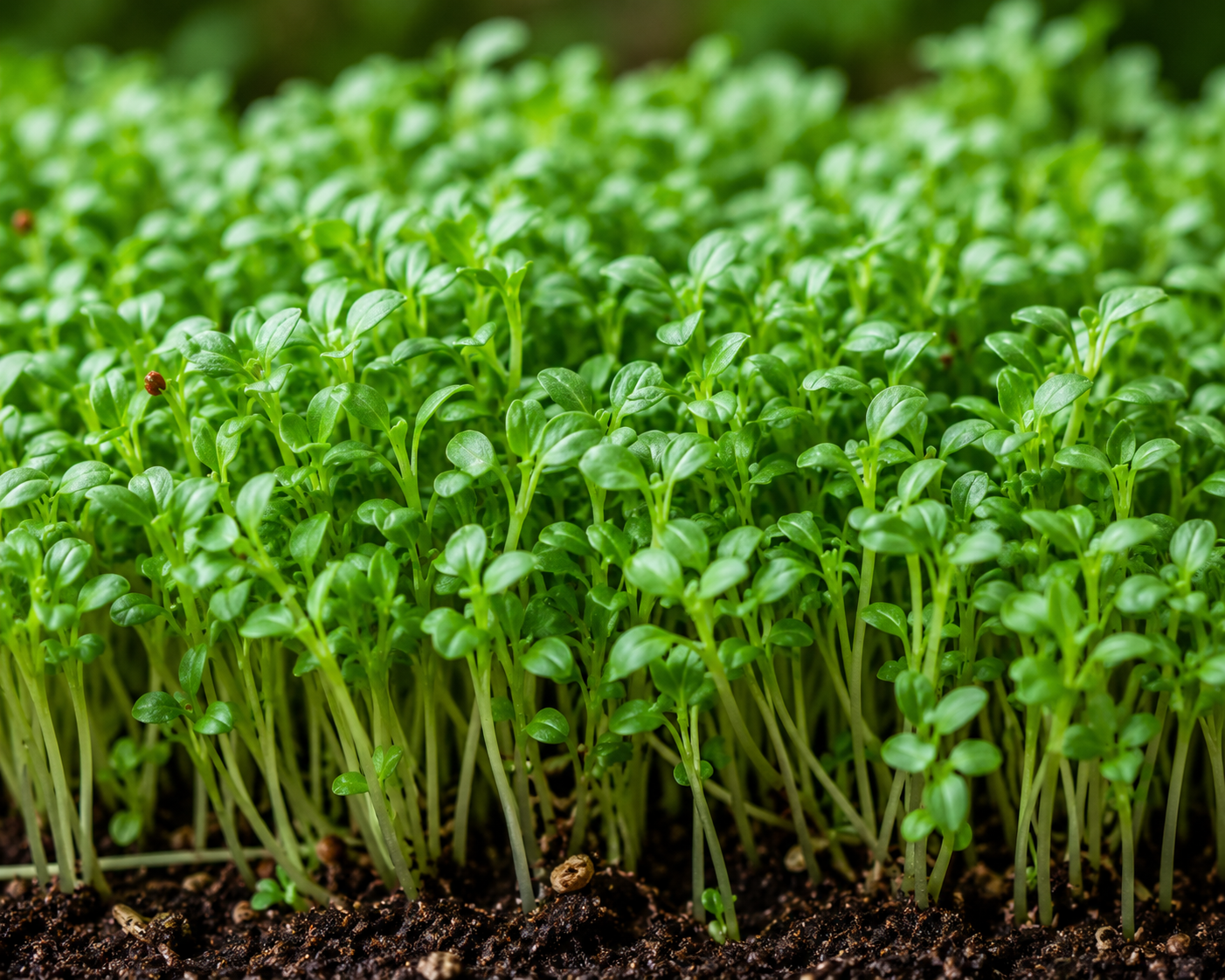
Cress (Lepidium sativum) is a fast growing annual herb. It is often referred to as Garden Cress to avoid confusion with Watercress and other species referred to as varieties of “cress”. Garden Cress and Watercress are related, both being part of the same branch of the Brassicaceae family.
More broadly, this family also contains radish, broccoli and turnips. Many members of this family also produce mustard seeds, and as such cress shares the same peppery and tangy flavour as both mustard and watercress.
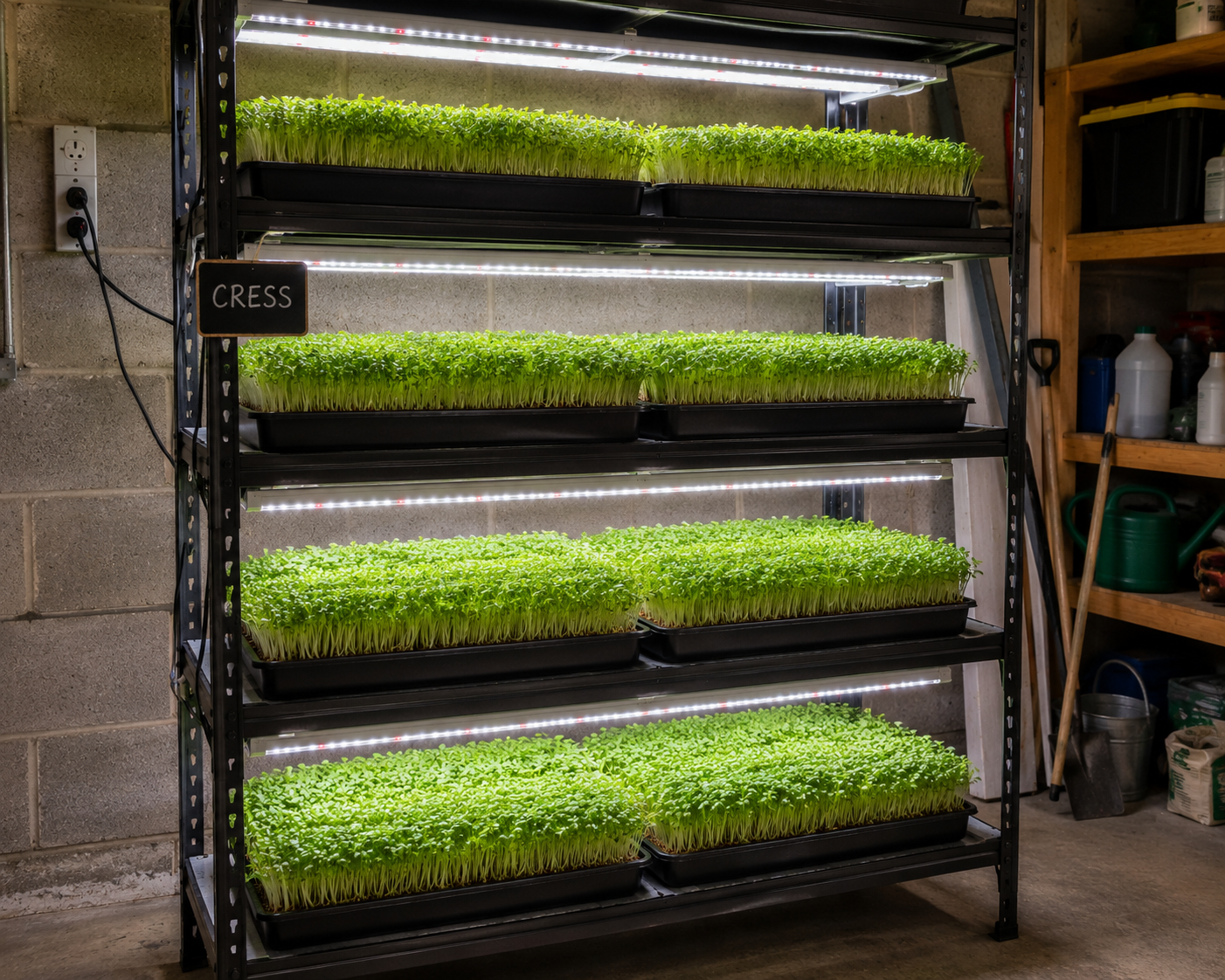
The plant can reach heights of up to 60 cm, but is often harvested within two weeks of harvesting as a microgreen or small salad green, when the shoots are less than 20 cm tall. The plants can be consumed raw, and have a high nutritional value. They are often added to soups and salads, and in the UK a common use is in sandwiches with egg and mayonnaise.
Cress production in controlled environments (brief literature review)
The impact of different nutrient solution salinity conditions on cress seems to depend both on the individual factor and the temperature at which the plants are grown. A study [1] investigated growing the plants at different salinity levels (specifically 1.8, 2.8, 3.8 and 4.8 mS cm-1) in an unheated greenhouse during two separate growing periods. Overall, the highest average yield was achieved using nutrient solution salinity of 1.8 mS cm-1. However, during the second growing season the highest yield was obtained using 3.8 mS cm-1.
Furthermore, which salinity resulted in the highest concentrations of various nutrients also seemed to vary wildly between growing seasons [1]. For example, in the first season sodium was lowest when 1.8 mS cm-1 was used, and highest at 3.8 mS cm-1. However, in the second season it was lowest at 3.8 mS cm-1 and highest at 4.8 mS cm-1. This indicates that temperature can drastically affect the impact of nutrient availability on cress, but the specific interactions between nutrient solution salinity and temperature have not been thoroughly investigated.
Which growth substrate is best also seems to depend on the most desired factors. A study [2] investigated the effects of using two different substates (sterile gauze and sterile grounded biochar) along with different light spectra (white, blue, red and sunlight). Generally, for physical characteristics such as sprout weight and length, white light or sunlight was best, with the best substrate depending on the specific characteristic (eg. gause was better for achieving maximum sprout length, but biochar was better for achieving maximum sprout weight).
However, the highest concentration of polyphenols and flavonoids was achieved under blue light (molecular content was only measured for plants grown using gause) [2]. Overall this suggests that white light or sunlight is generally more effective for the size of the plant, but monocolour blue light may increase the concentration of some important organic molecules. That said, there is also evidence from other research that a mixture or red and blue light results in significant improvement to various plant characteristics compared with sunlight.
A pair of studies measured the impact of using sunlight or two ratios of red and blue LEDs (60R:40B and 90R:10B) [3, 4]. The results showed that both ratios resulted in significant improvement in all measured categories, which included the physical size of the plant and the concentration of chlorophyll, phenols and anthocyanin [3], as well as factors related to the rate of photosynthesis [4]. In most cases, the ratio of 60R:40B resulted in the greatest improvement, though the 90R:10B ratio achieved the greatest increase in dry weight [3], stomatal conductance and total soluble carbohydrates [4].
Grower Insights:
Garden cress is often used in traditional medicine across India and the Middle East. In India, it is known as chandrashoor, and is used as part of the alternative medicinal practice of ayurveda. This practice usually involves a mixture of herbs, minerals and metals in an attempt to balance the three dosha or substances within the body (wind, bile, and phlegm), while suppressing natural urges that are thought of as damaging to health. The practice has been described as pseudoscientific, especially as some of the metals used are toxic.
In the Middle East it is called habbat al hamra, and is again used in traditional medicine. The seeds are also sometimes mixed with custard powder and served as a hot drink. Additionally, due to its fast growth rate, garden cress is often used in educational scientific experiments to help teach children about plants.
References
1) Duyar, H., 2022. Effects of salinity levels of nutrient solution in different growing periods on yield and some quality parameters of garden cress (Lepidium sativum L.) cultivation by floating systems.
2) Livadariu, O., Maximilian, C., Raiciu, A.D. and Șerbănică, C.P., 2022. The assessment of the type of substrate and LEDs’ irradiation influence on garden cress sprouts (Lepidium sativum L.). Applied Sciences, 12(9), p.4732.
3) Ajdanian, L., Babaei, M. and Aroiee, H., 2019. The growth and development of cress (Lepidium sativum) affected by blue and red light. Heliyon, 5(7).
4) Ajdanian, L., Babaei, M. and Aroiee, H., 2020. Investigation of photosynthetic effects, carbohydrate and starch content in cress (Lepidium sativum) under the influence of blue and red spectrum. Heliyon, 6(12).