Robotics and Autonomy in Indoor Farming
Robotics and autonomy in indoor farming are increasingly shaping how food is grown within controlled environments. In vertical farms, greenhouses, and other forms of Controlled Environment Agriculture (CEA), robots are now moving beyond experimental prototypes to become core operational tools. These technologies are not simply replacing human labour; they are redefining how tasks are performed, how crops are monitored, and how data drives decision-making. From automated seeding to robotic harvesting, the integration of robotics into CEA systems represents both a technological and operational shift, offering potential gains in efficiency, consistency, and scalability.
Why Robotics Matters in Indoor Plant Production
Indoor farming operates within tightly regulated environmental conditions, where every element from light to humidity is managed to optimise plant health and yield. While this precision offers considerable advantages, it also requires a consistent and intensive level of labour input. Tasks such as transplanting seedlings, inspecting plants for disease, adjusting nutrient delivery, and harvesting can be repetitive and time-consuming when performed manually. Robotics addresses these challenges by automating labour-intensive activities, reducing variability in quality, and enabling round-the-clock operation without fatigue. This is particularly relevant in regions with labour shortages or where labour costs are high, making automation economically attractive as well as operationally beneficial.
The Types of Robotics Used in CEA
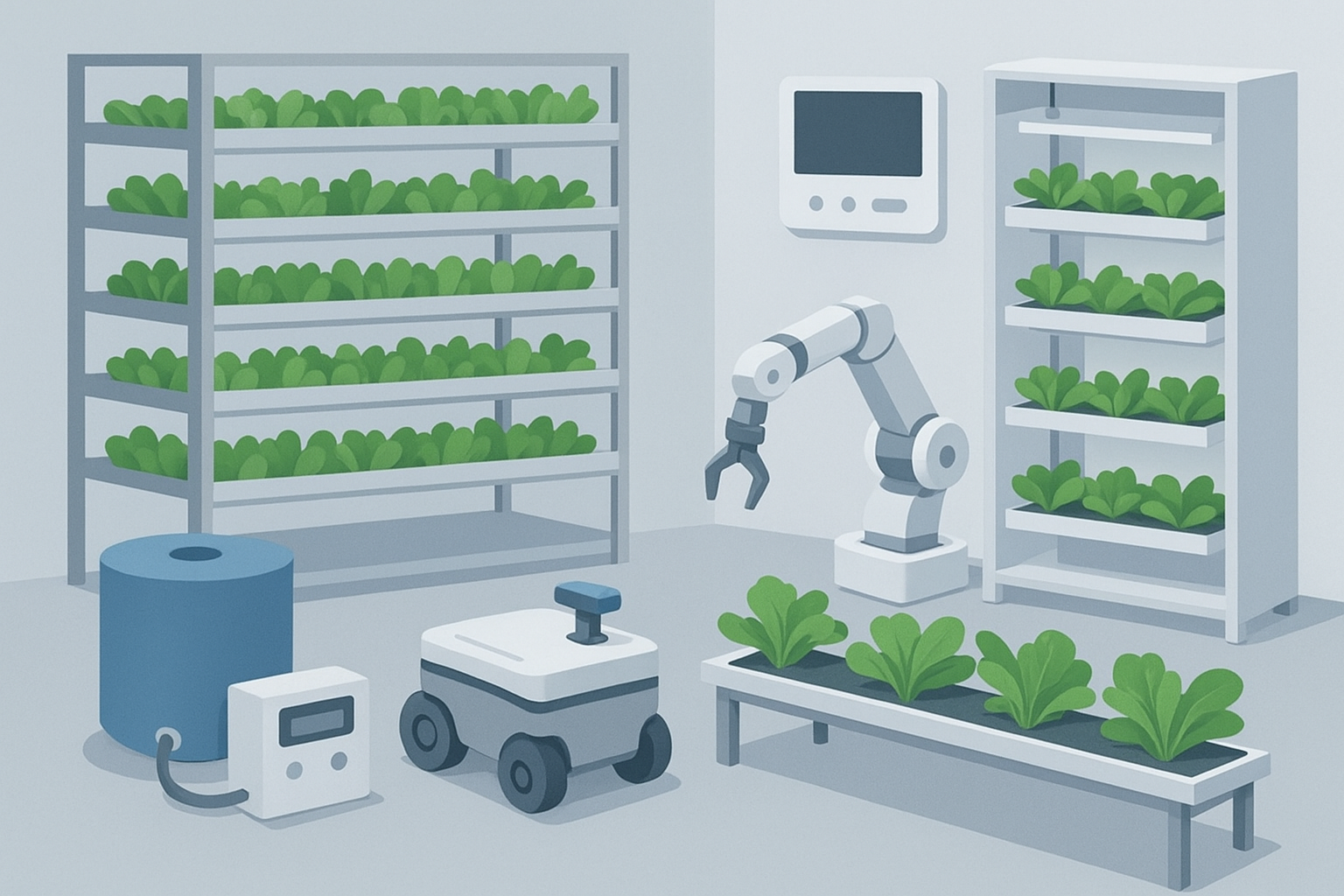
Robotics in indoor farming can be broadly divided into mobile and stationary systems. Mobile robots often navigate between growing racks or along greenhouse aisles, performing monitoring, maintenance, or harvesting tasks. They rely on machine vision and navigation systems to move safely and efficiently in confined spaces. Stationary robotics, in contrast, may be integrated into fixed automation lines, such as automated seeders, transplanters, or robotic arms for precision harvesting. Some systems are modular, allowing a combination of stationary and mobile units to work collaboratively.
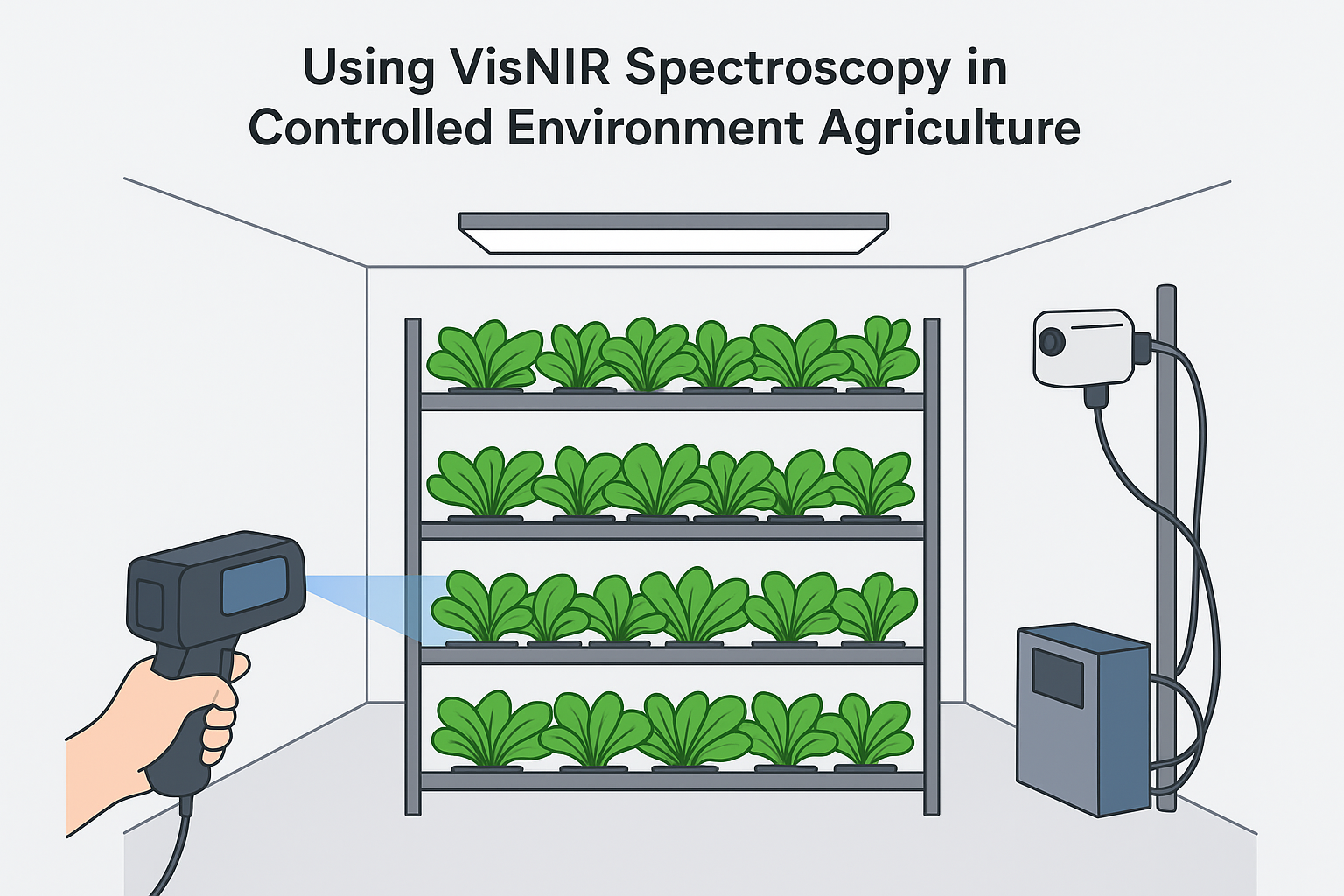
An important category within CEA robotics is crop monitoring robots, equipped with RGB, multispectral, or hyperspectral cameras, and sometimes even LiDAR sensors. These systems can detect subtle changes in plant health that may not be visible to the human eye, enabling early intervention and potentially reducing crop losses. Harvesting robots, another major category, must handle delicate crops without causing damage; this has led to the development of soft grippers, vacuum-assisted pickers, and other adaptive end-effectors.
Integration with Autonomy and Data Systems
Robotics in CEA rarely operate in isolation. Autonomous operation is achieved through integration with environmental control systems, nutrient delivery systems, and farm management software. Data collected by robots can be fed into artificial intelligence models, which may then adjust growing conditions, schedule interventions, or optimise harvest timing. For example, a mobile robot monitoring lettuce growth could automatically trigger lighting adjustments or alter nutrient solution recipes via the farm’s central control system.
This integration also enables predictive maintenance for both plants and machines. A robotic monitoring platform can flag declining plant performance before it becomes visible, while simultaneously reporting mechanical wear or calibration drift within its own systems. In high-value crop production, such as leafy greens, herbs, and strawberries, this level of precision can have a significant economic impact.
Benefits and Limitations
The potential benefits of robotics and autonomy in indoor farming are substantial. Labour efficiency can improve markedly, with robots handling repetitive and ergonomically challenging tasks. Production can become more consistent, as machines apply uniform handling and monitoring techniques. Furthermore, continuous data capture can lead to deeper agronomic insights, supporting more accurate yield forecasting and resource management.
However, adoption is not without challenges. Initial capital costs can be significant, especially for smaller farms, and return on investment may take several years to realise. Maintenance and technical expertise requirements are also higher compared to traditional manual systems. In addition, robotic systems must be tailored to specific crops and production layouts; there is no single universal solution that fits all farms. This often means that a degree of customisation is necessary, which can extend development time and cost.
Current Developments and Future Outlook
Recent advancements in computer vision, artificial intelligence, and lightweight materials are accelerating the capabilities of robotics in CEA. Robots are becoming more dexterous, more precise, and more energy-efficient. Some companies are developing fully autonomous production cells, in which seeding, transplanting, monitoring, and harvesting occur within an enclosed, robot-managed environment. Others are focusing on collaborative robots (cobots) that work alongside human operators, enhancing productivity without replacing human judgement and adaptability.
Looking ahead, increased standardisation of growing systems could lower barriers to automation. If production environments adopt consistent layouts and crop handling protocols, robot manufacturers will be able to design systems with greater cross-farm compatibility. Advances in machine learning may also enable robots to adapt more rapidly to new crop varieties or changing environmental parameters without extensive reprogramming. In the longer term, fully autonomous vertical farms with minimal human intervention could emerge, potentially operated remotely via cloud-based control systems.
Environmental and Economic Implications
The integration of robotics into indoor farming has both environmental and economic implications. From an environmental perspective, greater precision in resource application can reduce waste in water, fertiliser, and energy. If robots can detect and address plant stress early, they may also help reduce the need for chemical interventions. Economically, robotics could potentially make high-quality, locally grown produce more competitive against imports, particularly in urban centres where land is expensive but demand for fresh produce is high – but, this will only be true in scenarios where the initial capital investment in robotic technology is reduced.
Nevertheless, the overall sustainability of robotic CEA depends on how energy and materials are sourced, as well as how systems are maintained and eventually decommissioned. While automation can improve operational efficiency, it should be implemented alongside broader sustainability measures, such as renewable energy integration and circular resource management.
Conclusion
Robotics and autonomy in indoor farming represent a significant evolution in the way food is produced under controlled environment conditions. By addressing labour challenges, enhancing operational precision, and enabling deeper integration with digital farm management systems, these technologies have the potential to transform CEA operations at multiple scales. However, successful adoption requires careful consideration of costs, compatibility, and long-term sustainability. As robotics technology matures and becomes more accessible, it is likely to play an increasingly central role in the future of vertical farming and other forms of CEA, contributing to a more resilient and efficient food production system.