Introduction: Why Accessible Technology Matters in Indoor Agriculture
Affordable smart farm technology for indoor farming is a key driver in making Controlled Environment Agriculture (CEA) viable for a broader range of growers. While early CEA systems often relied on expensive, custom-engineered solutions, the availability of low-cost sensors, automation modules, and data platforms is shifting the economics of indoor farming. This trend has significant implications: it lowers the barrier to entry for small and medium-scale producers, supports experimentation in research and education, and encourages adoption in regions or communities where high-capital systems would be impractical. In effect, affordable smart technologies are transforming indoor farming from a niche practice into a more accessible, adaptable, and scalable food production method.
The Role of Smart Tools in a Controlled Environment
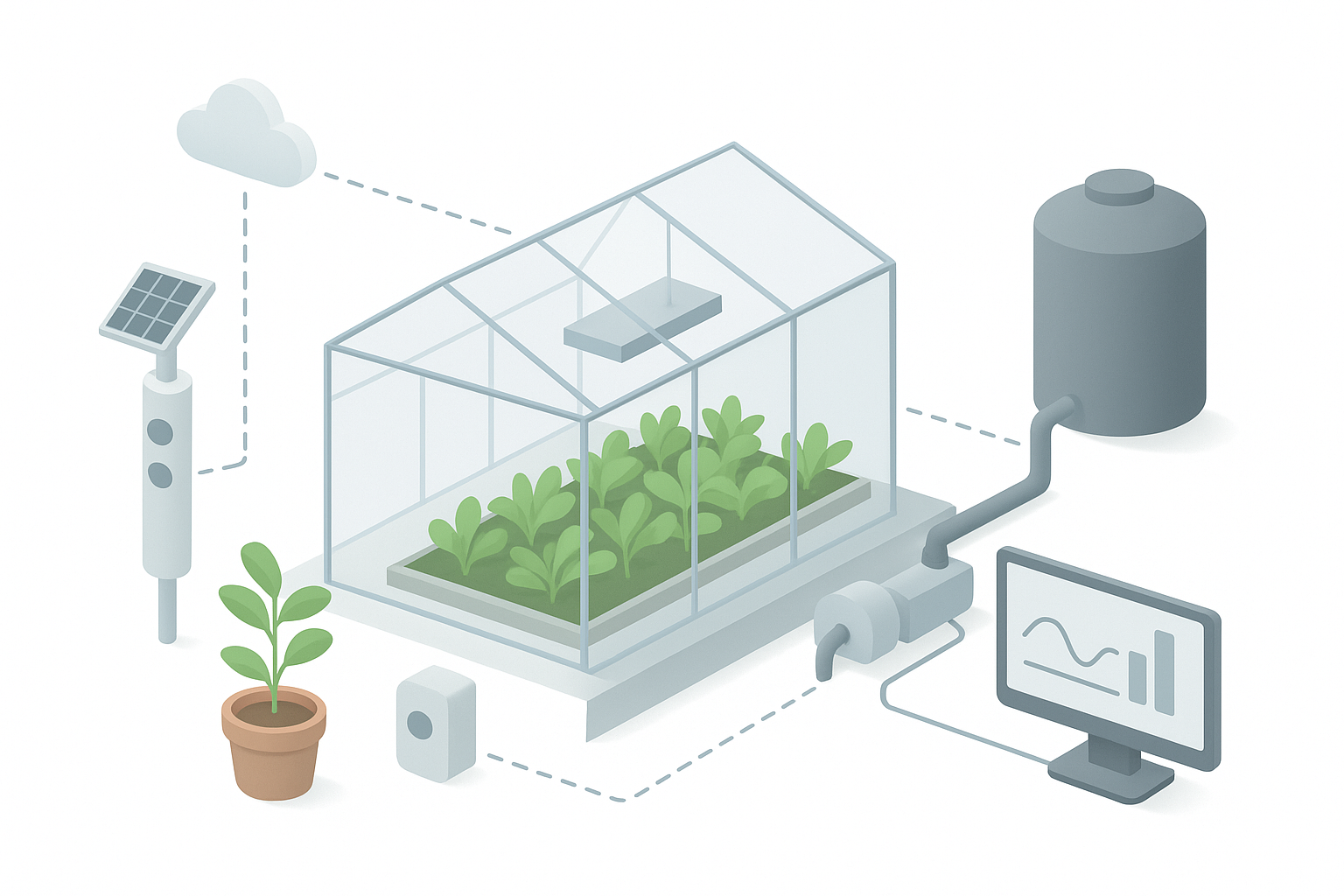
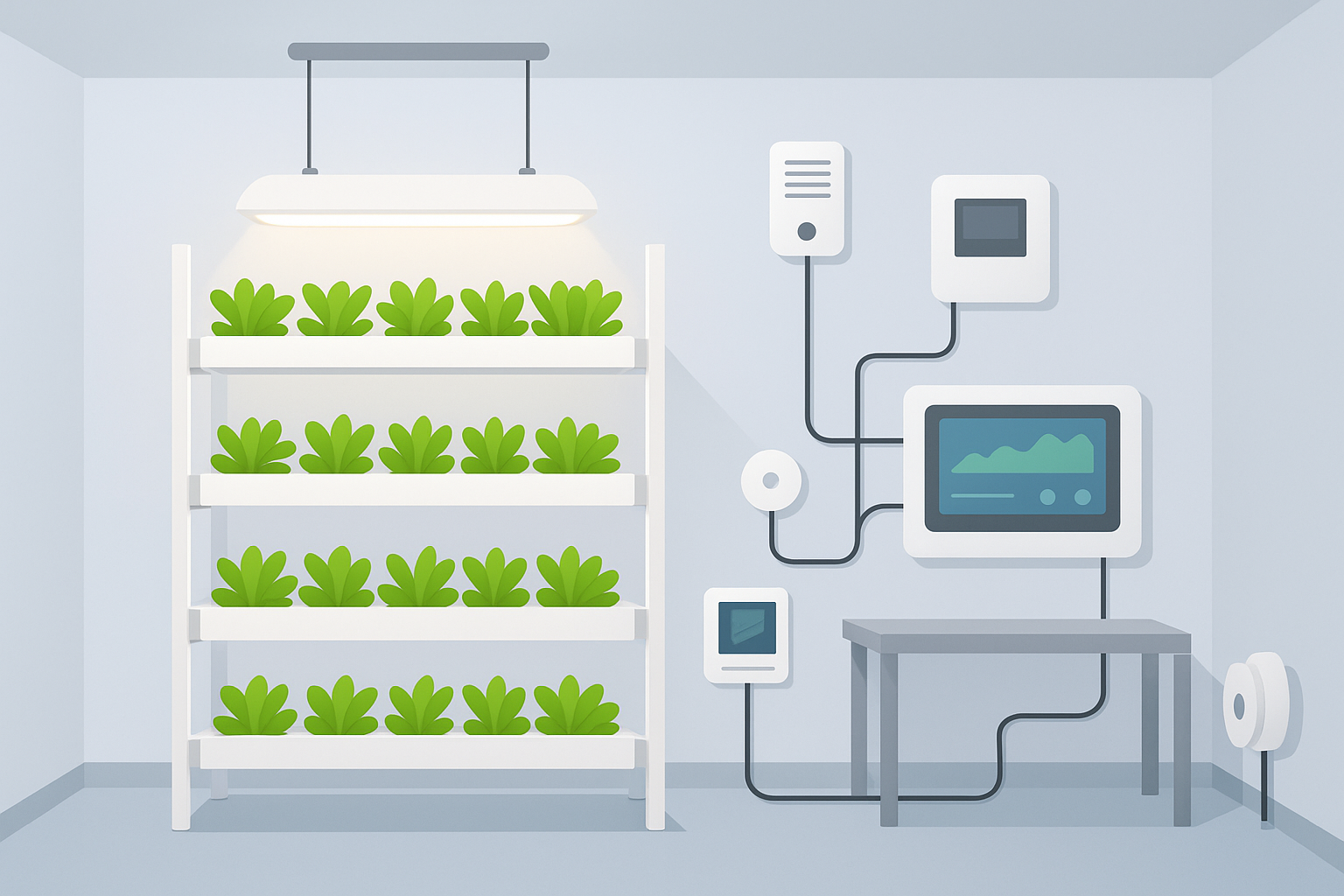
Smart farming tools in an indoor context generally combine three capabilities: sensing, automation, and data analysis. Sensors monitor key parameters such as air temperature, humidity, CO2 concentration, and light intensity; these feed into automated control systems that adjust lighting, irrigation, ventilation, and nutrient delivery. Data platforms then aggregate and interpret the readings, enabling growers to make informed decisions about crop care. In the past, such integration demanded proprietary hardware and specialised engineering. Today, off-the-shelf microcontrollers, low-cost wireless sensors, and open-source software can perform many of the same functions with reasonable accuracy and reliability.
An example is the use of compact environmental monitors, available for under £50, that can connect via Wi-Fi or Bluetooth to a central dashboard. These provide near real-time visibility of conditions at plant level, allowing for timely interventions. When paired with affordable actuators or relays, even basic environmental triggers, such as switching on a fan when humidity exceeds a set threshold, can be implemented with minimal cost and technical training.
Cost Reduction through Open Standards and Scalable Design
One of the most significant enablers of affordable indoor farm technology is the spread of open-source hardware and software platforms. Devices such as Arduino and Raspberry Pi have become common in agriculture projects due to their low cost, large community support, and adaptability. Similarly, open protocols like MQTT (message queuing telemetry transport) allow devices from different manufacturers to share data over a single network. This interoperability reduces reliance on proprietary ecosystems that can lock users into expensive upgrades.
Scalable design is another factor. Affordable tools often start small, handling a single task, but can be expanded as the farm grows. For instance, a grower might begin with a single environmental sensor node and a basic timer-based irrigation system, then gradually add modules for fertigation control, light dimming, or predictive analytics as budget and need allow. This staged investment model aligns particularly well with start-ups and research projects, where budgets are often phased rather than front-loaded.
Balancing Affordability with Reliability
Low-cost equipment does not always equate to low-quality, but affordability often comes with trade-offs. Cheaper sensors may have reduced precision, shorter lifespan, or limited calibration options. For example, an inexpensive humidity sensor may perform well in steady conditions but drift in accuracy under fluctuating temperatures. Mitigation strategies include redundancy (using multiple inexpensive sensors to cross-check data) or adopting a hybrid approach, where affordable devices handle non-critical monitoring while more accurate instruments are reserved for tasks where precision is paramount.
Power management, connectivity stability, and physical durability also influence the long-term viability of affordable smart farming tools. In a humid, warm environment such as a vertical farm, protective enclosures, corrosion-resistant components, and robust cabling can make the difference between equipment lasting months or years. These considerations are essential in ensuring that the initial cost savings of affordable devices translate into genuine operational value.
Broader Impacts: Accessibility, Education, and Innovation
The availability of affordable smart farm technology is not only lowering costs for commercial growers but is also enabling innovation in unexpected contexts. Educational institutions can now integrate indoor farming modules into curricula without requiring major capital outlay, giving students hands-on experience with modern agricultural practices. Community food projects and urban agriculture initiatives can adopt low-cost monitoring and automation to boost yield and reduce labour without prohibitive investment.
For researchers, particularly in developing countries, affordable smart tools open the door to conducting experiments and collecting data that would previously have been out of reach. Such democratisation of technology supports global collaboration and accelerates the exchange of best practices. Moreover, as adoption widens, manufacturers benefit from increased volumes, which can further reduce prices and encourage the development of devices optimised for indoor farming applications.
Looking Ahead: Trends in Affordability and Integration
The next phase of affordable smart farming tools for indoor farming will likely focus on deeper integration and improved interoperability. Cloud-connected analytics, AI-assisted decision-making, and predictive maintenance systems are already filtering down from high-end CEA operations into budget-conscious setups, driven by falling computing costs and open-source development. Advances in sensor miniaturisation and wireless communication standards promise to reduce the physical footprint of monitoring systems, making it easier to retrofit older facilities or adapt tools for unconventional growing spaces.
At the same time, affordability will increasingly be defined not only by purchase price but by total cost of ownership, including maintenance, energy consumption, and potential downtime. As indoor farming expands to meet urban food security needs and to serve niche markets such as high-value crops or pharmaceutical plants, the combination of cost-effective smart tools and careful system design will be a decisive factor in commercial success.
In summary, affordable smart farm tech for indoor farming is reshaping the sector’s economics and accessibility. By combining low-cost sensors, open-source control systems, and scalable integration, growers of all sizes can adopt data-driven practices once reserved for high-budget operations. The result is a more inclusive, adaptable, and sustainable approach to food production within controlled environments.