
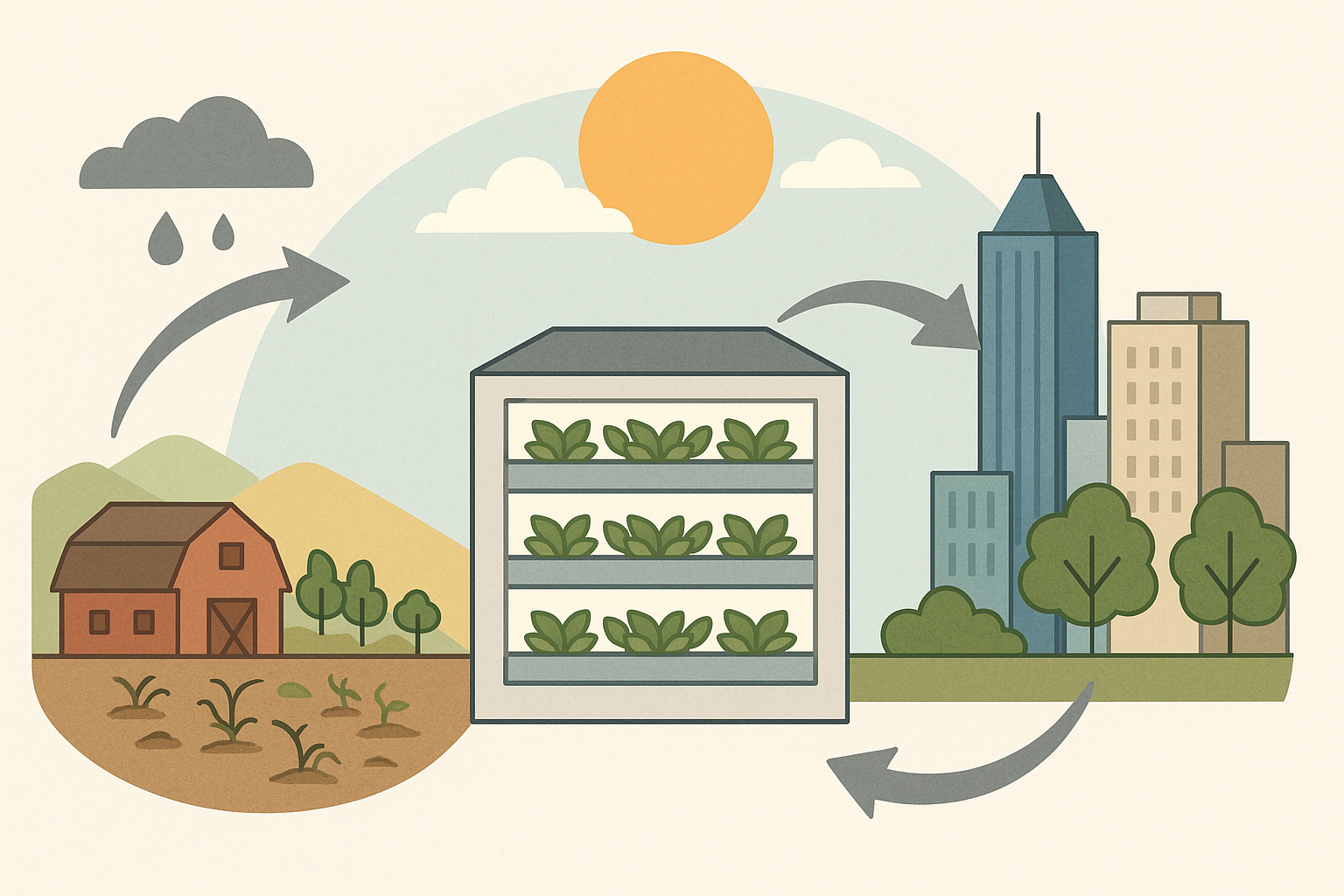
Controlled Environment Agriculture (CEA) represents a radical rethinking of how and where we grow food. At its core, the CEA vision is about designing resilient, resource-efficient food systems that operate independently of traditional climatic and geographical constraints. Vertical farming is one of its most visible applications: a form of CEA that layers crop production vertically in controlled, often indoor, environments. But beyond the technological novelty lies a deeper purpose: to address the pressing global challenges of food security, urbanisation, climate change, and land degradation. This article explores the underlying motivations, ambitions, and long-term implications of the movement towards CEA and vertical farming, tracing the evolution of a vision that is steadily reshaping agriculture for the twenty-first century.
From Land-Based Agriculture to Controlled Systems: A Necessary Shift
The historical model of agriculture, reliant on soil, seasonality and expansive land use, is increasingly under strain. Arable land is diminishing due to urban expansion, soil depletion and pollution; meanwhile, the global population is projected to reach nearly 10 billion by 20501. Meeting future food demand using conventional methods would require unsustainable increases in land, water and energy use. CEA, by contrast, offers an alternative rooted in control, efficiency and locality.
The vision behind CEA is therefore not merely about technological optimisation; it is about rethinking the foundational assumptions of food production. By decoupling crop growth from external weather patterns, CEA systems allow for year-round, high-density cultivation with dramatically reduced inputs. This includes efficient use of water (typically up to 95% less than field farming - 2), minimised pesticide reliance, and proximity to consumers, which reduces transportation emissions and spoilage.
Urban Agriculture and the Redesign of Food Systems
Vertical farming epitomises a growing ambition to reintegrate agriculture into the urban fabric. The urban CEA vision proposes that cities, often viewed as sites of consumption and waste, can become centres of food production. By locating farms closer to the point of sale or consumption, vertical farms reduce supply chain vulnerabilities and offer fresher produce with lower environmental impact.
This vision extends beyond mere space-saving. It represents a paradigm in which agriculture becomes modular, scalable, and adaptive to local needs. In cities like Singapore, Tokyo, and New York, vertical farms are already demonstrating how underused urban infrastructure, (rooftops, warehouses, even underground spaces) can become productive assets3. In regions facing climatic extremes or import dependency, the appeal of localised, controllable production systems is particularly compelling.
Climate Change Resilience and Environmental Sustainability
Climate change is one of the most significant threats to global food systems. Extreme weather events, shifting rainfall patterns and rising temperatures are making open-field agriculture increasingly unpredictable. CEA offers a strategic buffer against these risks. In sealed environments, growers can maintain optimal conditions for plant growth regardless of external variables, thereby ensuring more reliable yields.
Moreover, CEA systems, when powered by renewable energy sources and integrated into circular resource flows (such as nutrient recycling and rainwater harvesting), can become models of low-impact agriculture. Studies suggest that vertical farms, despite their current energy demands, have the potential to achieve low carbon production, potentially even carbon neutrality, as renewable integration improves and LED technology becomes more efficient (4).
The environmental vision driving CEA is thus one of sustainable intensification: producing more food with fewer resources, lower emissions, and reduced ecological harm. This is not a futuristic ideal; it is already being piloted in commercial operations and research institutions worldwide.
Technological Integration and the Rise of Data-Driven Growing
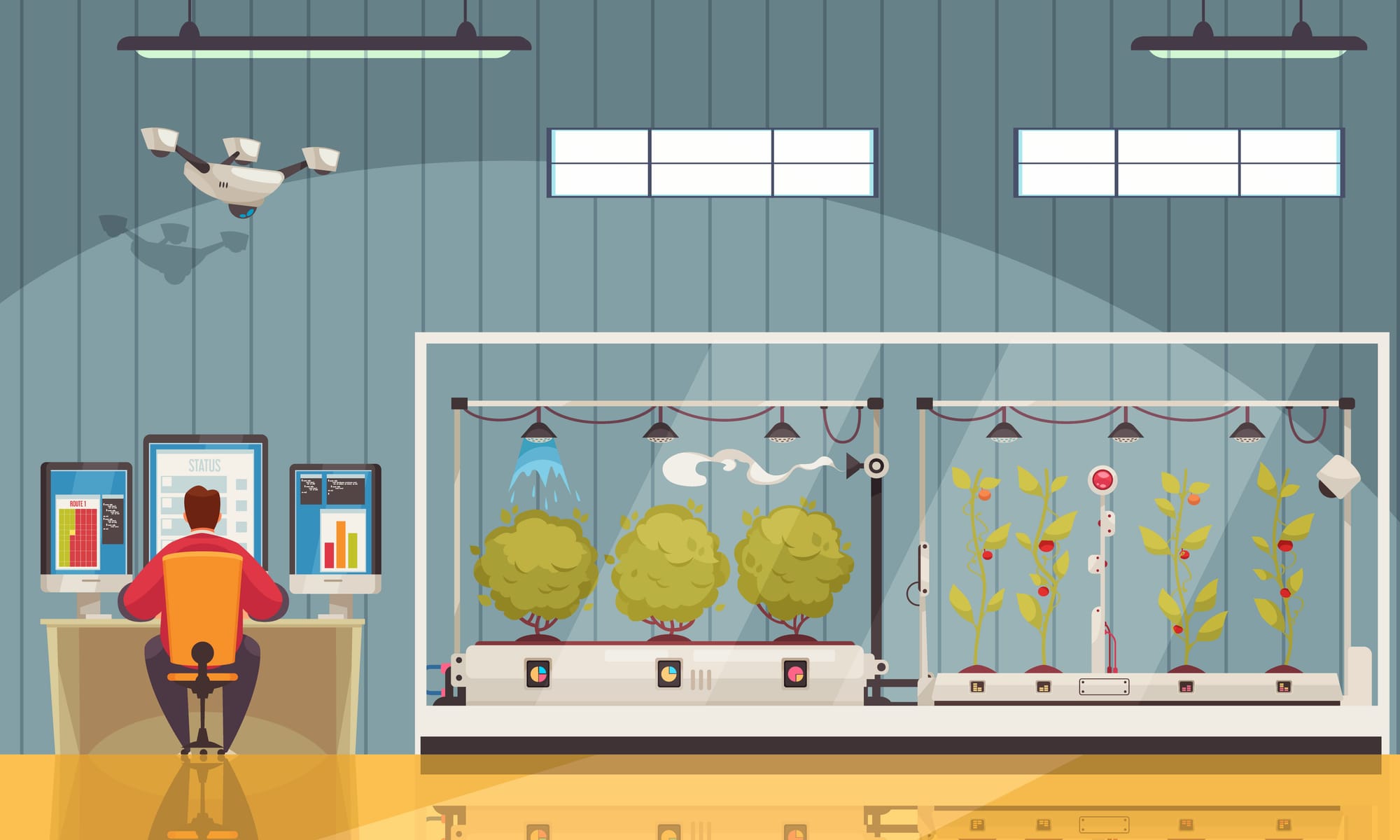
One of the most distinctive features of CEA is its reliance on precise environmental control, enabled by sensors, automation, and advanced data analytics. In contrast to conventional farming, which must contend with natural variability, CEA allows growers to manipulate variables such as light intensity, temperature, humidity, carbon dioxide concentration and nutrient delivery with a high degree of accuracy.
This scientific control has led to the concept of ‘crop recipes’: optimised growth protocols for specific plant varieties, developed through iterative experimentation and machine learning. As artificial intelligence becomes more integrated with CEA systems, the capacity for autonomous decision-making and continuous optimisation is expanding.
The vision here is one of ‘programmable agriculture’, where the biological needs of plants are matched precisely with the available environmental inputs. For researchers and technologists, this presents an unprecedented opportunity to refine agronomic knowledge and to innovate new growing systems tailored to future needs.
Socio-Economic Considerations: Equity, Employment, and Education
While the technological promise of CEA is substantial, its long-term impact depends equally on how it addresses social and economic dimensions. The CEA vision is not purely mechanistic; it encompasses questions of access, inclusivity, and community benefit.
In many regions, vertical farms are being used as educational tools, community assets, or vehicles for workforce development. Programmes in urban areas have demonstrated how CEA can provide employment opportunities, especially in regions with declining manufacturing bases5. Moreover, the controlled, often indoor nature of the work offers new possibilities for safer, more inclusive working conditions, particularly for those with physical limitations or health vulnerabilities.
However, issues remain around affordability and access. Will CEA-grown produce be accessible to all, or will it remain a premium commodity? Will automation in vertical farms displace traditional farming jobs, or create new categories of employment? These are not peripheral questions, they are central to the long-term legitimacy and social value of the CEA movement.
Global Adoption and Regional Variations
The global uptake of CEA varies significantly according to climate, policy, and market maturity. In Asia, high population densities and import dependence have driven early adoption, with countries like Japan and Singapore investing heavily in vertical farming research and infrastructure6. In North America and Europe, interest has often been market-led, driven by consumer demand for fresh, local, pesticide-free produce.
In the Middle East, where water scarcity is acute, CEA is increasingly seen as a strategic necessity. In the Netherlands, a global leader in horticultural innovation, CEA forms part of a national strategy for sustainable agricultural exports, with high-tech greenhouses and vertical farms contributing to food system resilience and innovation.
These regional differences reflect not only climatic or demographic conditions, but also variations in the underlying vision of CEA: as a commercial venture, a national food security strategy, or a tool for urban regeneration.
What Lies Ahead: Innovation and Integration
As CEA technologies mature, the boundaries between different systems (greenhouses, vertical farms, aquaponics, and biotech-enabled growing) are beginning to blur. The future may lie in hybrid models that combine the strengths of each approach: precision agriculture with renewable energy integration; urban production with rural supply chains; low-tech accessibility with high-tech control.
A key challenge for the CEA vision is scale: can it feed a significant portion of the global population, or will it remain a supplementary niche? Addressing this question will require progress in areas such as energy efficiency, economic viability, and crop diversity. Currently, vertical farms focus mainly on leafy greens and herbs; expanding into staple crops remains an ongoing research goal.
The next frontier may also involve biotechnological advances: engineered crops optimised for CEA conditions, or novel growing media that further reduce environmental impact. Policy frameworks will play a critical role in facilitating or constraining these developments.
Conclusion: A Vision Grounded in Necessity and Possibility
The CEA vision is both a response to urgent global pressures and an articulation of an alternative future. It embodies a belief that food production can be redesigned: made more efficient, resilient, and equitable. This is not a utopian project, but a practical, evolving strategy grounded in science, innovation and a reassessment of how we value land, labour, and food.
The long-term success of CEA and vertical farming will depend not only on technical refinement, but also on broad collaboration between scientists, growers, policy-makers, and communities. As the sector develops, critical questions remain: How will this evolve as technology advances? What forms of CEA will prove most viable across different regions? And how can this vision contribute not only to agricultural efficiency, but to wider ecological and social renewal?
Footnotes
- United Nations Department of Economic and Social Affairs. World Population Prospects 2022.
- Barbosa, G.L. et al. (2015). “Comparison of Land, Water, and Energy Requirements of Lettuce Grown Using Hydroponic vs. Conventional Agricultural Methods”. International Journal of Environmental Research and Public Health, 12(6), 6879–6891.
- Banerjee, C. & Adenaeuer, L. (2014). “Up, Up and Away! The Economics of Vertical Farming”. Journal of Agricultural Studies, 2(1), 40–60.
- Beacham, A.M., Vickers, L.H. & Monaghan, J.M. (2019). “Vertical farming: a summary of approaches to growing skywards”. The Journal of Horticultural Science and Biotechnology, 94(3), 277–283.
- Al-Kodmany, K. (2018). “The Vertical Farm: A Review of Developments and Implications for the Vertical City”. Buildings, 8(2), 24.
- Kozai, T. (2016). “Resource use efficiency of closed plant production system with artificial light”. Acta Horticulturae, 1134, 27–34.