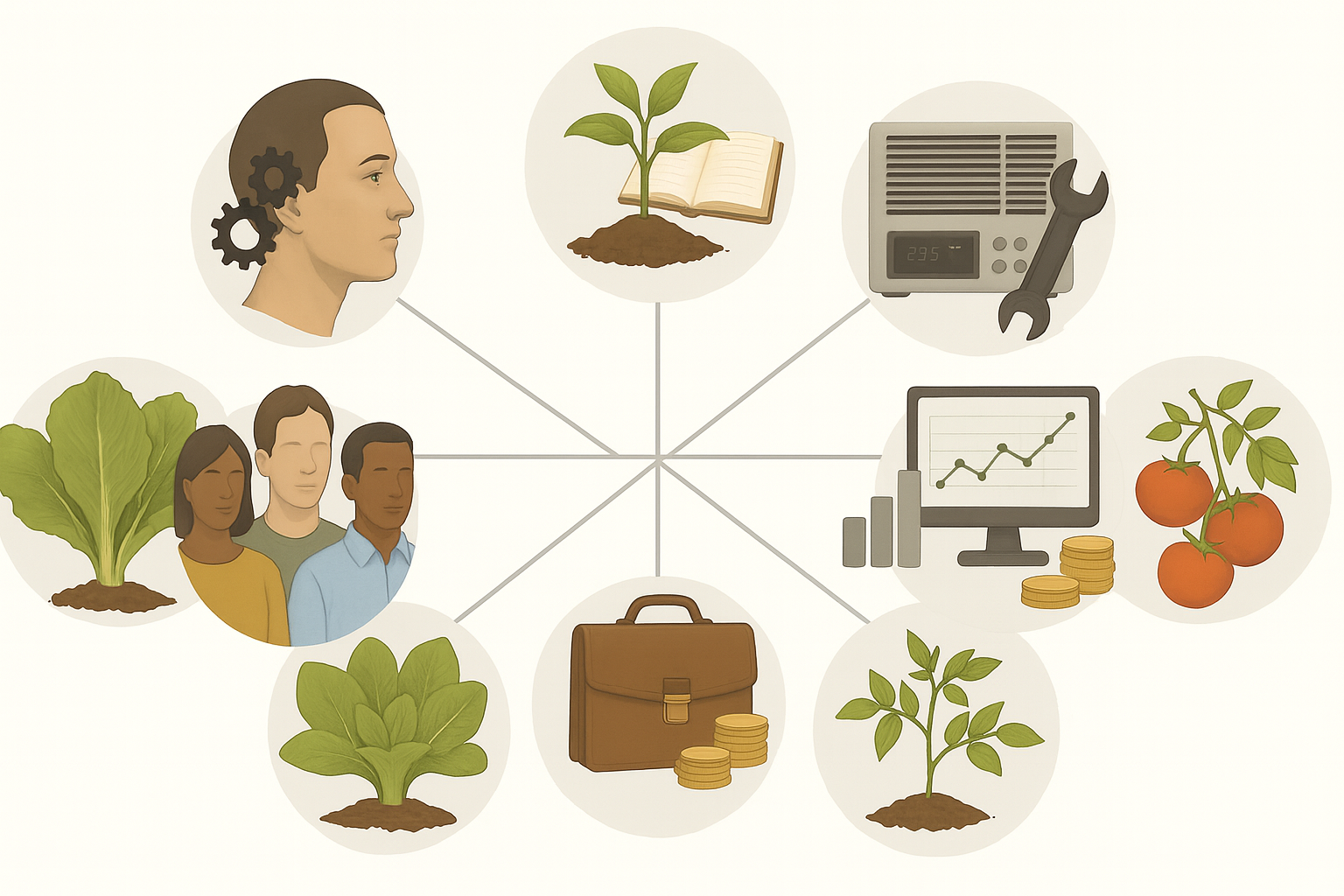
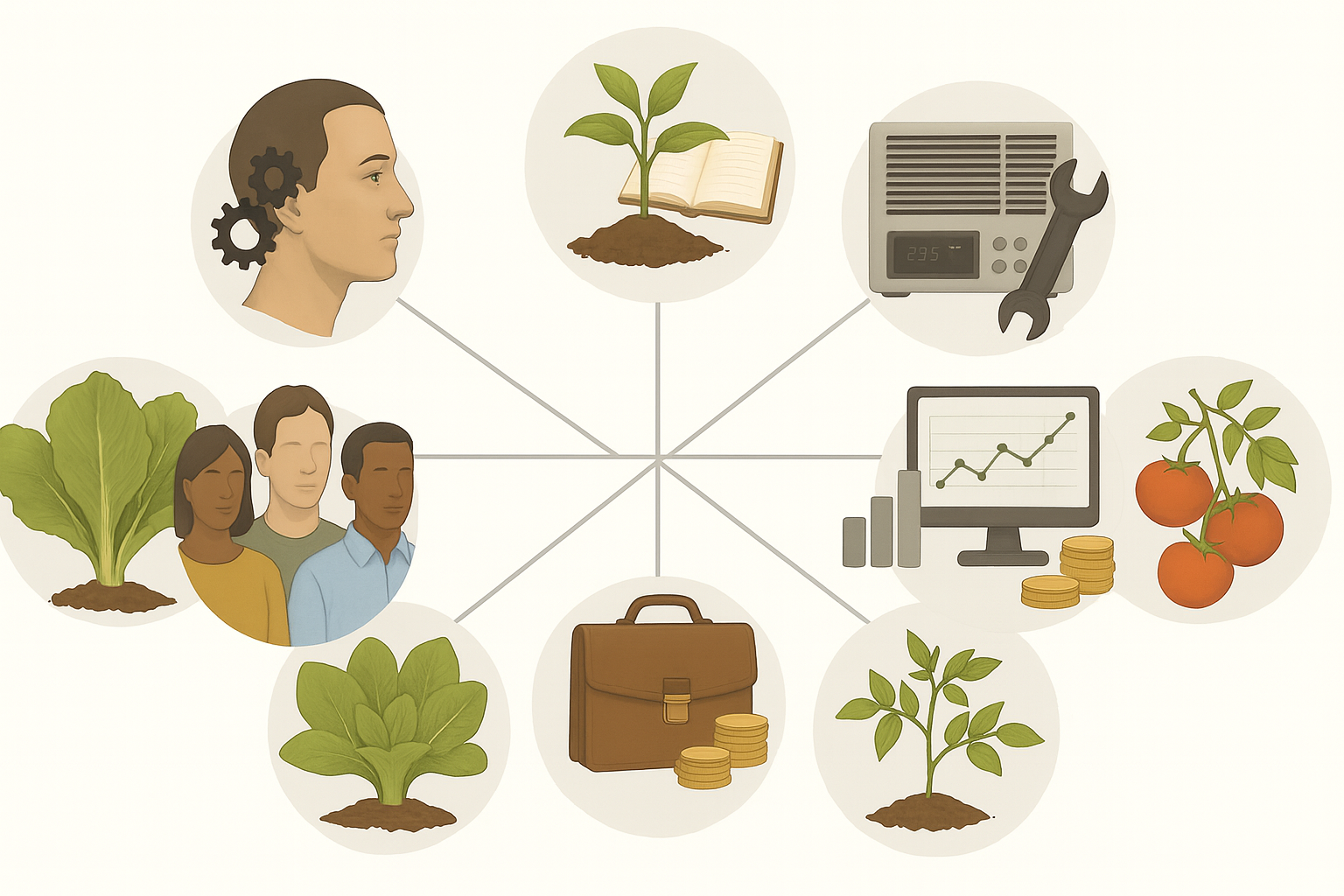
The question of what skills are needed for indoor farming has become increasingly relevant as vertical farming and other controlled environment agriculture (CEA) approaches move from experimental projects to commercial-scale enterprises. Growing crops indoors is not a straightforward extension of traditional agriculture; it requires a distinctive set of technical, scientific, and managerial capabilities. These skills are not confined to operating machinery or handling plants. Instead, they span plant science, engineering, environmental management, data analysis, and business strategy, along with a mindset that is adaptable, analytical, and resilient. Understanding the breadth of these skills is essential for anyone considering a role in vertical farming, whether as a grower, researcher, investor, or policymaker.
The shift from traditional to controlled environments
Farming has always demanded practical knowledge of soils, seasons, and weather. In contrast, indoor plant production demands the ability to replicate and regulate those conditions within closed systems. Vertical farms typically replace soil with hydroponic or aeroponic growing media, and natural sunlight with artificial lighting calibrated to specific crop needs. Managing these systems requires precision and continuous monitoring. The grower becomes less a field labourer and more a systems operator and problem-solver. This fundamental shift makes clear why the skills required for indoor farming are so different from those of outdoor cultivation.
Scientific literacy and plant physiology
An effective vertical farmer must be comfortable with plant science at a practical level. Crops in controlled environments respond to variables such as light intensity, photoperiod, nutrient composition, carbon dioxide levels, and vapour pressure deficit. A basic understanding of plant physiology helps growers interpret why leaves may show signs of nutrient stress or why certain cultivars respond better to particular environmental settings. While it is not necessary to hold an academic degree in botany or horticulture, the ability to read scientific information, apply it to real-world production, and adjust management practices accordingly is fundamental.
Engineering and technical competence
Vertical farms are complex infrastructures combining environmental controls, irrigation, lighting systems, and increasingly automation. Knowing how to operate, maintain, and troubleshoot these technologies is vital. Engineers play a central role in design and construction, but growers and managers must also develop a working knowledge of sensors, pumps, and climate control systems. A minor equipment failure can quickly escalate into crop loss if it is not identified and resolved promptly. Technical competence also extends to an appreciation of energy efficiency, as the high electrical demand of lighting and HVAC systems can determine whether a farm is commercially viable.
Data-driven thinking
Indoor farming environments are uniquely measurable. Sensors can record light levels, humidity, nutrient concentrations, and plant growth rates in real time. Making use of this information requires data literacy: the capacity to collect, interpret, and act upon evidence rather than intuition. Successful farms often integrate decision support systems or digital twins to model plant responses before implementing changes. Thus, the farmer becomes part data analyst, interpreting patterns and correlations to refine both yield and quality. This is a skill set that is becoming as central to vertical farming as soil knowledge is to traditional agriculture.
Business acumen and strategic planning
Indoor farming is capital-intensive and margin-sensitive. Beyond growing skills, entrepreneurs must understand economics, market dynamics, and supply chain logistics. Profitability depends not only on producing crops but also on aligning production with customer demand, whether that is restaurants, retailers, or institutional buyers. Decisions around crop selection, pricing, and distribution require business acumen alongside horticultural knowledge. Skills in financial planning, project management, and risk assessment are therefore as essential as the ability to run a nutrient dosing system.
Collaboration and multidisciplinary working
Few vertical farms succeed through the expertise of one person alone. These enterprises rely on collaboration between plant scientists, engineers, data specialists, business managers, and policy advisors. The ability to communicate across disciplines, to translate technical jargon into shared understanding, and to integrate multiple perspectives is a valuable skill in its own right. Vertical farming is inherently interdisciplinary, and those who thrive are usually those who are comfortable learning from others and bridging knowledge gaps.
Adaptability and problem-solving mindset
Perhaps the most important attribute is not a discrete technical skill but a mindset. Vertical farming is still a young sector; technologies evolve quickly, and there are limited standardised playbooks. Farmers must be willing to experiment, adapt, and respond to unexpected challenges, from pest outbreaks to fluctuating energy prices. Problem-solving under pressure, combined with the patience to test and refine solutions, is what distinguishes resilient operators from those who falter. In many cases, setbacks are not failures but opportunities to build better systems.
The integration of skills for long-term success
What skills are needed for indoor farming cannot be reduced to a checklist. Rather, it is the integration of scientific literacy, technical competence, data analysis, business awareness, and adaptive thinking that leads to effective indoor plant production. Vertical farming is a field where biology meets engineering, and where human ingenuity is applied to the fundamental challenge of feeding populations sustainably. Those entering the sector should expect to be part grower, part scientist, part engineer, and part strategist – which hopefully presents an inspiring challenge!
Conclusion
Vertical farming offers opportunities for innovation in agriculture, but it demands a comprehensive and interdisciplinary skill set. The future of the sector depends on individuals and teams who are not only capable growers but also curious learners, critical thinkers, and adaptive problem-solvers. Asking what skills are needed for indoor farming is therefore not only about identifying gaps in knowledge, but also about recognising the mindset required to succeed. For anyone considering involvement in this sector, developing these abilities is not simply beneficial; it is essential to ensure that indoor farming realises its promise as a sustainable and productive form of agriculture.