Understanding the opportunity
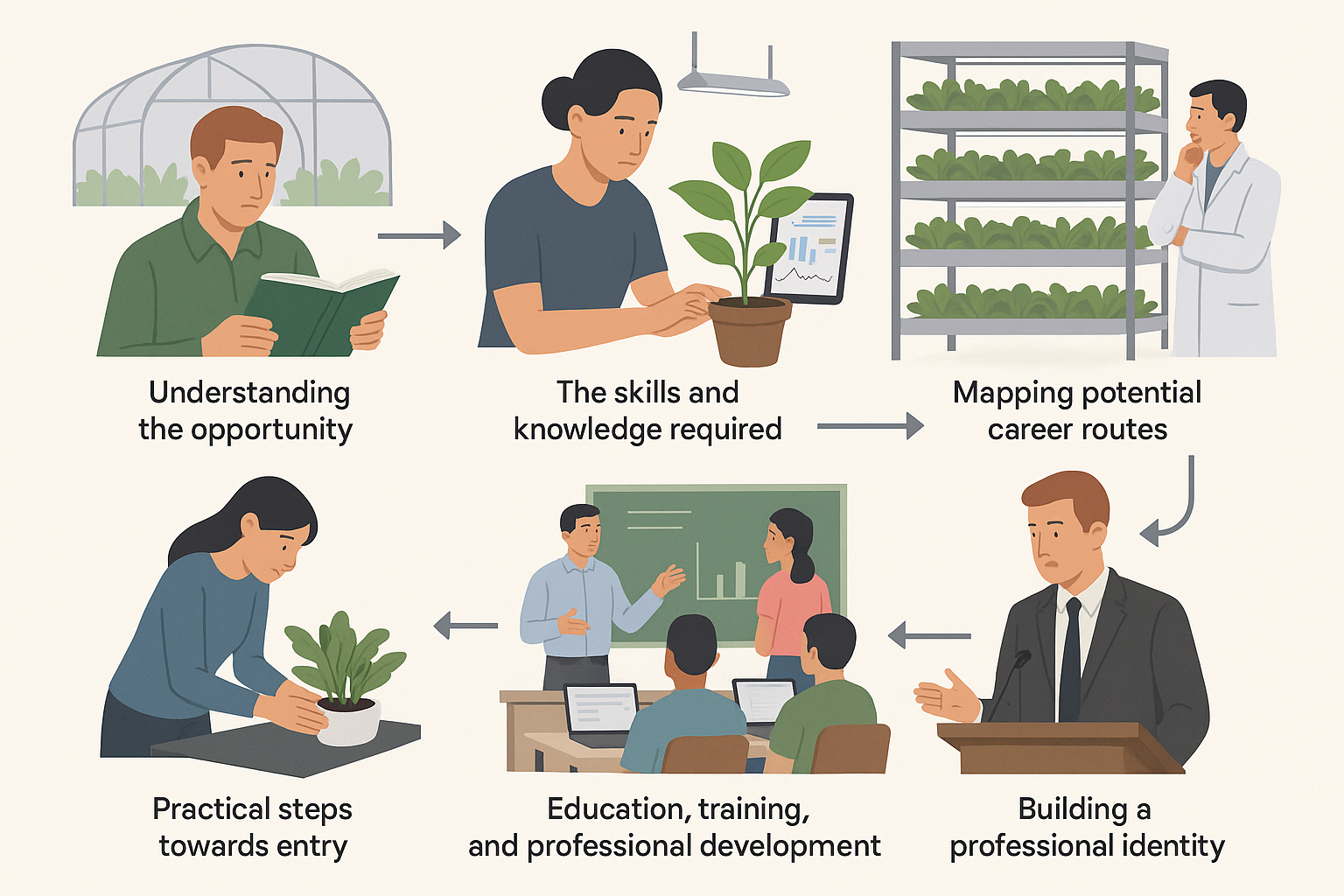
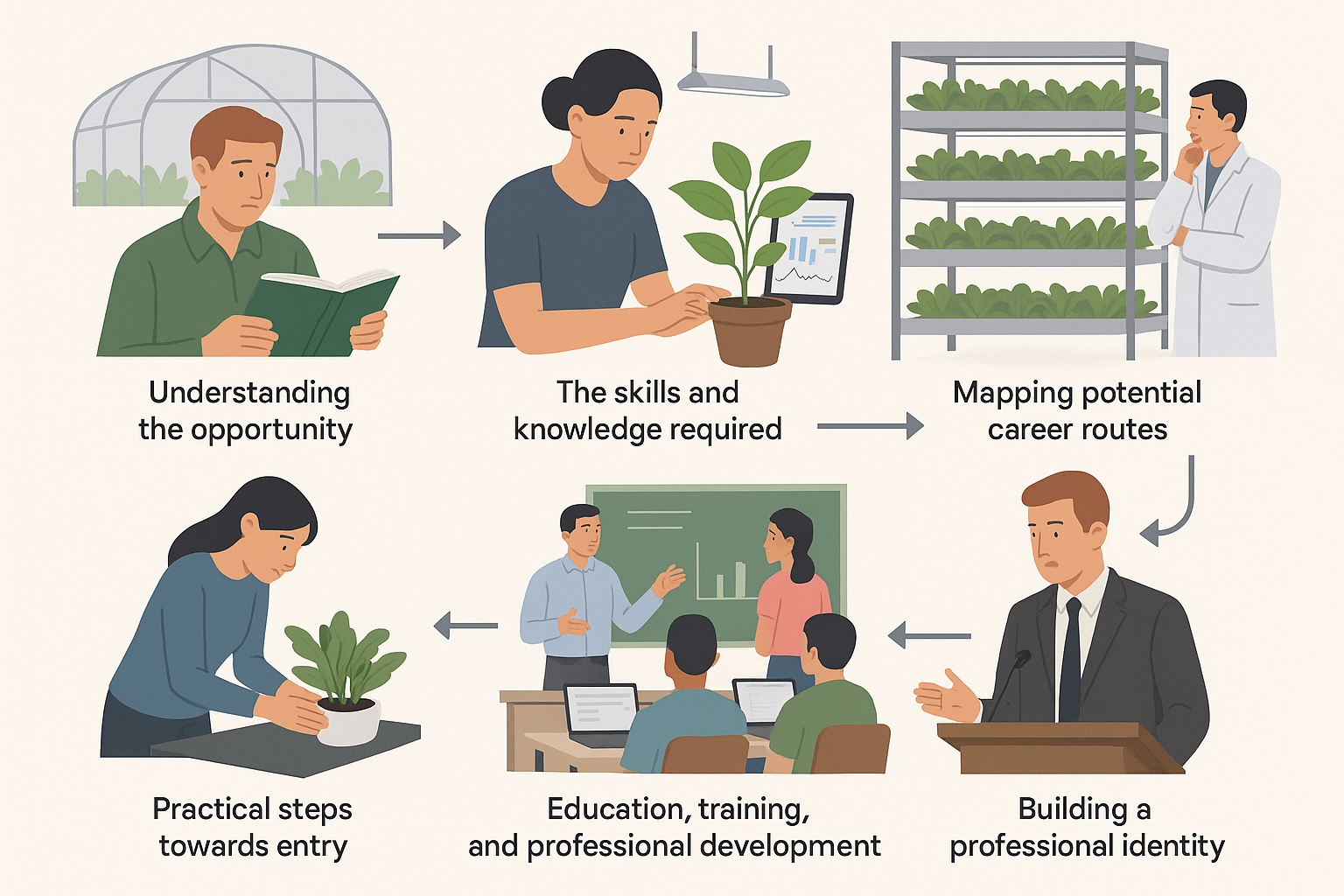
For those wondering what steps to take for a career in indoor farming, the first stage is to appreciate the scale and importance of Controlled Environment Agriculture (CEA) and vertical farming as emerging sectors. These approaches to food production have grown in prominence as concerns about land use, resource efficiency, and climate resilience intensify. Instead of depending on the unpredictability of outdoor conditions, CEA systems allow growers to manage light, temperature, humidity, and nutrients with precision. This capacity has profound implications for how food can be produced in densely populated regions, arid climates, and areas where arable land is limited. It also creates new career pathways for those with interests in plant science, technology, sustainability, and agri-business.
The skills and knowledge required
To begin in this sector, it is essential to develop a combination of practical and conceptual skills. Knowledge of plant biology provides the foundation, particularly in areas such as photosynthesis, nutrient uptake, and pest management. Equally important is familiarity with engineering systems that sustain indoor farms: lighting, irrigation, ventilation, and data monitoring platforms. For many professionals, a multidisciplinary mindset is critical, as success often depends on understanding how biological processes interact with mechanical systems. This is why many universities and training centres now offer modules and degrees in sustainable agriculture, horticultural technology, and agri-tech entrepreneurship. For those who are already working in agriculture, gaining exposure to CEA practices through apprenticeships or pilot projects can be a vital step.
Mapping potential career routes
The indoor farming industry is not limited to growers alone; it encompasses a wide range of specialisations. Some professionals focus on research and development, investigating crop varieties best suited for high-density production under artificial lighting. Others work in systems engineering, refining the design of modular farms or energy-efficient climate control systems. There are also roles in operations management, food supply logistics, and policy development, each requiring different skill sets. For individuals just starting out, volunteering or interning at established CEA facilities can provide insight into the day-to-day realities of crop cycles, operational costs, and market challenges. Over time, this hands-on experience can lead to positions of responsibility in farm management or consultancy.
Education, training, and professional development
Formal study is not the only entry point, but it is often a useful starting framework. Universities, vocational schools, and online learning platforms increasingly offer programmes dedicated to horticulture, plant physiology, or agricultural technology. These may include courses tailored specifically to CEA and vertical farming, such as LED lighting design, hydroponic nutrient formulation, or environmental control systems. Alongside this, industry associations and networks, including the Association for Vertical Farming (AVF) and the UK Urban AgriTech collective, provide workshops, networking opportunities, and professional accreditation schemes. Engaging with these networks is valuable not only for technical knowledge, but also for establishing credibility in a competitive field.
Practical steps towards entry
Beyond study, aspiring professionals should consider how to demonstrate their commitment and adaptability. Starting with small-scale projects, such as tabletop hydroponics or community growing initiatives, can provide tangible results that strengthen a personal portfolio. Documenting these experiments, analysing the results, and reflecting on challenges can also be powerful when applying for roles or further training. Employers in this sector tend to value resilience, analytical ability, and the willingness to innovate. Since CEA is still developing, there is rarely a fixed career ladder; instead, progression depends on the individual’s initiative in building relevant skills and proving them in real-world contexts.
The wider significance of careers in indoor farming
A career in CEA and vertical farming is not only about individual employment prospects. It contributes to broader questions of food security, sustainability, and climate change adaptation. For instance, indoor farms are increasingly being integrated into urban planning strategies to shorten supply chains and reduce food miles. They also create opportunities for renewable energy integration, water recycling, and the development of new horticultural techniques. For students or early-career professionals considering this path, it is important to recognise that personal expertise feeds into a global conversation about how societies will feed themselves sustainably in the decades ahead.
Starting a business as a vertical farmer
For some, the most appealing route is not employment within an existing company, but establishing a venture of their own. Beginning as an independent vertical farmer requires more than horticultural expertise; it also demands sound business planning, market research, and financial management, but it is a business model which can potentially start small, allowing time to acquire the necessary skills, with some rudimentary growing technology, setup in a space such as a spare bedroom or garage. Prospective entrepreneurs should start by identifying the crops best suited to their location and potential customer base, whether that means leafy greens for local restaurants, herbs for supermarkets, or specialist produce for niche markets. A clear business plan will be essential, outlining capital requirements, projected operating costs, revenue streams, and routes to market. In addition, new entrants should consider partnerships with technology suppliers, local authorities, or research institutions to strengthen both their technical capacity and their credibility. As with all business startups, while the risks are potentially significant, the opportunity to shape a business model that combines innovation with sustainable food production can be highly rewarding for those prepared to take on the challenge.
Building a professional identity
Finally, those who wish to advance in indoor farming should consider how to establish themselves as professionals in a growing yet competitive space. This often involves publishing insights, sharing case studies, or participating in academic and industry conferences. Many successful careers are built on a balance of technical ability, practical problem-solving, and the capacity to communicate knowledge to colleagues, clients, or policy-makers. By doing so, professionals not only progress personally, but also strengthen the visibility and credibility of the sector as a whole.