
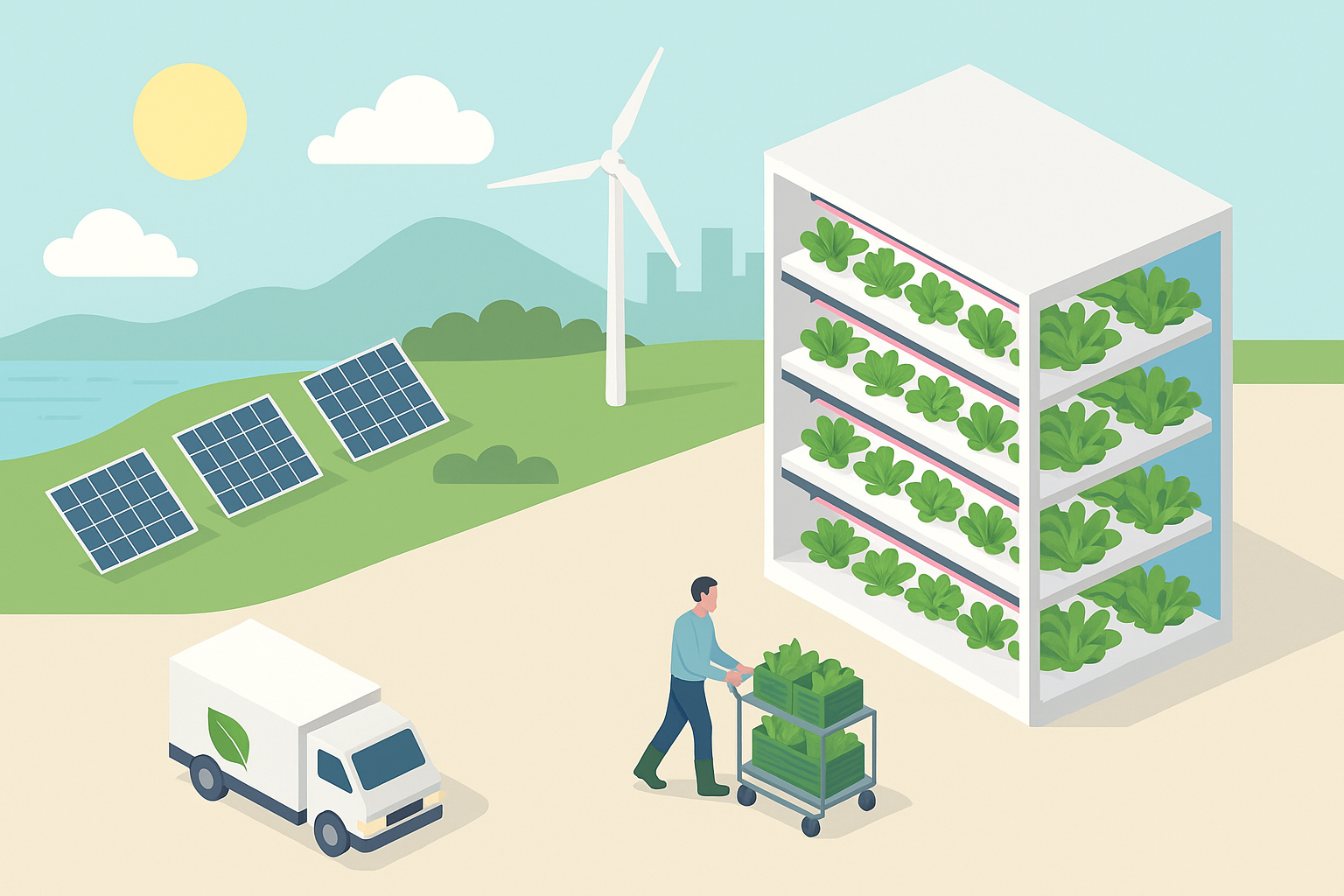
Exploring how Controlled Environment Agriculture contributes to sustainable food systems
Controlled Environment Agriculture (CEA) and climate change are increasingly discussed in tandem, as growing concerns over environmental degradation and food system resilience intensify. CEA, encompassing technologies such as vertical farming, hydroponics, aeroponics, and greenhouse cultivation, offers an alternative model of food production that is not only highly efficient but also inherently adaptive to changing climatic conditions. At a time when conventional agriculture is both impacted by and contributing to the climate crisis, CEA provides a credible pathway towards a more sustainable, climate-resilient food future.
Conventional Agriculture and the Climate Challenge
Modern conventional agriculture is a major contributor to climate change. It accounts for approximately 24% of global greenhouse gas emissions when land use, deforestation, fertiliser application, and methane from livestock are included in the total estimate1. Additionally, agriculture is highly vulnerable to climatic disruptions: erratic weather patterns, prolonged droughts, and extreme temperatures are affecting yields, reducing arable land availability, and threatening global food security.
With the global population projected to exceed 9.7 billion by 20502, and the planet already experiencing biodiversity loss and soil degradation at alarming rates, the need for more sustainable agricultural practices is urgent. Traditional open-field farming, dependent on vast land areas and unpredictable environmental conditions, increasingly struggles to meet these demands without exacerbating ecological harm.
How CEA Reduces Environmental Pressures
CEA offers a strategic reconfiguration of food production that can reduce agriculture’s environmental footprint while improving its resilience. By decoupling crop cultivation from external weather conditions, CEA facilities can operate year-round in urban or peri-urban environments. This removes the need for seasonal planting schedules and allows for more consistent output.
Water usage in CEA systems is markedly lower than in traditional farming. Hydroponic systems, for example, use up to 90–95 percent less water than soil-based agriculture. Nutrient solutions are recirculated rather than lost to evaporation or runoff, which also limits the risk of waterway pollution; an issue often linked to nitrogen and phosphorus leaching from conventional farms.
Moreover, because many CEA systems are located closer to urban centres, the carbon emissions associated with transporting produce across long distances are significantly reduced. This localised production model, sometimes referred to as ‘short food supply chains’, also supports fresher food delivery and reduces spoilage-related waste.
Minimising Land Use and Protecting Biodiversity
Vertical farming, a prominent branch of CEA, takes this concept further by stacking crops in layers to maximise yield per square metre. This spatial efficiency reduces the pressure to clear forests or grasslands for agricultural expansion; an activity that is a key driver of biodiversity loss and carbon release through deforestation3. By freeing land from cultivation, CEA indirectly supports rewilding efforts, carbon sequestration in soil, and the conservation of natural ecosystems.
In densely populated regions or areas where arable land is degraded, indoor plant production offers an opportunity to restore food production capacity without incurring further ecological harm. For instance, in regions experiencing desertification or saltwater intrusion, controlled systems offer a lifeline for continued crop cultivation.
Energy Demand and the Carbon Trade-off
However, CEA is not without challenges, particularly regarding its energy requirements. LED lighting, climate control systems, water pumps, and sensors demand a reliable and often intensive energy supply. If that energy is derived from fossil fuels, the carbon savings gained through other efficiencies may be offset or even reversed.
Transitioning to renewable energy sources is therefore essential if CEA is to fulfil its low-carbon potential. Many indoor farms are already investing in solar panels, wind energy, or purchasing clean energy from the grid. As renewable technologies become more efficient and widely available, the integration of green energy into CEA systems is likely to increase, improving the overall sustainability profile of these operations.
Towards Climate-Resilient Food Systems
In the broader context of climate adaptation, CEA plays a crucial role in enhancing food system resilience. Climate-controlled environments allow growers to maintain production despite external shocks, such as floods, heatwaves, or supply chain disruptions. This capacity for controlled, localised, and secure food production makes CEA a valuable component of national food security strategies.
Furthermore, CEA is conducive to crop diversification and experimentation with new plant varieties, including those with greater nutritional density or faster growth cycles. These innovations contribute to both dietary health and food security in regions facing environmental and socio-economic stress.
The Road Ahead: Integrating CEA into Climate Policy
As policymakers confront the dual challenges of reducing emissions and securing food supplies, the integration of CEA into national climate strategies will become increasingly relevant. Support for research and development, infrastructure funding, and energy innovation can help scale up CEA adoption while ensuring environmental performance standards are maintained.
Equally, CEA should not be seen as a replacement for all conventional farming, but as a complementary system particularly suited to urban areas, climatically vulnerable zones, or regions with high population densities. Its benefits will be maximised when it forms part of a diversified, decentralised, and inclusive food system.
Conclusion: Rethinking Agriculture for a Changing Climate
CEA and climate change are tightly interwoven in both problem and solution space. While agriculture contributes significantly to environmental degradation, it also holds potential as a site for innovation and carbon reduction. CEA represents one of the most promising tools for transforming food production in a warming world; its value lies not only in its technological sophistication but in its capacity to produce food more efficiently, reliably, and locally, while easing the pressure on land, water, and ecosystems.
- IPCC (2019). Climate Change and Land: An IPCC Special Report on Climate Change, Desertification, Land Degradation, Sustainable Land Management, Food Security, and Greenhouse Gas Fluxes in Terrestrial Ecosystems.
- United Nations Department of Economic and Social Affairs (2019). World Population Prospects 2019.
- FAO (2020). State of the World’s Forests 2020: Forests, Biodiversity and People.