
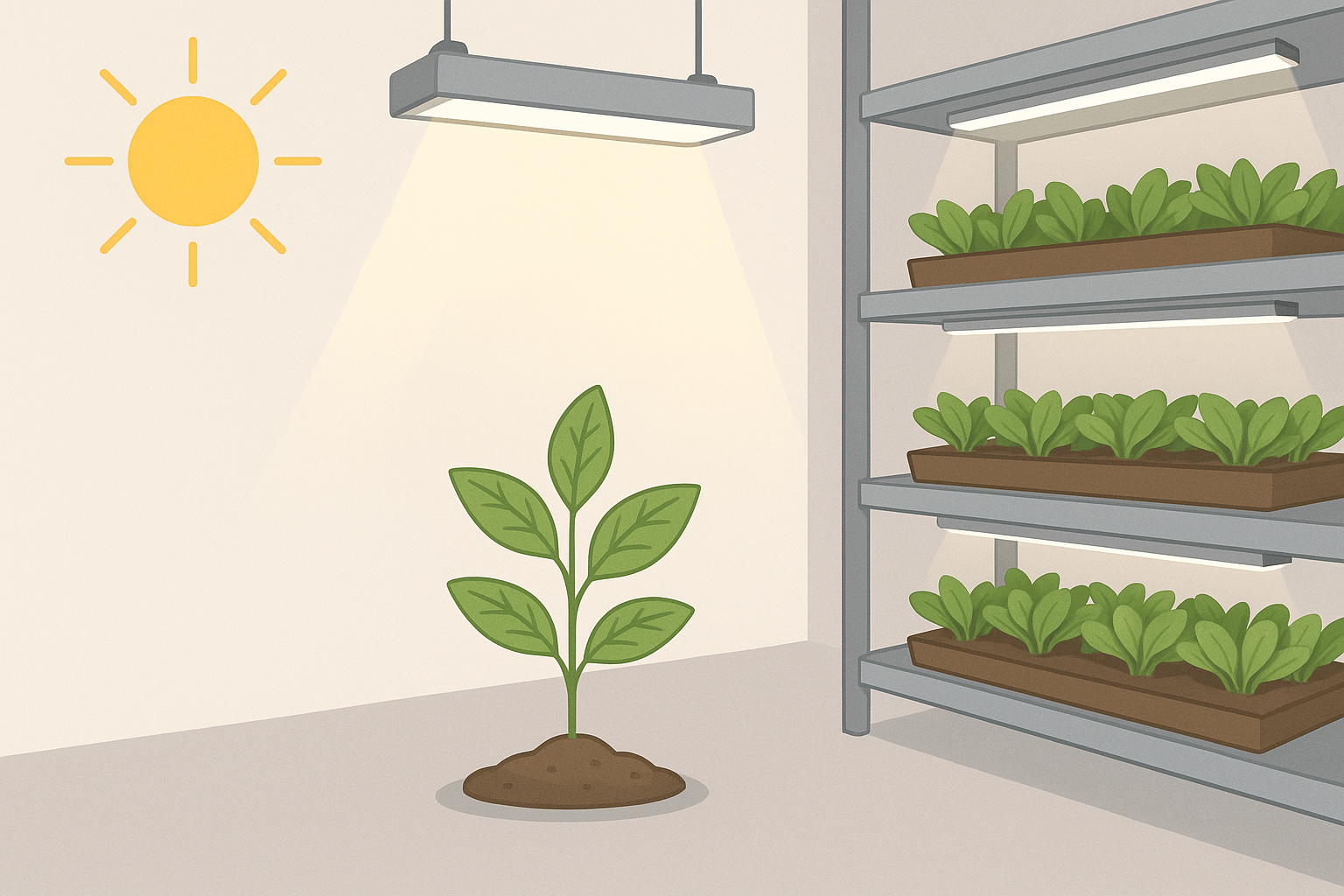
Controlled Environment Agriculture (CEA) relies heavily on precise environmental control to optimise plant growth. Central to this approach is the use of artificial lighting in indoor plant production, which allows crops to photosynthesise independently of natural daylight. In fully enclosed systems such as vertical farms, growth chambers, and indoor horticultural facilities, artificial light not only supplements but often replaces sunlight altogether. This capability to manipulate light quality, intensity, duration, and spectrum gives growers an unprecedented level of control over crop performance, nutritional composition, and productivity.
Why Artificial Lighting is Foundational to Indoor Growing
Photosynthesis, the biochemical process through which plants convert light into chemical energy, is entirely dependent on light availability. In natural environments, sunlight provides this input. However, in indoor systems where sunlight is limited or entirely absent, artificial lighting becomes indispensable. Its role is not merely to replace daylight but to enable consistent, year-round crop production. This constancy is particularly vital in regions with low winter light levels, short daylengths, or highly variable climates.
Moreover, artificial lighting enables photoperiod manipulation, which is essential for triggering flowering, vegetative growth, or dormancy in many crop species. This level of control allows for optimised production cycles and more predictable yields. In vertical farming contexts, where crops are stacked in layers without access to natural light, artificial lighting is the primary energy source driving photosynthesis.
The Science Behind Light Quality and Plant Response
Not all light is equally useful to plants. While the human eye is most sensitive to green wavelengths, plants primarily use blue (400–500 nm) and red (600–700 nm) light for photosynthesis. This falls within the range known as photosynthetically active radiation (PAR). Blue light influences vegetative growth and leaf morphology; red light affects flowering and stem elongation. The ratio between red and blue light can therefore be adjusted to guide specific developmental outcomes, depending on crop type and growth stage.
Advancements in lighting technology have allowed researchers and growers to fine-tune these parameters. Spectral engineering, which is the deliberate selection and combination of wavelengths, can improve growth efficiency, enhance desirable traits such as colour or nutritional content, and even inhibit pathogens or undesirable morphological responses. While the science continues to evolve, it is now well established that lighting quality significantly influences both biomass production and crop quality in CEA systems.
Lighting Technologies Used in CEA
Historically, high-intensity discharge lamps, such as high-pressure sodium (HPS) and metal halide (MH), were widely used due to their broad spectrum and established efficacy. Fluorescent tubes also found a role, particularly for propagation and early-stage growth. However, each of these systems had drawbacks in terms of energy efficiency, heat output, and longevity.
The most significant transformation in recent years has been the widespread adoption of light-emitting diodes (LEDs). LEDs offer several advantages: they are energy efficient, emit minimal heat, have long operational lifespans, and allow precise spectral customisation. Unlike legacy lighting systems, LEDs can be tuned to emit very specific wavelengths, enabling tailored light recipes for different crops and stages of growth.
This flexibility supports both high yields and high-quality produce while reducing energy input per unit of biomass. However, the capital cost of LED installations can be significant; thus, return on investment calculations are essential in commercial operations. Ongoing improvements in LED efficacy (measured in micromoles of PAR per joule) continue to enhance their value proposition in indoor agriculture.
Integration with Other Environmental Controls
Artificial lighting does not operate in isolation; it is intricately linked with other CEA parameters such as temperature, humidity, CO₂ concentration, and nutrient delivery. For example, light intensity directly affects plant transpiration rates, which in turn influence irrigation needs. Moreover, the heat generated by lighting must be accounted for in climate control strategies to avoid thermal stress or unbalanced growth.
Automated control systems are now commonly used to synchronise lighting with other environmental variables. For instance, dynamic lighting schedules that mimic natural dawn and dusk patterns can reduce plant stress and improve resource-use efficiency. Some advanced systems also integrate real-time plant feedback via imaging sensors or chlorophyll fluorescence monitoring, further optimising photosynthetic output and energy efficiency.
Energy Demand and Sustainability Considerations
While the use of artificial lighting in indoor plant production brings numerous agronomic advantages, it also introduces challenges related to energy consumption and sustainability. Lighting typically represents the single largest energy cost in a vertical farming operation, often accounting for 40–60% of total electricity use.
To address this, a growing number of facilities are integrating renewable energy sources such as solar or wind power into their systems. Additionally, some adopt waste-heat recovery or co-generation approaches to enhance overall energy efficiency. Research is also ongoing into adaptive lighting strategies that dynamically adjust intensity based on real-time crop needs, thereby reducing unnecessary energy expenditure.
Life cycle assessments of lighting technologies reveal that the environmental impact of LED systems is substantially lower than traditional lighting when considered over their full operational lifespan. Nonetheless, the upfront energy footprint of manufacturing, and the eventual disposal of lighting components, remain important areas for further improvement.
Conclusion: A Critical Enabler of CEA Success
The use of artificial lighting in indoor plant production is not merely a technical requirement; it is a foundational element that defines the very viability of Controlled Environment Agriculture. By decoupling plant growth from natural sunlight, artificial lighting makes possible the consistent, high-density, and high-quality crop production that underpins vertical farming and other CEA models.
As research progresses and technology continues to evolve, lighting strategies will become ever more sophisticated. The trend is towards dynamic, responsive systems that balance crop physiology with operational efficiency and sustainability. For growers, researchers, and policymakers alike, a nuanced understanding of artificial lighting is essential to unlocking the full potential of CEA to meet the food production challenges of the future.