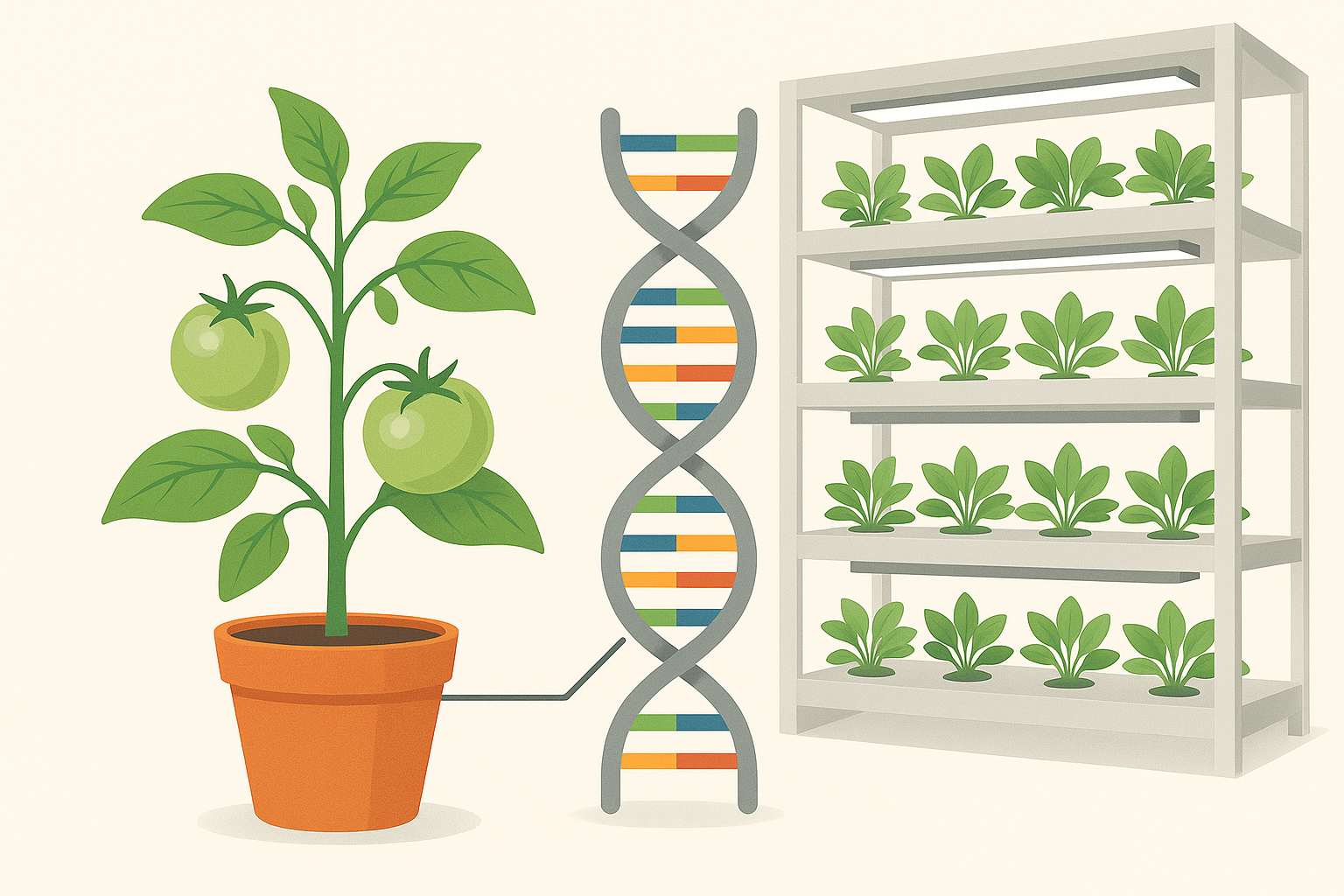
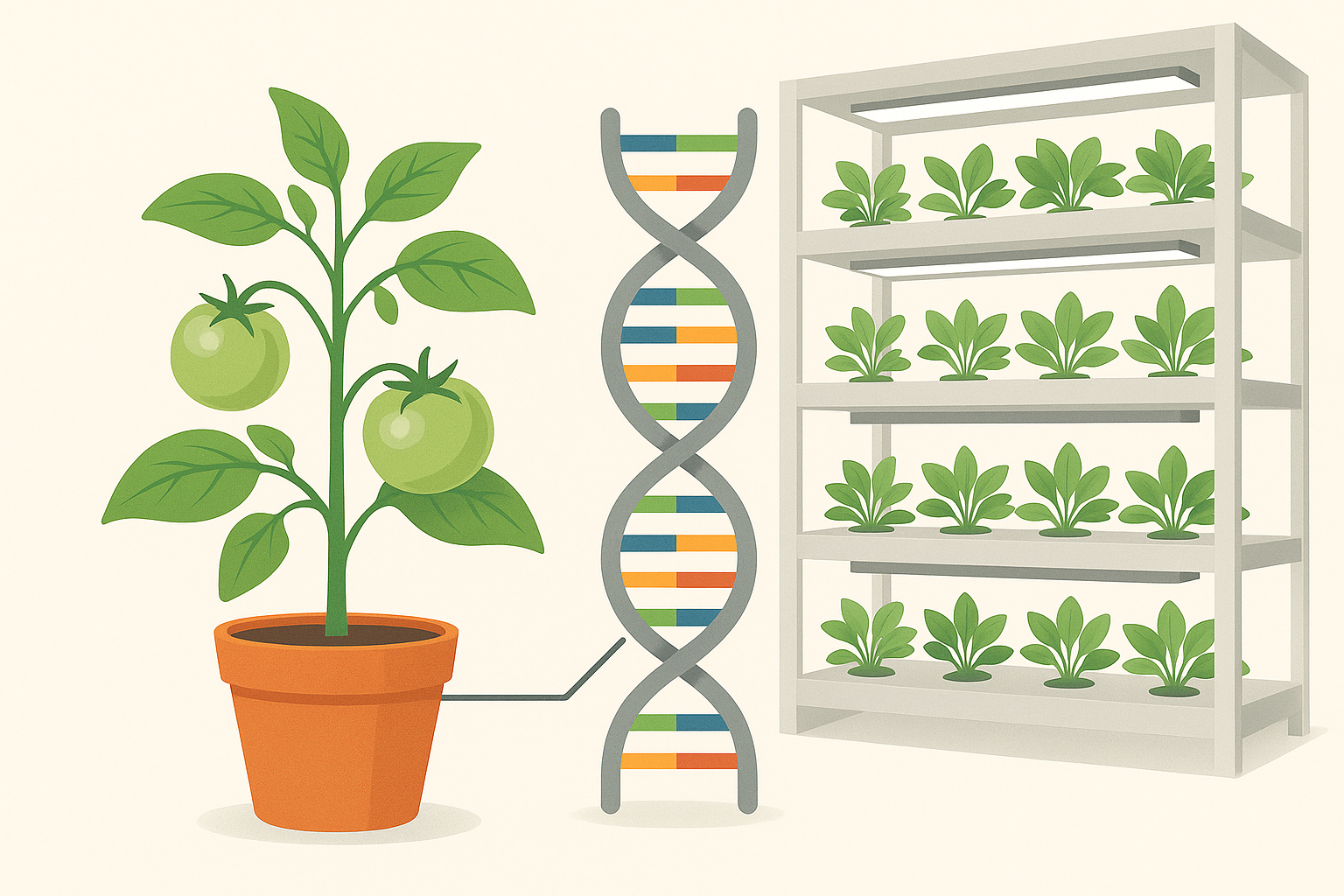
The potential of genetic modification of crop plants for CEA and vertical farming lies in its ability to align plant traits with highly controlled conditions, maximising efficiency, resilience, and output. Unlike traditional field agriculture, indoor systems allow crops to be shielded from variable weather, pests, and soil constraints, yet they also impose specific demands: compact plant forms, precise nutrient use, rapid growth cycles, and predictable yields. Genetic modification (GM) provides a means of tailoring plants for these unique environments, complementing the advances in engineering and automation that underpin modern controlled environment growing systems.
Genetic Modification Opportunities in CEA
Conventional crops were bred for open-field cultivation, where traits such as drought tolerance, pest resistance, or deep root systems are valuable. In vertical farming and other indoor systems, these adaptations can be unnecessary or even inefficient. What matters instead are qualities such as uniform canopy architecture for LED light capture, low energy investment in lignified tissue, high nutrient- and photon-use efficiency. Genetic modification allows breeders and researchers to accelerate the development of such traits in a way that traditional breeding alone may not achieve.
Moreover, CEA offers an unusually suitable context for GM crops because containment is inherently built into the system. Plants are grown in enclosed facilities, reducing the risk of unintended gene flow to wild relatives or neighbouring fields, which is a common concern in outdoor GM cultivation. This containment could ease some regulatory and public acceptance issues, particularly if modifications are targeted at traits that benefit sustainability, such as reduced fertiliser demand or enhanced nutrient density.
Traits of Interest for Indoor Farming
The most relevant genetic modifications for CEA focus on optimising plant metabolism and morphology for resource efficiency. For example, modifying photosynthetic pathways to enhance light-use efficiency can help align plants with artificial lighting spectra. Research into reducing the shade-avoidance response may produce compact plants that direct energy into edible biomass rather than stem elongation. Similarly, manipulating flowering genes could create varieties that reliably produce fruits or leafy harvests under artificial photoperiods.
Nutrient-use efficiency is another promising area. GM approaches could reduce the need for added nitrogen or phosphorus by improving uptake pathways or enhancing symbiotic interactions, although such effects in hydroponic systems require careful study. For high-value produce, traits such as increased vitamin content, altered pigment production, or the synthesis of secondary metabolites may allow indoor farming to cater to health-focused and pharmaceutical markets.
Research and Real-World Applications
Although commercial GM crops have primarily been designed for large-scale field systems (such as herbicide-tolerant soya or insect-resistant maize), there is growing academic interest in tailoring crops for controlled environments. Studies have explored tomatoes with modified compact growth habits, lettuce engineered for higher antioxidant content, and rice adapted for efficient nutrient uptake. Research into photosynthetic efficiency, including manipulation of RuBisCO activity and synthetic carbon-fixation pathways, also has potential applications for high-density indoor farms.
In practice, however, there are currently few genetically modified varieties specifically bred for CEA. The sector is still young, and most growers rely on conventionally bred cultivars adapted to greenhouses or open fields. Yet as the economic case for vertical farming develops, the incentive to invest in dedicated GM lines is likely to increase. The collaboration of plant scientists, breeders, and technology providers will be essential in bridging this gap.
Regulatory and Ethical Considerations
The use of GM crops remains subject to strict regulation in many jurisdictions, including the European Union and the United Kingdom. Approvals require detailed risk assessments concerning environmental release, food safety, and long-term monitoring. In contrast, the United States has a more established pathway for GM approval, which has supported wider adoption.
For CEA, the regulatory landscape is somewhat nuanced. Since crops are cultivated indoors, arguments can be made for lower risk of environmental escape. However, consumer acceptance remains a central barrier. Public perceptions of GM technology have often been sceptical, particularly in Europe, and vertical farming businesses seeking to market directly to consumers may hesitate to adopt GM lines until clear demand emerges.
Ethical considerations are also important. Some critics argue that the adoption of GM in indoor farming could accelerate corporate consolidation of seed supply, restricting grower autonomy. Others see the technology as a vital tool for food security in urbanising populations, enabling tailored crops that reduce energy and resource inputs. Balancing these perspectives requires transparent discussion and evidence-based policy.
Barries to adoption of GM in CEA
One of the most significant challenges to the adoption of genetic modification in CEA and vertical farming lies in public perception. Indoor farms are already viewed by some as overly artificial, with sceptics highlighting the absence of soil, natural light, and traditional farming practices. The introduction of GM crops into these systems risks reinforcing such perceptions, drawing on long-standing cultural narratives around so-called "Frankenstein foods".
Critics may argue that combining highly controlled environments with genetic modification pushes food production even further from nature, regardless of the evidence of safety or sustainability benefits. This could exacerbate consumer distrust, particularly in markets such as the UK and wider Europe where opposition to GM crops remains entrenched. For indoor farming businesses that rely on consumer-facing brands and premium positioning, navigating these perceptions will be as important as the technical feasibility of the crops themselves.
The Future of Genetic Modification for Vertical Farming
Looking ahead, genetic modification is likely to be one of several approaches to crop design in controlled environments, alongside traditional breeding, marker-assisted selection, and emerging techniques such as genome editing with CRISPR-Cas. The precision of genome editing, in particular, allows for subtle changes that may not even be classified as GM under some regulatory frameworks. This raises the prospect of developing indoor-optimised cultivars with traits finely tuned to specific LED spectra, hydroponic systems, or climate recipes.
If adopted, these crops could transform the economics of vertical farming by reducing input costs, shortening growth cycles, and opening markets for nutritionally enhanced produce. Success will depend not only on scientific innovation but also on regulatory clarity, consumer trust, and a willingness within the industry to invest in long-term plant development.
Conclusion
Genetic modification of crops for CEA and vertical farming represents an emerging frontier where plant science meets controlled environment growing technology. While current practice relies on conventional varieties, the potential to design crops that thrive in indoor systems is considerable. Enclosed environments provide both the ideal context for experimentation and the means to mitigate ecological concerns, although societal acceptance and regulation remain decisive factors.
For growers, researchers, and policy-makers, the central question is not whether GM crops will find a place in CEA, but when and how their adoption will unfold. As the sector matures, collaboration between plant biologists, agronomists, engineers, and investors will determine whether genetically modified indoor crops move from theory to practical reality.