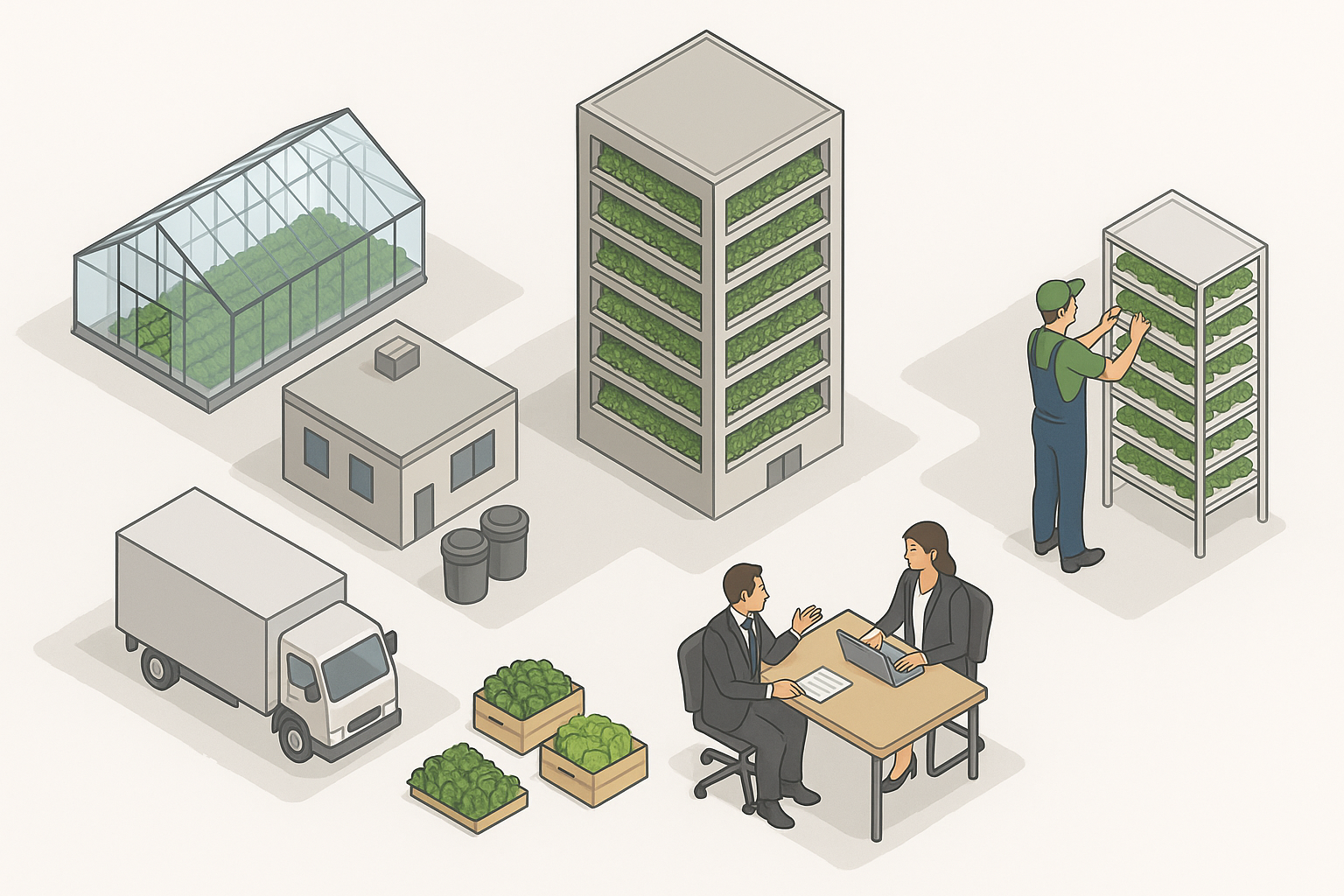
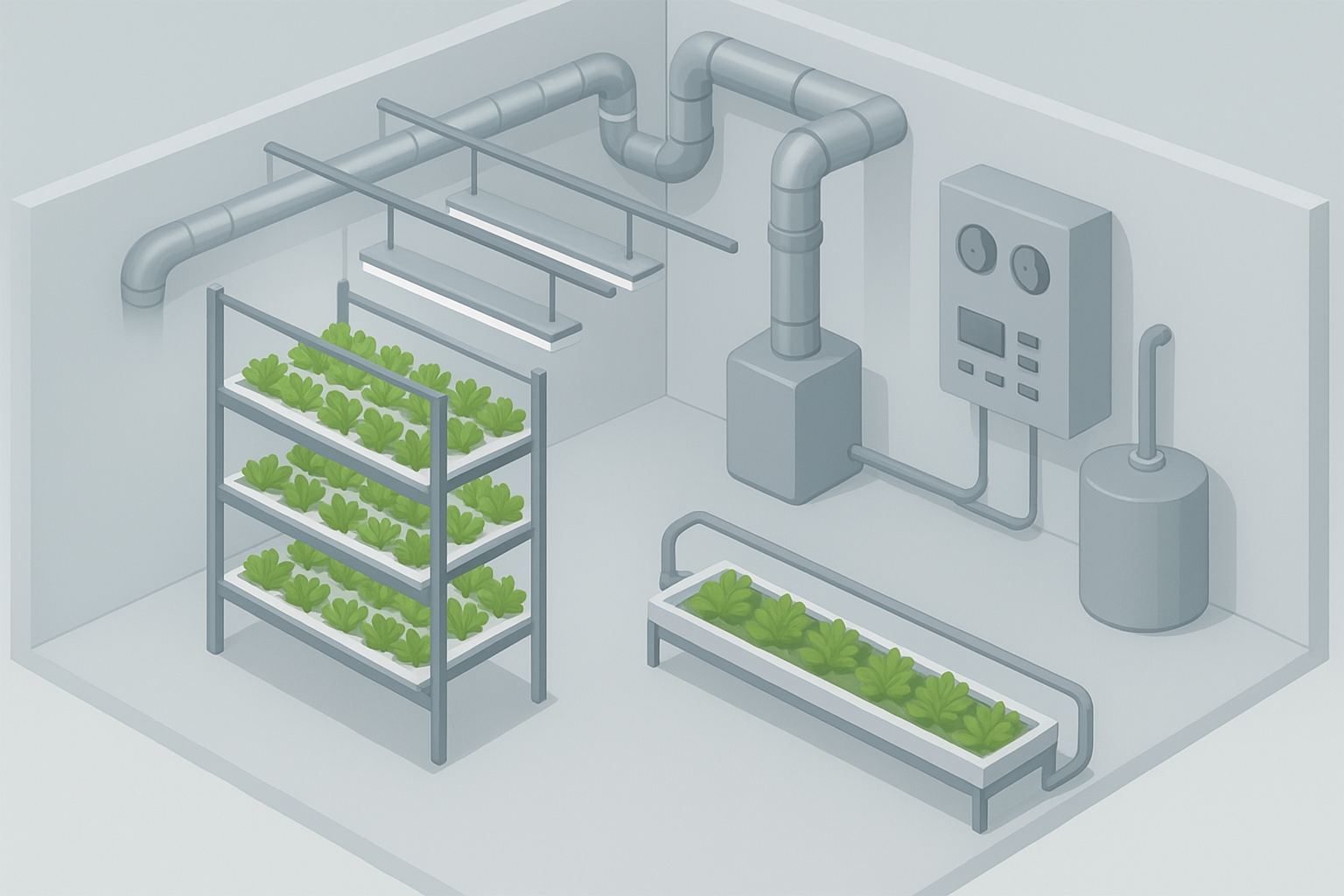
Introduction to System Design in Indoor Farming
System designs which are optimised for maximum efficiency in space and energy use are essential for the development of successful controlled environment agriculture (CEA) and vertical farming ventures. The design process shapes every aspect of production: it determines energy demand, crop quality, labour requirements, operational resilience, and long-term economic viability. Unlike conventional agriculture, indoor farming systems are artificially engineered ecosystems. Every environmental parameter, including light intensity, photoperiod, temperature, humidity, air movement, nutrient delivery, and CO₂ concentration, must be actively controlled and balanced. This high degree of control offers great potential for consistent yields and year-round production, but also demands a thoughtful and integrated approach to design.
A well-conceived system is not simply an assembly of individual components such as lighting rigs, shelving, or irrigation networks. It is a carefully orchestrated configuration in which each element interacts with the others. For example, the choice of lighting technology affects both crop photosynthesis and heat load, which in turn influences ventilation and cooling requirements. Similarly, the layout of growing areas dictates how efficiently workers can move between tasks, and whether the farm can adapt to new crops or technologies without major reconfiguration. These interdependencies make system design a multidisciplinary exercise, requiring input from horticulturists, engineers, data specialists, and sustainability experts.
Balancing Biological and Engineering Priorities
A central challenge in CEA system design lies in balancing the needs of the crop with the realities of engineering and operational constraints. Plant biology dictates certain requirements: each species and cultivar has optimal ranges for temperature, humidity, light spectrum, and nutrient composition. Meeting these parameters ensures healthy growth, maximises yield, and minimises plant stress. However, engineering solutions that meet these needs must be efficient, reliable, and cost-effective. Over-engineering a system may produce ideal growing conditions, but at an energy or financial cost that undermines profitability. Under-engineering, on the other hand, risks inconsistent production and higher crop losses.
This balancing act is further complicated by the dynamic nature of indoor farming environments. The growth cycle of plants changes their requirements over time; a young seedling may need different light intensities and nutrient formulations compared to a mature plant approaching harvest. System design must accommodate these shifting demands, often through flexible or programmable infrastructure, such as adjustable lighting rigs, modular shelving, or variable-speed climate control systems.
Energy and Resource Efficiency as Design Priorities
Indoor farms operate in a closed environment, which offers opportunities for resource recirculation and efficiency optimisation. Energy is typically the largest operational expense, making it a critical focus during system design. Strategies for energy efficiency include the selection of high-efficiency LED lighting, heat recovery systems, and integration with renewable energy sources such as rooftop photovoltaics. Water efficiency can be addressed through closed-loop hydroponic or aeroponic systems, which minimise waste by recirculating nutrient solutions. Designing for efficiency is not solely an environmental consideration; it directly impacts the economic sustainability of the operation.
Equally important is the consideration of material and equipment lifespan. Components such as pumps, sensors, and climate control units should be selected for durability and ease of maintenance. A system that requires constant repairs or replacements will incur both financial and operational penalties, potentially leading to production interruptions.
Spatial Planning and Workflow Optimisation
The physical layout of an indoor farm is a decisive factor in its efficiency. A well-planned space allows for smooth workflow, minimises unnecessary movement, and reduces the risk of contamination. In vertical farming, where multiple crop layers are stacked within a limited footprint, access to plants for monitoring, harvesting, and maintenance must be considered alongside space for infrastructure such as air ducts, irrigation lines, and wiring.
Automation is increasingly influencing spatial design choices. The integration of conveyor systems, robotic arms, and autonomous guided vehicles (AGVs) requires clear pathways and specific clearances. However, the cost and complexity of automation must be weighed against the labour savings and production gains it delivers. Even in less automated facilities, ergonomic considerations, such as reducing the need for bending or overhead reaching, can improve efficiency and worker safety.
Integrating Monitoring and Control Systems
Precision in environmental management depends on accurate data collection and responsive control systems. Sensors that monitor temperature, humidity, CO₂ concentration, and nutrient solution chemistry are central to modern CEA design. These devices feed into central control software, enabling real-time adjustments to environmental conditions. Some systems employ predictive algorithms that anticipate changes in plant requirements or external conditions, reducing fluctuations and maintaining stability.
Designing for monitoring and control is not only a matter of installing the right sensors; it also involves ensuring that these systems are accessible for calibration and maintenance. A control system that fails or provides inaccurate data can have cascading effects on crop quality and yield. Redundancy in critical systems, along with clear alert protocols, can safeguard against unexpected failures.
Scalability and Future-Proofing
An often-overlooked aspect of system design is its ability to adapt to future needs. Crop selection, market demand, and technological advancements can change rapidly, and systems that are rigidly configured may struggle to adapt. Modular designs, where growing units can be added or removed without major disruption, offer flexibility for scaling operations. Likewise, designing infrastructure with spare capacity, such as additional electrical load tolerance or space for extra HVAC units, can accommodate growth without requiring a full system overhaul.
The pace of innovation in vertical farming technologies suggests that a farm built today will likely incorporate different equipment or processes within a few years. Ensuring that the initial design can integrate these developments without prohibitive cost or downtime is a hallmark of forward-thinking system design.
Conclusion: The Case for Integrated Planning
Effective system design in CEA and vertical farming systems can be the difference between economically viable production and business failure. It requires harmonising biological, engineering, economic, and operational considerations into a coherent whole. This integrated planning ensures that each subsystem supports the others, creating a productive and resilient environment for plant growth. In doing so, well-designed systems not only deliver consistent yields and high-quality crops, but also position indoor farms to operate sustainably in both environmental and financial terms.
The most successful CEA and vertical farming enterprises invest in rigorous design planning before a single crop is planted. By doing so, they create facilities capable of delivering reliable production, adapting to future challenges, and demonstrating the full potential of controlled environment agriculture as a sustainable food production model.
Technical Annex: System Design Reference for CEA and Vertical Farming
1. Sample System Layouts
System layouts in indoor farming must align crop biology with engineering practicality. The following examples illustrate common configurations used in commercial operations:
Single-Layer Hydroponic BayA flat-bed hydroponic system in which plants are grown on shallow channels or floating rafts. This design allows for easy access and is suited to low-growing leafy crops. It is often used in glasshouse-type CEA where overhead light is plentiful, but can be adapted for artificial lighting.
Multi-Tier Vertical RackStacked growing levels supported by steel or aluminium frameworks, each fitted with integrated LED lighting and irrigation. This configuration maximises yield per square metre and is particularly suited to urban vertical farms with limited floor area. Space between tiers must allow for airflow, maintenance access, and uniform light distribution.
Automated Conveyor CarouselA moving rack or tray system in which plants travel through different environmental zones during their growth cycle. This layout supports high-throughput production with minimal labour, and can be integrated with robotic harvesting.
Zoned Environmental ChambersThe facility is divided into smaller compartments, each with its own environmental controls. This allows multiple crops or stages of growth to be managed simultaneously under optimal conditions for each.
2. Environmental Parameter Ranges
Optimal ranges depend on crop type; however, the following high-level reference values are applicable to many leafy greens, herbs, and small fruiting crops in CEA systems:
3. Integrated Equipment Options
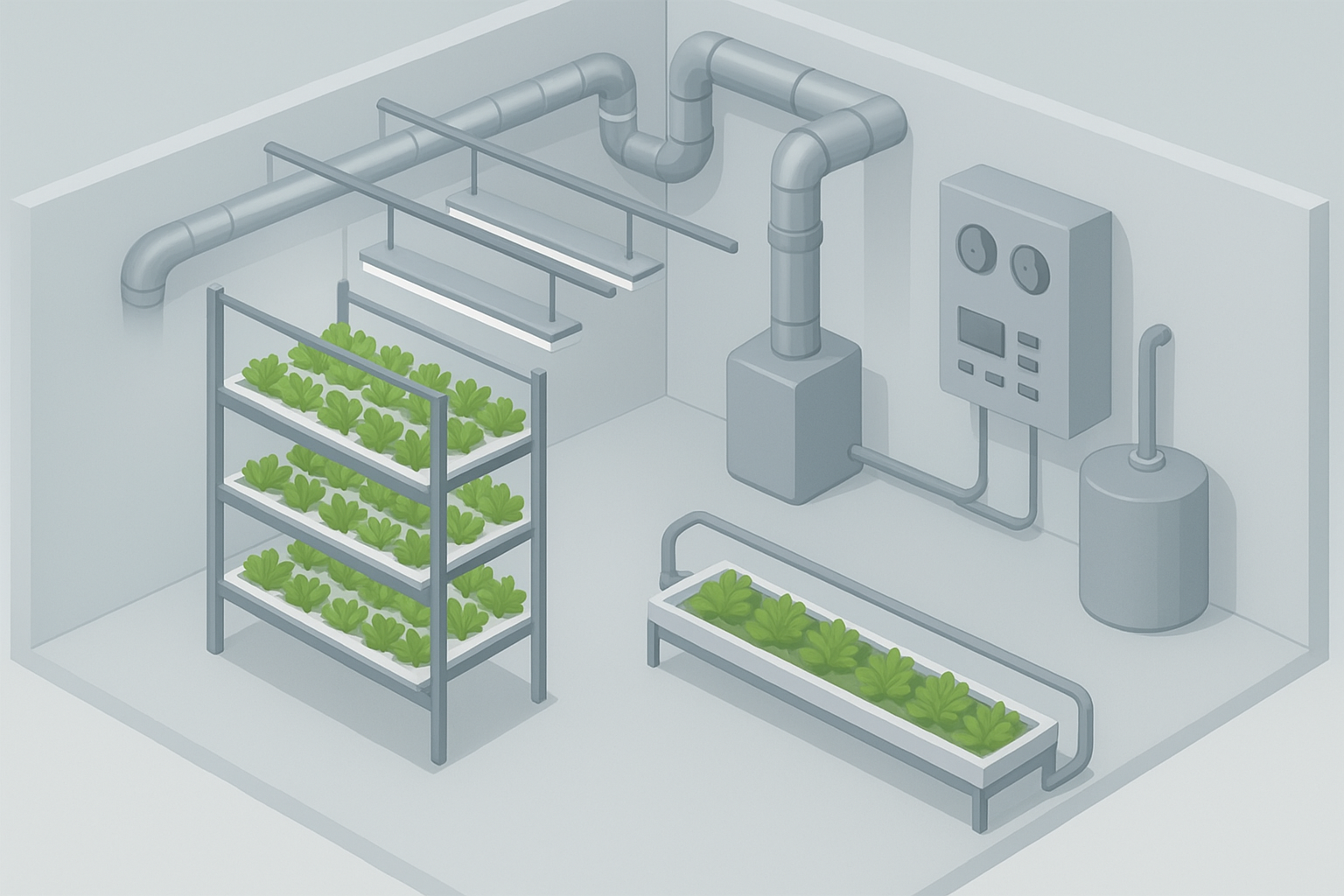
System design requires careful selection of equipment to maintain stable and efficient operations:
Lighting
- LED Arrays: high-efficiency, adjustable spectrum, and dimmable for different crop stages.
- Top-Lighting vs Inter-Lighting: Top-lighting for leafy greens; inter-lighting beneficial for taller fruiting crops.
Climate Control
- HVAC Units: capable of precise temperature and humidity control, with heat recovery for energy savings.
- Dehumidifiers: standalone or integrated into HVAC to manage moisture loads.
- CO₂ Injection Systems: controlled via sensors to maintain optimal enrichment levels.
Irrigation and Nutrient Delivery
- Recirculating irrigation: hydroponics (flood and drain, nutrient film technique, deep water culture, etc.), or aeroponics, selected according to crop type.
- Automated Dosing Systems: for accurate EC and pH management.
- UV Sterilisation: prevents pathogen build-up in recirculating water.
Air Movement
- Horizontal Airflow Fans: for even air distribution in single-layer systems.
- Vertical Ducting with Diffusers: ensures uniform conditions across multiple tiers.
Monitoring and Control
- Environmental Sensors: temperature, humidity, CO₂, light intensity, and nutrient parameters.
- Centralised Control Software: allows automated responses, trend analysis, and remote access.
- Redundancy and Backup Power: to prevent system failure during outages.
Structural and Spatial Considerations
- Modular Racking: adjustable height and spacing to suit different crops.
- Floor Drainage and Cleanability: essential for hygiene and biosecurity.
- Automation Interfaces: reserved space and connectivity for future equipment upgrades.
4. Integration Principles
In practice, system design should be guided by the principle that each component must support the performance of the whole. For example, lighting intensity affects both HVAC cooling load and irrigation demand. Similarly, changes in CO₂ setpoints influence ventilation strategies. Cross-disciplinary design reviews at the planning stage ensure that no single subsystem is optimised at the expense of overall efficiency.
Where feasible, energy and resource flows should be integrated. Heat rejected from lighting or HVAC can pre-warm incoming air or nutrient solutions; nutrient-rich condensate from dehumidifiers can be reclaimed and treated; excess electricity from on-site renewables can power LED lighting or charge backup batteries.