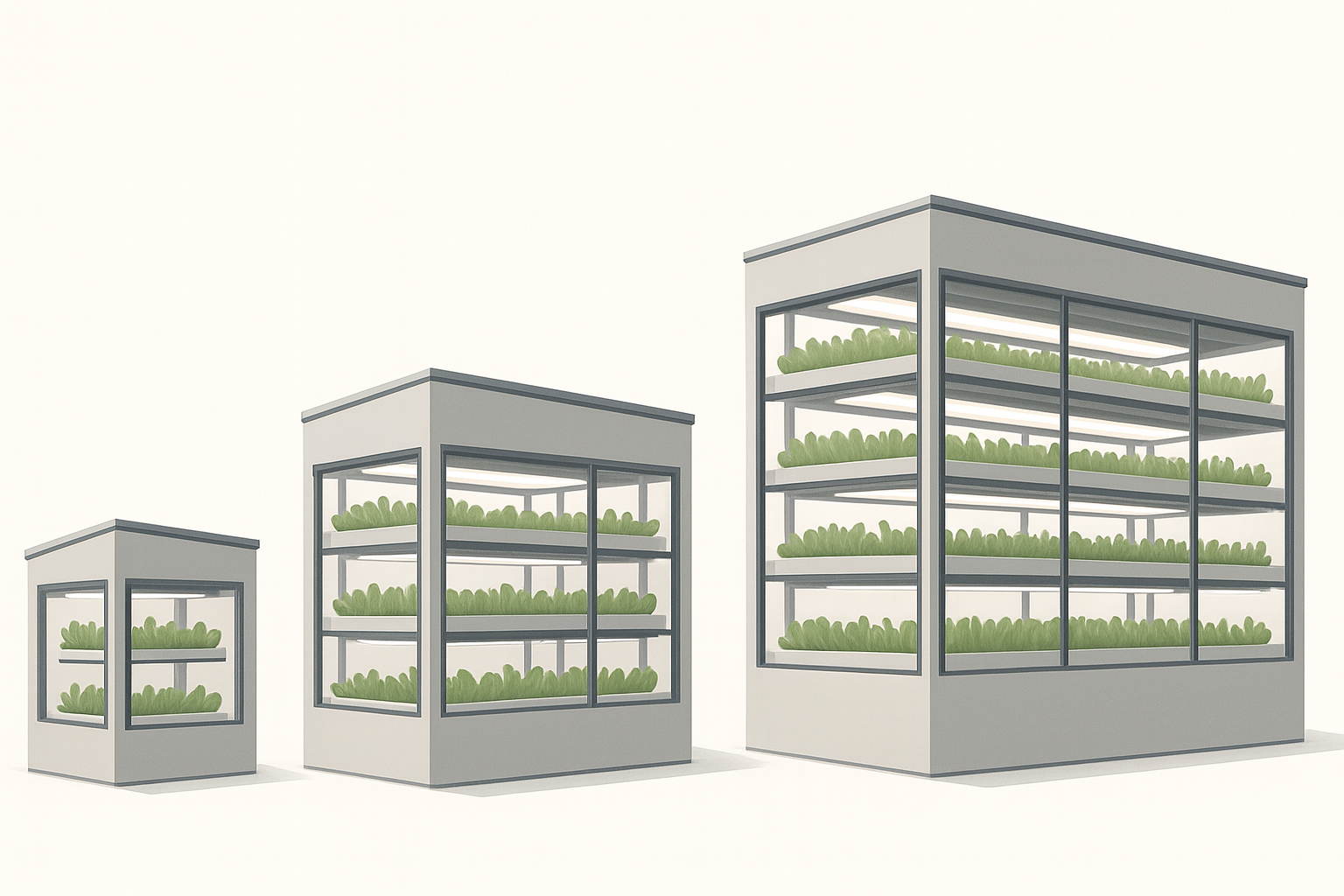
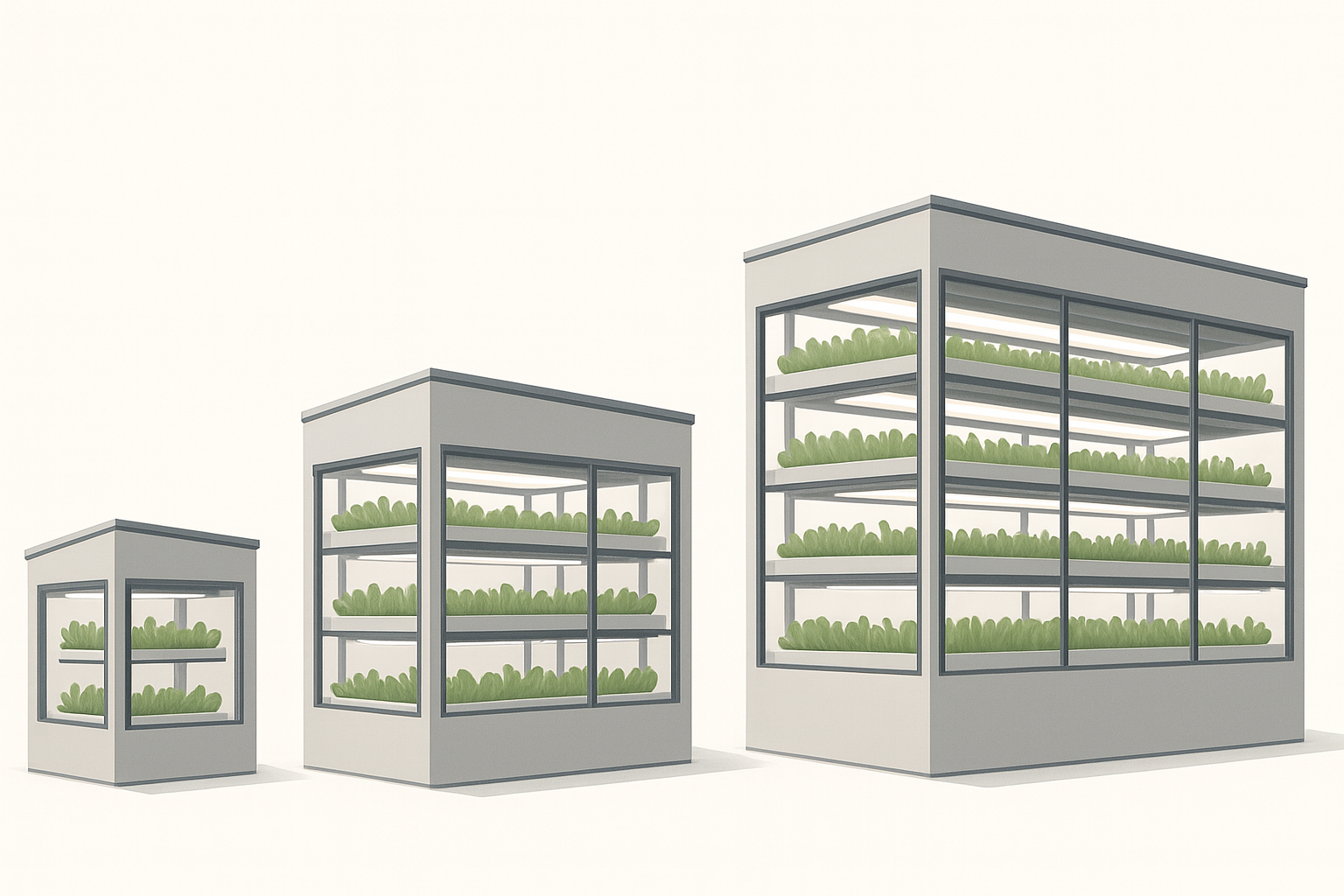
Introduction: the central challenge of scale
One of the most persistent questions in the development of controlled environment agriculture (CEA) is how to determine the appropriate scale for a vertical farming enterprise. The challenge for achieving economies of scale in vertical farming lies in balancing the advantages of larger production systems against the significant capital investment, operational complexity, and market demand required to sustain them. While theory suggests that larger farms should deliver efficiency through shared infrastructure and reduced unit costs, the unique characteristics of vertical farming mean that the relationship between scale and profitability is not always straightforward.
Why scale matters in vertical farming
Economies of scale describe the reduction in per-unit cost as the scale of production increases. In traditional agriculture this concept is well established: larger fields, larger machinery, and larger harvest volumes generally reduce the cost of producing each kilogram of food. Vertical farming, however, operates under a very different set of conditions. Instead of fields, it relies on controlled growing environments with stacked layers of plants. Inputs such as energy, water, and labour behave differently in these systems. For instance, energy costs scale linearly with plant volume rather than declining with scale, while labour savings from automation depend on whether technology is affordable at the size of operation.
Understanding the interplay between fixed and variable costs is central to decisions about farm size. A small vertical farm may serve niche markets with premium crops, achieving profitability despite higher unit costs. Larger farms may reduce the relative weight of rent, staffing, and management overheads, but they must also sell far more produce at consistent prices to remain viable.
Structural constraints and capital intensity
The design of a vertical farm imposes inherent constraints on how scale affects efficiency. Infrastructure such as HVAC systems, water recirculation, and LED lighting often requires significant upfront investment that does not scale down efficiently for smaller units. At the same time, very large facilities face challenges in maintaining uniform environmental conditions across wide spaces, which can erode expected gains in efficiency. This balance between too small and too large is part of the strategic dilemma faced by new entrants to the sector.
Moreover, capital costs dominate vertical farming economics. A facility capable of producing at scale may require tens of millions of pounds in investment, which narrows the pool of potential operators to institutional investors or corporate-backed ventures. Smaller independent growers may instead choose modular or container-based systems that limit exposure to risk but also reduce their ability to capture economies of scale.
Market dynamics and demand considerations
Farm size decisions are not only a matter of engineering and finance but also of market demand. A vertical farm built to supply major retailers must demonstrate reliability, consistent volume, and quality; this often necessitates scale and automation. By contrast, a farm targeting local restaurants, speciality grocers, or direct-to-consumer sales may benefit from a smaller footprint that matches niche demand. Economies of scale, therefore, must be evaluated in relation to market access. An overbuilt facility with insufficient customers will quickly face financial pressure, whereas a well-matched mid-scale farm may achieve stability through careful alignment of supply and demand.
Importantly, produce categories influence scale requirements. Leafy greens, herbs, and microgreens dominate current vertical farming because they grow quickly and can be sold at a premium. These crops require less space and allow faster crop cycles, favouring smaller or modular farms. Expansion into fruiting crops such as tomatoes, peppers, or strawberries generally requires larger footprints, more sophisticated technology, and higher energy inputs, which in turn affect the balance between scale and profitability.
Technology, automation, and labour
Automation is often seen as the path towards achieving economies of scale in vertical farming, but it carries its own complexities. Robotic harvesting, automated seeding, and AI-driven climate control systems can reduce labour costs dramatically. However, these technologies require scale to justify their expense, meaning they are viable only once a farm has reached a certain size. Smaller farms may struggle to afford such systems, relying instead on manual labour which raises per-unit costs. This reinforces the challenge of scaling: farms too small cannot afford automation, while farms too large face significant risks if systems fail or markets fluctuate.
A further consideration is the skill base required to manage large automated facilities. The labour force musthave not only horticultural knowledge but also technical expertise in software, sensors, and robotics. This requirement can add both cost and operational complexity as the farm scales.
Risk, resilience, and the optimal size
The optimal scale for a vertical farm will not be a universal concept but a balance of technical, financial, and market factors. Risk increases with size, since higher capital commitments expose operators to greater vulnerability if markets decline or technology underperforms. Conversely, very small farms may never achieve the efficiency required to compete with conventional agriculture or with larger vertical farms.
Resilience often comes from modular expansion strategies: operators start small, prove their market, and expand in increments rather than building massive facilities from the outset. This approach allows a farm to benefit from learning and technology refinement, while gradually moving closer to the scale where economies of operation become possible.
Conclusion: efficiency depends on context
The challenge for achieving economies of scale in vertical farming is deeply context-dependent. Decisions about farm size must account for crop choice, capital availability, technological readiness, and above all the characteristics of the intended market. There is no simple formula that guarantees success. Instead, prospective vertical farmers must weigh the potential benefits of larger scale against the risks of oversupply, technical failure, and high capital costs.
As research progresses and technologies improve, the relationship between farm size and efficiency may shift. Advances in LED efficiency, renewable energy integration, and modular automation could enable economies of scale to be realised more reliably. For now, success lies in careful strategic alignment between farm design and the realities of demand. Scale is not simply about building bigger; it is about building smart, sustainable systems that match both market opportunities and operational capabilities.