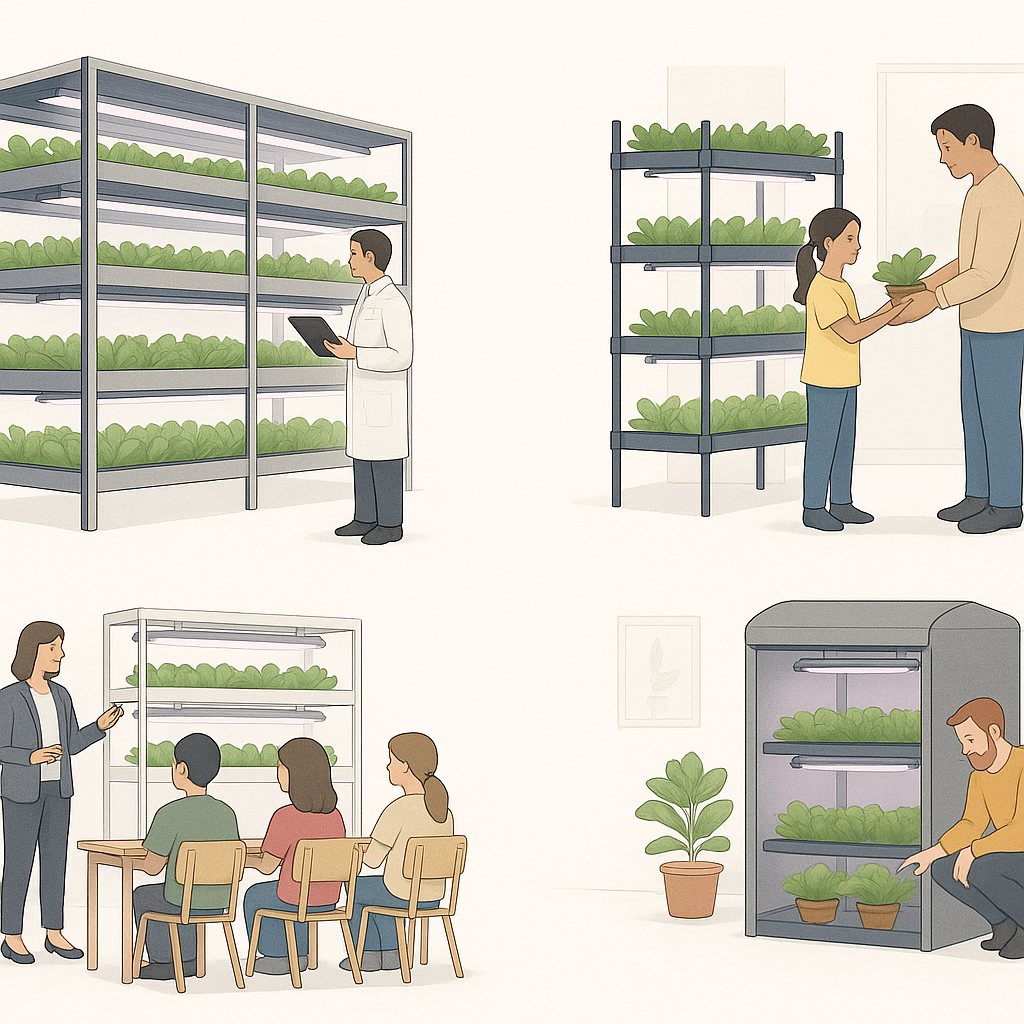
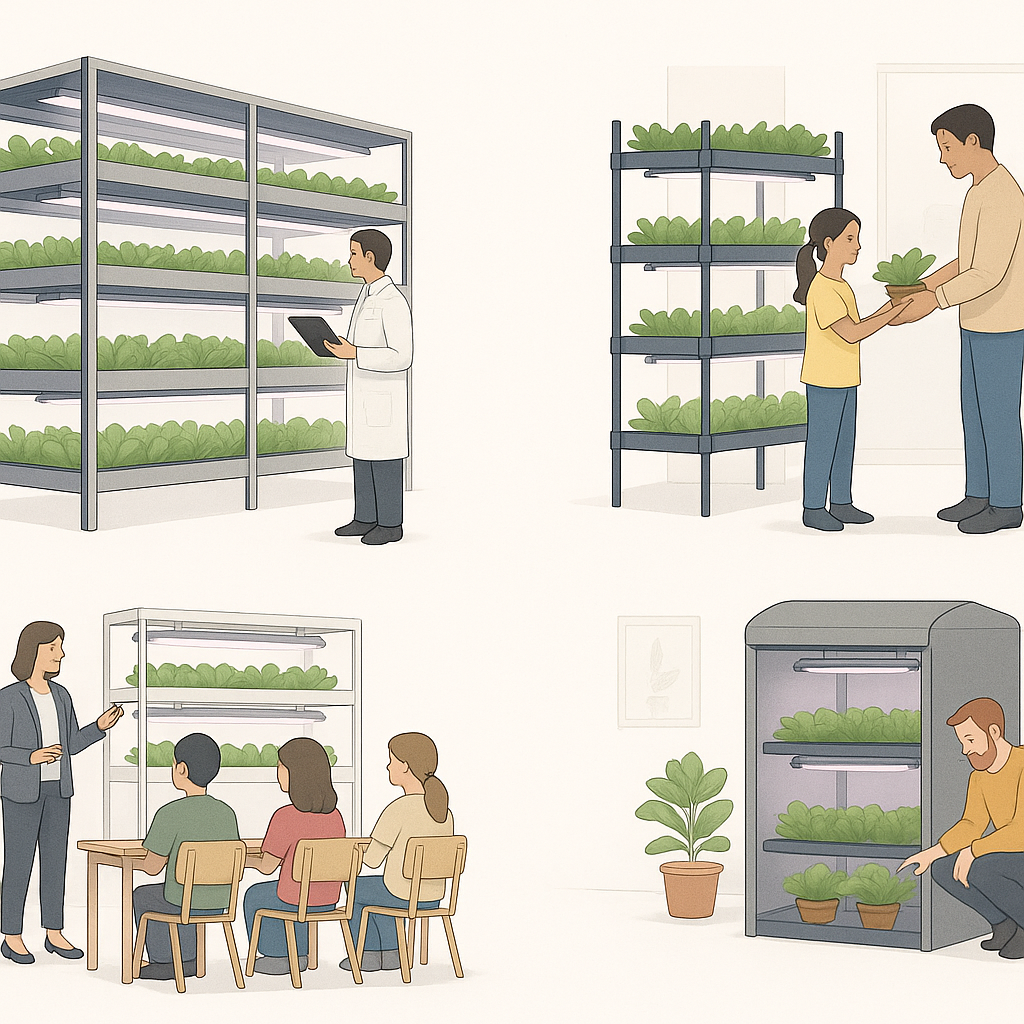
Establishing a clear purpose is the foundation of any controlled environment agriculture (CEA) project. Whether the ambition is to build a large-scale vertical farm supplying supermarkets, to establish a small community hub that improves access to fresh produce, to create an educational facility for students, or simply to pursue a personal interest at home, defining the goals for your indoor farming system is essential. Without a well-articulated aim, decision-making around technology choices, investment levels, crop selection, and long-term sustainability can become fragmented and less effective.
Why clarity of goals matters
CEA encompasses a spectrum of production systems, from simple hobbyist hydroponic setups to advanced climate-controlled vertical farms spanning thousands of square metres. Each end of this spectrum demands different levels of capital investment, technical expertise, operational management, and expected returns. A grower seeking commercial viability must prioritise efficiency, scalability, and profitability. By contrast, a community-led farm may value inclusivity, education, and local engagement more highly than yield optimisation. The act of defining goals is not simply an early formality; it directly shapes the structure and trajectory of the enterprise.
The challenges of CEA also differ markedly between contexts. Energy consumption, for example, can be a critical barrier to commercial profitability, but in a school-based demonstration project the emphasis may instead be on showcasing renewable energy integration and providing students with a learning platform. Clear objectives help align the design of the farming system with what is realistically required, rather than what is technically possible but unnecessary.
Commercial indoor farming
Commercial CEA ventures aim to generate profit from the reliable supply of high-quality crops, often leafy greens, herbs, or soft fruits. Such projects require significant planning and a strong business model. Factors such as energy costs, local market demand, crop selection, and labour requirements must be carefully considered.
For commercial operators, the goals are often measurable in terms of yield per square metre, resource-use efficiency, return on investment, and consistency of supply. Technologies such as multi-tier racks, automated nutrient dosing, artificial lighting strategies, and integrated pest management systems are chosen to maximise output and minimise risk. Investors and lenders are typically involved, meaning that economic metrics weigh heavily in decision-making. Defining commercial goals clearly at the outset is vital in order to attract capital and to guide the farm towards profitability in a competitive marketplace.
Community-focused indoor farms
Community CEA initiatives have different priorities. These projects may be organised by local councils, charities, or social enterprises, and often seek to improve access to nutritious food, strengthen local resilience, or provide employment opportunities in underserved areas. They can also play a role in addressing urban food deserts where fresh produce is limited.
The goals of community farms are less about maximising yields and more about generating social value. This might include volunteer engagement, educational workshops, or creating inclusive spaces that promote well-being. Although financial sustainability remains important, community farms often rely on grants, public funding, or cooperative models rather than purely on market sales. Defining these goals helps establish clear expectations for stakeholders and participants, ensuring that the farm remains aligned with its broader social mission rather than drifting into commercial pressures it may not be equipped to handle.
Educational applications of indoor farming
CEA is increasingly being used in schools, colleges, and universities as a tool to teach plant science, engineering, sustainability, and digital technology. From simple bench-top hydroponic systems in classrooms to sophisticated university research facilities, the role of education shapes how the farm is designed and used.
In educational settings, the goals often include hands-on learning, demonstration of sustainable practices, and exposure to advanced agri-tech. For example, an indoor growing unit in a secondary school might provide students with direct experience of nutrient cycles, plant physiology, and the role of controlled lighting in crop growth. At the university level, CEA research may inform broader debates about food security, climate change adaptation, and sustainable land use policy. Defining educational goals is therefore key to choosing the right scale, complexity, and level of integration with the curriculum.
Hobby farming and personal interest
At the smallest scale, many people pursue indoor farming as a hobby. This might take the form of a simple hydroponic kit on a kitchen counter, a small grow tent in a spare room, or a converted shed at the bottom of a garden. Here the goals are personal enjoyment, self-sufficiency, and experimentation rather than financial return.
Defining hobby goals allows individuals to avoid unnecessary expense and complexity. A hobbyist seeking to grow herbs for cooking, for example, may require only a compact system with modest energy use, while an enthusiast experimenting with different crop varieties might prefer a more adaptable modular setup. In either case, the primary aim is satisfaction, learning, and perhaps the pleasure of sharing produce with family and friends.
Connecting goals with design decisions
Once goals have been defined, they guide the technical and financial decisions that follow. For instance, a commercial grower with an ambition to scale rapidly will design with automation and modular expansion in mind. A community grower will prioritise accessibility and social impact. An educational institution will invest in systems that demonstrate scientific principles clearly. A hobbyist will value affordability, ease of use, and flexibility.
Clear goals also help avoid common pitfalls. Without a defined purpose, projects may overinvest in technology, misjudge market opportunities, or set unrealistic expectations. Conversely, a well-defined goal creates a coherent framework that can be revisited as the project evolves, providing both direction and a measure of progress.
Wider context: CEA and the future of food
Defining goals within CEA does not occur in isolation. Indoor farming is part of a wider debate about sustainable food systems, climate resilience, and urban development. Commercial farms may contribute to reducing food miles; community farms may address health inequalities; educational farms may inspire the next generation of agri-tech innovators; hobbyist projects may increase awareness of resource use and food provenance. Each goal contributes differently, but all form part of a collective shift towards diversified and resilient food production.
By defining the goals for your indoor farming system clearly, you not only improve the likelihood of success at your own scale but also ensure that your project fits meaningfully into this broader context. Whether your ambition is profit, social value, education, or personal fulfilment, clarity at the outset is the cornerstone upon which effective design and long-term sustainability are built.